• Fri frakt över 249 kr
  • •
  • Snabba leveranser
  • •
  • Billiga böcker
Kundservice

Du är på sajten för privatpersoner.

Företag, bibliotek eller offentlig verksamhet?

Du handlar på classic.bokus.com, där alla dina funktioner finns intakta.
Till classic.bokus.com
Bokus logotyp. Gå till startsidan.
  • Erbjudanden
  • Nyheter
  • Student
  • Topplistor
  • Barn & ungdom
  • Bokus Play
  • E-böcker
  • Pocketböcker
  • Spel & pussel

10% rabatt på allt med kod NYSTART10 →

Sidfot

Mina sidor

    Hjälp

    • Kundservice
    • Vanliga frågor och svar
    • Frakt och leverans
    • Retur vid ångerrätt
    • Reklamera vara
    • Betalning
    • Köpvillkor
    • Allmänna villkor
    • Information om webbplatsens tillgänglighet

    Om Bokus

    • Om oss
    • Pressrum
    • För studenter
    • För företag
    • För bibliotek och offentlig verksamhet
    • För leverantörer
    • Hållbarhet

    Populärt

    • Aktuella erbjudanden
    • Presentkort
    • Studentlitteratur
    • Nya böcker
    • Topplistor
    • Signerade böcker
    • Engelska böcker

    Inspiration

    • Boktips
    • BookTok
    • Populära bokserier
    • Barnbokskaraktärer
    • Populära författare
    Logotyp för Bokus
    Följ oss på Facebook (extern länk)Följ oss på Instagram (extern länk)Följ oss på YouTube (extern länk)Följ oss på TikTok (extern länk)
    bokus @ CookiesAnpassa cookiesIntegritetspolicyKöpvillkor
    Till Citymail hemsida (extern länk)Till Budbee hemsida (extern länk)Till Postnord hemsida (extern länk)Till Schenker hemsida (extern länk)Till Early Bird hemsida (extern länk)Till Walleys hemsida (extern länk)
    1. Ekonomi och Ledarskap
    2. Företagsekonomi
    3. Entreprenörskap

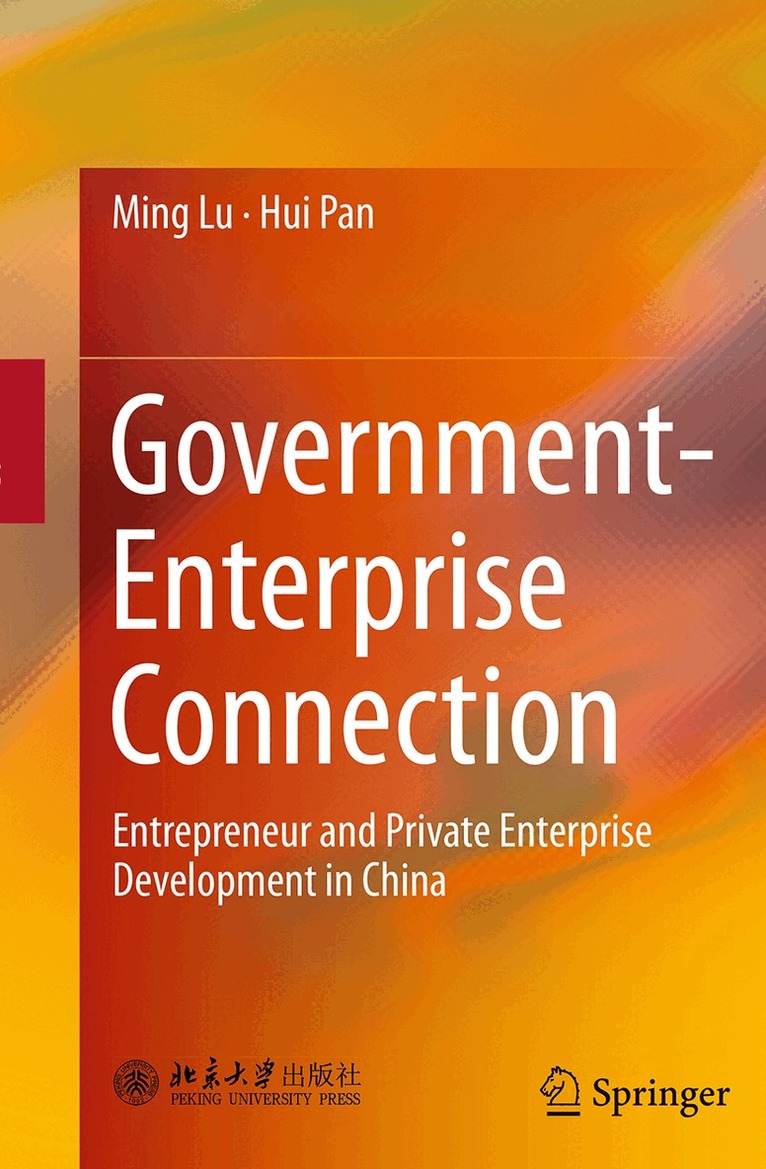
    Government-Enterprise Connection

    Entrepreneur and Private Enterprise Development in China

    AvMing Lu,Hui Pan

    Häftad, Engelska, 2016

    563 kr

    Beställningsvara. Skickas inom 10-15 vardagar. Fri frakt över 249 kr.

    Fler format och utgåvor

    Inbunden

    546 kr

    Beskrivning

    This book is an empirical study on the relationship between private enterprises, entrepreneurs and the government in P. R. China. The two authors conducted a detailed survey of enterprises and entrepreneurs in Liuzhou, Guangxi Zhuang Autonomous Region, China. Although it was only conducted in a medium sized city, the survey provides a rare source of information on matched entrepreneur-enterprise pairs. It provides detailed information on management, performance, enterprise-government relationship, as well as entrepreneurs' personal information and measurements of various psychological parameters. With this first-hand information, the authors analyzed several interesting issues concerning enterprise-entrepreneur-government relationships. Readers will gain an understanding of the following topics:Why and how does China have such special enterprise-entrepreneur-government relationships?Do enterprises' political connections in the form of entrepreneurs' political status help improve the performances of these enterprises?Which of the surveyed entrepreneurs could become members of the People's Congress and the People's Political Consulting Conference?How do entrepreneurs feel when they are faced with greater government intervention?How will China move ahead in the ongoing reform and development in the light of the enterprise-entrepreneur-government relationship?This book examines the way in which China's enterprise-entrepreneur-government relationship helps enterprises develop in a transitional market. In the appendix to this book, one of the authors, Ming Lu, provides evidence, based on data from listed companies, that having political connections can help enterprises enter the markets of provinces other than their place of registration. However, this political connection also distorts the market by giving the entrepreneurs more opportunities to develop their business. At the same time, those entrepreneurs who face interventions from the government also shoulder greater costs in the form of loss of psychological happiness. The inference of this book is that at some point in the foreseeable future, China will gradually build its market system and integrate its domestic markets, so that private enterprises will no longer rely so heavily on their political connections.

    Produktinformation

    • Utgivningsdatum:2016-08-23
    • Mått:155 x 235 x 10 mm
    • Vikt:277 g
    • Format:Häftad
    • Språk:Engelska
    • Antal sidor:168
    • Förlag:Springer Verlag, Singapore
    • ISBN:9789811012952

    Utforska kategorier

    • Entreprenörskap inom Ekonomi och Ledarskap
    • Ekonomisk politik inom Ekonomi och Ledarskap

    Mer om författaren

    Ming LU is a Distinguished Professor of Economics, the Director of China Centre for Development Studies at Shanghai Jiao Tong University, and a Professor at Fudan University, China. He is also the Research Fellow of Peking University-Lincoln Institute, and Hitotsubashi University, Japan. He worked as a Fulbright Scholar at Harvard University and National Bureau of Economic Research (NBER). He has consulted for the World Bank and Asian Development Bank. His recent research tries to link political economy with economic geography to analyze regional and urban issues. He is also interested in urban labor economics that studies how social interaction and knowledge spillover affect employment and economic growth in the local labor market.Hui PAN is a Professor and Vice President of Guangxi University of Finance and Economics. She holds Ph.D. in Economics, and worked as Post-doc in both economics and psychology. Her research interests include consumption, management psychology, and private enterprise development.

    Innehållsförteckning

    • Government-Enterprise Connection: Entrepreneur and Private Enterprise Development in China.- Government, Enterprise and Entrepreneur: Are These Relationships the Primary Productive Force?.- Entrepreneur and Enterprise Development: Human Capital, Political Capital and Decision-making Style.- Entrepreneur Political Participation: Building Government-enterprise Connections.- Entrepreneur Satisfaction: What Influence Does Government Intervention Have?.- Present and Future of Government-enterprise Relationship.