• Fri frakt över 249 kr
  • •
  • Snabba leveranser
  • •
  • Billiga böcker
Kundservice

Du är på sajten för privatpersoner.

Företag, bibliotek eller offentlig verksamhet?

Du handlar på classic.bokus.com, där alla dina funktioner finns intakta.
Till classic.bokus.com
Bokus logotyp. Gå till startsidan.
  • Erbjudanden
  • Nyheter
  • Student
  • Topplistor
  • Barn & ungdom
  • Bokus Play
  • E-böcker
  • Pocketböcker
  • Spel & pussel

10% rabatt på allt med kod: NYSTART10 →

Sidfot

Mina sidor

    Hjälp

    • Kundservice
    • Vanliga frågor och svar
    • Frakt och leverans
    • Retur vid ångerrätt
    • Reklamera vara
    • Betalning
    • Köpvillkor
    • Allmänna villkor
    • Information om webbplatsens tillgänglighet

    Om Bokus

    • Om oss
    • Pressrum
    • För studenter
    • För företag
    • För bibliotek och offentlig verksamhet
    • För leverantörer
    • Hållbarhet

    Populärt

    • Aktuella erbjudanden
    • Presentkort
    • Studentlitteratur
    • Nya böcker
    • Topplistor
    • Signerade böcker
    • Engelska böcker

    Inspiration

    • Boktips
    • BookTok
    • Populära bokserier
    • Barnbokskaraktärer
    • Populära författare
    Logotyp för Bokus
    Följ oss på Facebook (extern länk)Följ oss på Instagram (extern länk)Följ oss på YouTube (extern länk)Följ oss på TikTok (extern länk)
    bokus @ CookiesAnpassa cookiesIntegritetspolicyKöpvillkor
    Till Citymail hemsida (extern länk)Till Budbee hemsida (extern länk)Till Postnord hemsida (extern länk)Till Schenker hemsida (extern länk)Till Early Bird hemsida (extern länk)Till Walleys hemsida (extern länk)
    1. Djur och Natur
    2. Naturböcker
    3. Svampböcker

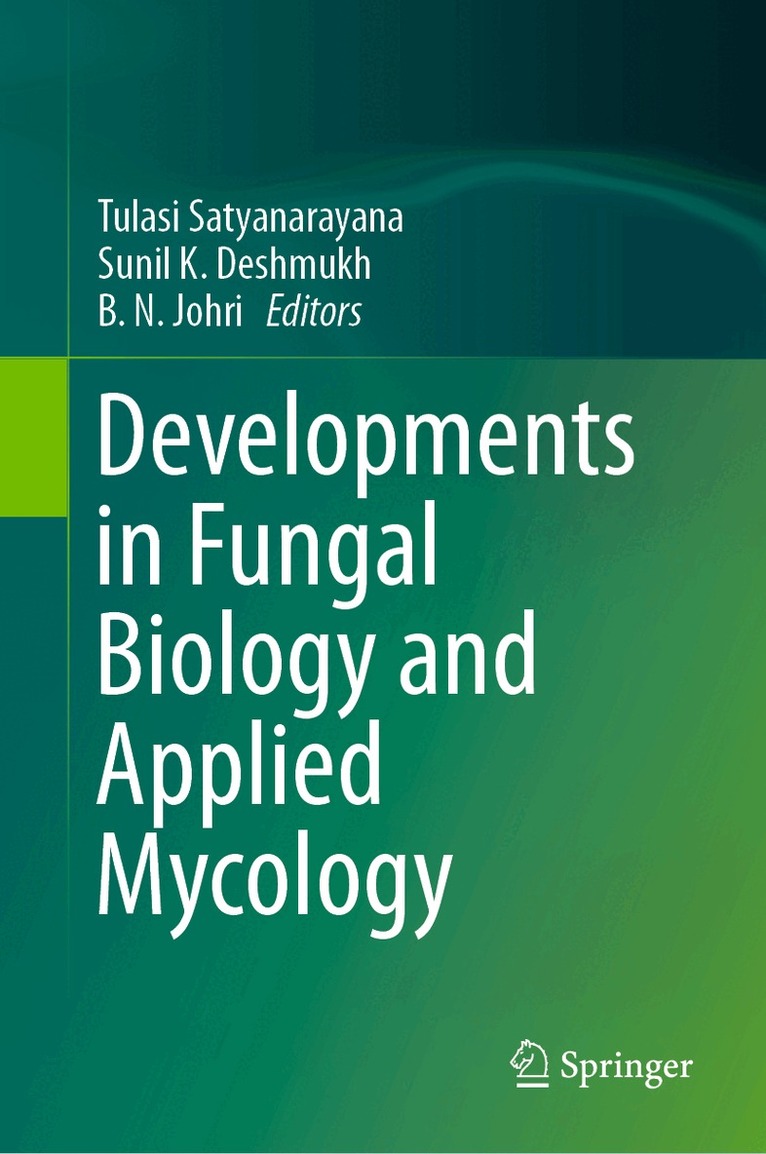
    Developments in Fungal Biology and Applied Mycology

    AvTulasi Satyanarayana,Sunil K. Deshmukh

    Inbunden, Engelska, 2018

    3 244 kr

    Beställningsvara. Skickas inom 10-15 vardagar. Fri frakt över 249 kr.

    Beskrivning

    This book explores the developments in important aspects of fungi related to the environment, industrial mycology, microbiology, biotechnology, and agriculture. It discusses at length both basic and applied aspects of fungi and provides up-to-date laboratory-based data.Of the estimated three million species of fungi on Earth, according to Hawksworth and coworkers, more than 100,000 have been described to date. Many fungi produce toxins, organic acids, antibiotics and other secondary metabolites, and are sources of useful biocatalysts such as cellulases, xylanases, proteases and pectinases, to mention a few. They can also cause diseases in animals as well as plants and many are able to break down complex organic molecules such as lignin and pollutants like xenobiotics, petroleum and polycyclic aromatic compounds. Current research on mushrooms focuses on their hypoglycemic, anti-cancer, anti-pathogenic and immunity-enhancing activities.This ready-reference resource on various aspects of fungi is intended for graduate and post-graduate students as well as researchers in life sciences, microbiology, botany, environmental sciences and biotechnology.

    Produktinformation

    • Utgivningsdatum:2018-01-25
    • Mått:155 x 235 x 37 mm
    • Vikt:1 205 g
    • Format:Inbunden
    • Språk:Engelska
    • Antal sidor:605
    • Upplaga:18001
    • Förlag:Springer Verlag, Singapore
    • ISBN:9789811047671

    Utforska kategorier

    • Svampböcker inom Djur och Natur
    • Svampar inom Naturvetenskap och teknik

    Mer om författaren

    Prof. T. Satyanarayana became a faculty fellow at the Division of Biological Sciences & Engineering, Netaji Subhas Institute of Technology (affiliated to the University of Delhi), New Delhi after retiring from Department of Microbiology, University of Delhi South Campus, New Delhi in 2016. He has over 270 scientific papers and reviews, 6 edited books and 3 patents to his credit. He is a fellow of National Academy of Agricultural Sciences (NAAS), the Association of Microbiologists of India (AMI), the Biotech Research Society (I) and the Mycological Society of India (MSI). He has 40 years of research and teaching experience and was president of the AMI and MSI. His research has focused on understanding the diversity and applications of yeasts, thermophilic fungi and bacteria and their enzymes as well as carbon sequestration using extremophilic bacterial carbonic anhydrases.Dr. Bhavdish N Johri is a professor and NASI senior scientist at the Department of Biotechnology & Bioinformatics Centre, Barkatullah University, India. He has been the recipient of many academic awards, including the Indian National Science Academy’s Young Scientist Medal, Rafi Kidwai Memorial award and Acharya PC Ray Fellowship (MPCST). He is a fellow of the National Academy of Sciences (I), National Academy of Agricultural Sciences and National Institute of Ecology. He has extensive teaching and research experience, and has 148 research publications and 3 edited books to his credit.Dr. Sunil Kumar Deshmukh is a fellow and area convenor at the Nano-Biotechnology Research Centre, The Energy and Resources Institute (TERI), New Delhi. He was assistant director (Natural Products) at Piramal Enterprises Ltd., Mumbai. He has broad industrial experience in the field of applied microbiology. He is now president of the Mycological Society of India. He has 100 publications and eight patent to his credit. He has also edited seven books.

    Innehållsförteckning

    • Chapter 1: Significant contributions of Prof. Shyam Bahadur Saksena to Indian mycology.- Chapter 2: Biology and significance of Saksenea vasiformis.- Chapter 3: History of Mycology in India: Some Glimpses.- Chapter 4: Various aspects of ammonia fungi.- Chapter 5: Marine Filamentous Fungi: Diversity, Distribution and Bioprospecting.- Chapter 6: Keratinophilic Fungi and Their Biotechnological Potentials.- Chapter 7: Fungal World of Cave Ecosystem.- Chapter 8: Anaerobic Gut Fungi.- Chapter 9: Fungal endophytes representing the diverse habitat and their role in plant protection.- Chapter 10: Fusarium oxysporum: Genomics, diversity and plant host interaction.- Chapter 11: Yeast genome sequencing: basic biology to biotechnology.- Chapter 12: Fungal differentiation: A model phenomenon to screen antifungal drugs.- Chapter 13: Candida albicans Biofilm as a Clinical Challenge.- Chapter 14: Characteristics and multifarious potential applications of HAP phytase of the unconventionalyeast Pichia anomala.- Chapter 15: Fungal Inulinolytic Enzymes: A current appraisal.- Chapter 16: Fungal Tannases: Recent Advances and Industrial Applications.- Chapter 17: Mycoremediation: An alternative treatment option for heavy metal bearing waste water.- Chapter 18: Treatment of landfill leachate using fungi: An efficient and cost-effective strategy.- Chapter 19: Studies on Mycorrhizae in Pinus gerardiana, a threatened pine of the NW Himalayas.- Chapter 20: Role of phosphate solubilising fungi in sustainable agriculture.- Chapter 21: Biotechnological Advancements in Industrial Production of Arbuscular Mycorrhizal Fungi: Achievements, Challenges and Future Prospects.- Chapter 22: Role of Fungicides in Crop Health Management: Prospects and Challenges.- Chapter 23: Bioherbicides: Strategies, Challenges and Prospects.- Chapter 24: Characterization of lamellate mushrooms - An appraisal.- Chapter 25: Occurrence and distribution of mushrooms in semi–ever green Sal (Shorearobusta) forest Chhattisgarh, Central-India.- Chapter 26: Fungal Pigments: An Overview.- Chapter 27: Ex-situ Conservation of Fungi: A Review.- Chapter 28: Camouflaged mycotoxins in some field crops and forages: A review.