• Fri frakt över 249 kr
  • •
  • Snabba leveranser
  • •
  • Billiga böcker
Kundservice

Du är på sajten för privatpersoner.

Företag, bibliotek eller offentlig verksamhet?

Du handlar på classic.bokus.com, där alla dina funktioner finns intakta.
Till classic.bokus.com
Bokus logotyp. Gå till startsidan.
  • Erbjudanden
  • Nyheter
  • Student
  • Topplistor
  • Barn & ungdom
  • Bokus Play
  • E-böcker
  • Pocketböcker
  • Spel & pussel

10% rabatt på allt med kod: NYSTART10 →

Sidfot

Mina sidor

    Hjälp

    • Kundservice
    • Vanliga frågor och svar
    • Frakt och leverans
    • Retur vid ångerrätt
    • Reklamera vara
    • Betalning
    • Köpvillkor
    • Allmänna villkor
    • Information om webbplatsens tillgänglighet

    Om Bokus

    • Om oss
    • Pressrum
    • För studenter
    • För företag
    • För bibliotek och offentlig verksamhet
    • För leverantörer
    • Hållbarhet

    Populärt

    • Aktuella erbjudanden
    • Presentkort
    • Studentlitteratur
    • Nya böcker
    • Topplistor
    • Signerade böcker
    • Engelska böcker

    Inspiration

    • Boktips
    • BookTok
    • Populära bokserier
    • Barnbokskaraktärer
    • Populära författare
    Logotyp för Bokus
    Följ oss på Facebook (extern länk)Följ oss på Instagram (extern länk)Följ oss på YouTube (extern länk)Följ oss på TikTok (extern länk)
    bokus @ CookiesAnpassa cookiesIntegritetspolicyKöpvillkor
    Till Citymail hemsida (extern länk)Till Budbee hemsida (extern länk)Till Postnord hemsida (extern länk)Till Schenker hemsida (extern länk)Till Early Bird hemsida (extern länk)Till Walleys hemsida (extern länk)
    1. Data och IT
    2. Systemvetenskap och AI

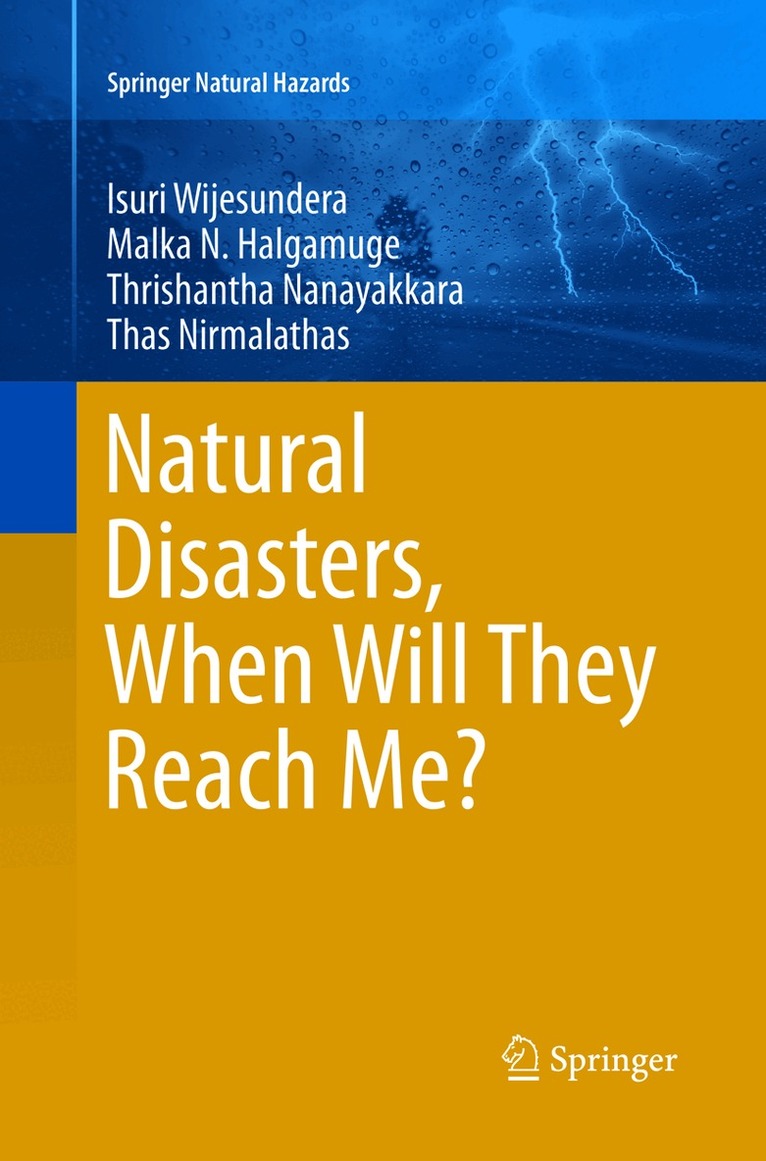
    Natural Disasters, When Will They Reach Me?

    AvIsuri Wijesundera,Malka N. Halgamuge

    Häftad, Engelska, 2018

    Del i serien Springer Natural Hazards

    1 435 kr

    Beställningsvara. Skickas inom 5-8 vardagar. Fri frakt över 249 kr.

    Fler format och utgåvor

    Inbunden

    1 086 kr

    Beskrivning

    The expected time of impact, also known as the mean first passage time (MFPT) to reach failure, is a critical metric in the management of natural disasters. A comprehensive case study of predicting cyclone induced flood is followed by a discussion of generic methods that predict MFPT addressing directional bias.

    Produktinformation

    • Utgivningsdatum:2018-05-30
    • Mått:155 x 235 x undefined mm
    • Vikt:218 g
    • Format:Häftad
    • Språk:Engelska
    • Serie:Springer Natural Hazards
    • Antal sidor:128
    • Förlag:Springer Verlag, Singapore
    • ISBN:9789811093319

    Utforska kategorier

    • Systemvetenskap och AI inom Data och IT
    • Miljövetenskap och miljöpolitik inom Naturvetenskap och teknik
    • Digital livsstil och datorspel inom Data och IT

    Mer om författaren

    Isuri Wijesundera completed her PhD in engineering at the University of Melbourne in 2016 and received her BSc degree in Electronics and Telecommunication Engineering from the University of Moratuwa, Sri Lanka in 2007. She previously worked as a Telecommunications Engineer in Sri Lanka (2007-10) and is currently attached to the Big-Data unit at Telstra, Australia. Her recent work focused on a research concerning analytical methods to find Mean First Passage Time (MFPT) on directionally biased inhomogeneous media.  Dr Malka N. Halgamuge is a Researcher in the Department of Electrical and Electronic Engineering of University of Melbourne. She obtained her PhD from the same department in 2007. She was awarded the Next Step Initiative Fellowship (2015), Australia-China Young Scientist Fellowship (2014), Dyason Fellowship, University of California (UCLA), Los Angeles, USA (2013), Early Career Researcher (ECR) Award from Alexander von Humboldt Foundation (2013) and Solander Fellowships, Lund University (2007 and 2008). She was the recipient of the Vice-Chancellor's Engagement Award (2010) and Vice-Chancellor's Knowledge Transfer Award (2008) for her research at the University of Melbourne. Her current research interests include investigating biological effect of electromagnetic fields on humans, energy management in wireless sensor networks and prediction of natural disasters (flood and bushfires). She has written one textbook and more than 60 peer reviewed technical articles.Thrishantha Nanayakkara received the BSc and MSc degrees in electrical engineering from the University of Moratuwa (UM), Sri Lanka (1996), and Saga University (SU), Japan (1998), and PhD in robotics from SU (2001). He was a postdoctoral research fellow in the department of biomedical engineering, Johns Hopkins University, USA, 2001-2003; a senior lecturer in the faculty of engineering at the UM; a Radcliffe Fellow at Harvard University,USA (2008/09), and a research affiliate at MIT (2008/09), USA. He is currently a senior lecturer in the department of Informatics, King’s College London. His research interests are in soft robotics, and robotic interaction with uncertain environments. He has published one textbook and more than 100 peer reviewed papers.Professor Thas (Ampalavanapillai) Nirmalathas is currently the Director of Melbourne Accelerator Programs (MAP) which supports entrepreneurial activities of the University Community through business acceleration models. He is also the Director of Melbourne Engineering Research Institute (MERIT) which brings the entire research activity of the Melbourne School of Engineering under one research institute. Professor Nirmalathas obtained his BEng and PhD in Electrical and Electronic Engineering from the University of Melbourne in 1993 and 1998 respectively. He has written more than 250 technical articles across areas including microwavephotonics, optical wireless network integration, and broadband networks and services.

    Innehållsförteckning

    • The stochastic nature of disaster propagation.- Predicting Flood induced by cyclones.- How to forecast the spread of bushfires.- Propagation on a non-homogeneous media in the presence of bias.- Conclusion.