• Fri frakt över 249 kr
  • •
  • Snabba leveranser
  • •
  • Billiga böcker
Kundservice

Du är på sajten för privatpersoner.

Företag, bibliotek eller offentlig verksamhet?

Du handlar på classic.bokus.com, där alla dina funktioner finns intakta.
Till classic.bokus.com
Bokus logotyp. Gå till startsidan.
  • Erbjudanden
  • Nyheter
  • Student
  • Topplistor
  • Barn & ungdom
  • Bokus Play
  • E-böcker
  • Pocketböcker
  • Spel & pussel

Må bättre, för mindre! Upp till 50% rabatt på hälsoböcker

Sidfot

Mina sidor

    Hjälp

    • Kundservice
    • Vanliga frågor och svar
    • Frakt och leverans
    • Retur vid ångerrätt
    • Reklamera vara
    • Betalning
    • Köpvillkor
    • Allmänna villkor
    • Information om webbplatsens tillgänglighet

    Om Bokus

    • Om oss
    • Pressrum
    • För studenter
    • För företag
    • För bibliotek och offentlig verksamhet
    • För leverantörer
    • Hållbarhet

    Populärt

    • Aktuella erbjudanden
    • Presentkort
    • Studentlitteratur
    • Nya böcker
    • Topplistor
    • Signerade böcker
    • Engelska böcker

    Inspiration

    • Boktips
    • BookTok
    • Populära bokserier
    • Barnbokskaraktärer
    • Populära författare
    Logotyp för Bokus
    Följ oss på Facebook (extern länk)Följ oss på Instagram (extern länk)Följ oss på YouTube (extern länk)Följ oss på TikTok (extern länk)
    bokus @ CookiesAnpassa cookiesIntegritetspolicyKöpvillkor
    Till Citymail hemsida (extern länk)Till Budbee hemsida (extern länk)Till Postnord hemsida (extern länk)Till Schenker hemsida (extern länk)Till Early Bird hemsida (extern länk)Till Walleys hemsida (extern länk)
    1. Djur och Natur
    2. Naturböcker
    3. Växtböcker

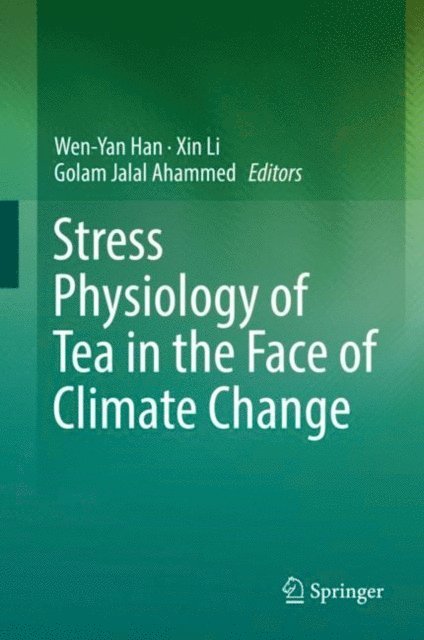
    Stress Physiology of Tea in the Face of Climate Change

    AvWen-Yan Han,Xin Li

    Inbunden, Engelska, 2018

    1 626 kr

    Beställningsvara. Skickas inom 10-15 vardagar. Fri frakt över 249 kr.
    Beskrivning

    ​This book focuses on the existing knowledge regarding the effect of global climate change on tea plant physiology, biochemistry, and metabolism as well as economic and societal aspects of the tea industry. Specifically, this book synthesizes recent advances in the physiological and molecular mechanisms of the responses of tea plants to various abiotic and biotic stressors including high temperature, low temperature or freezing, drought, low light, UV radiation, elevated CO2, ozone, nutrient deficiency, insect herbivory, and pathogenic agents. This book also discusses challenges and potential management strategies for sustaining tea yield and quality in the face of climate change. Dr. Wen-Yan Han is a Professor and Dr. Xin Li is an Associate Professor at the Tea Research Institute of the Chinese Academy of Agricultural Sciences (TRI, CAAS), Hangzhou, PR China. Dr. Golam Jalal Ahammed is an Associate Professor at the Department of Horticulture, College of Forestry, Henan University of Science and Technology, Luoyang, PR China.

    Produktinformation

    • Utgivningsdatum:2018-12-14
    • Mått:155 x 235 x undefined mm
    • Format:Inbunden
    • Språk:Engelska
    • Antal sidor:361
    • Förlag:Springer Verlag, Singapore
    • ISBN:9789811321399

    Utforska kategorier

    • Växtböcker inom Djur och Natur
    • Botanik inom Naturvetenskap och teknik
    • Miljövetenskap och miljöpolitik inom Naturvetenskap och teknik

    Mer om författaren

    Dr. Golam Jalal Ahammed is from Zhejiang University, Hangzhou, China. Dr. Wen-Yan Han and Dr. Xin Li are from Tea Research Institute, Chinese Academy of Agricultural Sciences, Hangzhou, China.

    Innehållsförteckning

    • Chapter 1. Global climate change, stress and tea production: Present and future.- Chapter 2. Understanding response of tea plants to heat stress and the mechanisms of adaptation.- Chapter 3. How tea plants deal with low temperatures?.- Chapter 4. Response of tea plants to moisture stress.- Chapter 5. Low light-induced changes in tea metabolite- A review.- Chapter 6. Ultraviolet (UV) radiation and Ozone: molecular and physiological adaptations in tea.- Chapter 7. Elevated carbon dioxide-induced perturbations in metabolism of tea plants.- Chapter 8. Nutrient deficiency or abundance in tea plants: Metabolism to productivity.- Chapter 9. Understanding and exploiting the impact of heavy metals stress on tea physiology and quality.- Chapter 10. Differential changes in tea quality as influenced by insect herbivory.- Chapter 11. Molecular and physiological mechanisms of defense against pathogens in tea plants.- Chapter 12. Role of micro-organism in improving stress tolerance of tea in the context of global climate change.- Chapter 13. Plant hormones as mediators of stress tolerance in tea plants.- Chapter 14. Understanding metabolomics of tea for improving stress tolerance.- Chapter 15. Toward the development of climate resilient tea: Physiological and molecular intervention.