• Fri frakt över 249 kr
  • •
  • Snabba leveranser
  • •
  • Billiga böcker
Kundservice

Du är på sajten för privatpersoner.

Företag, bibliotek eller offentlig verksamhet?

Du handlar på classic.bokus.com, där alla dina funktioner finns intakta.
Till classic.bokus.com
Bokus logotyp. Gå till startsidan.
  • Erbjudanden
  • Nyheter
  • Student
  • Topplistor
  • Barn & ungdom
  • Bokus Play
  • E-böcker
  • Pocketböcker
  • Spel & pussel

10% rabatt på allt med kod: NYSTART10 →

Sidfot

Mina sidor

    Hjälp

    • Kundservice
    • Vanliga frågor och svar
    • Frakt och leverans
    • Retur vid ångerrätt
    • Reklamera vara
    • Betalning
    • Köpvillkor
    • Allmänna villkor
    • Information om webbplatsens tillgänglighet

    Om Bokus

    • Om oss
    • Pressrum
    • För studenter
    • För företag
    • För bibliotek och offentlig verksamhet
    • För leverantörer
    • Hållbarhet

    Populärt

    • Aktuella erbjudanden
    • Presentkort
    • Studentlitteratur
    • Nya böcker
    • Topplistor
    • Signerade böcker
    • Engelska böcker

    Inspiration

    • Boktips
    • BookTok
    • Populära bokserier
    • Barnbokskaraktärer
    • Populära författare
    Logotyp för Bokus
    Följ oss på Facebook (extern länk)Följ oss på Instagram (extern länk)Följ oss på YouTube (extern länk)Följ oss på TikTok (extern länk)
    bokus @ CookiesAnpassa cookiesIntegritetspolicyKöpvillkor
    Till Citymail hemsida (extern länk)Till Budbee hemsida (extern länk)Till Postnord hemsida (extern länk)Till Schenker hemsida (extern länk)Till Early Bird hemsida (extern länk)Till Walleys hemsida (extern länk)
    1. Naturvetenskap och teknik
    2. Teknik och industri
    3. Energiteknik

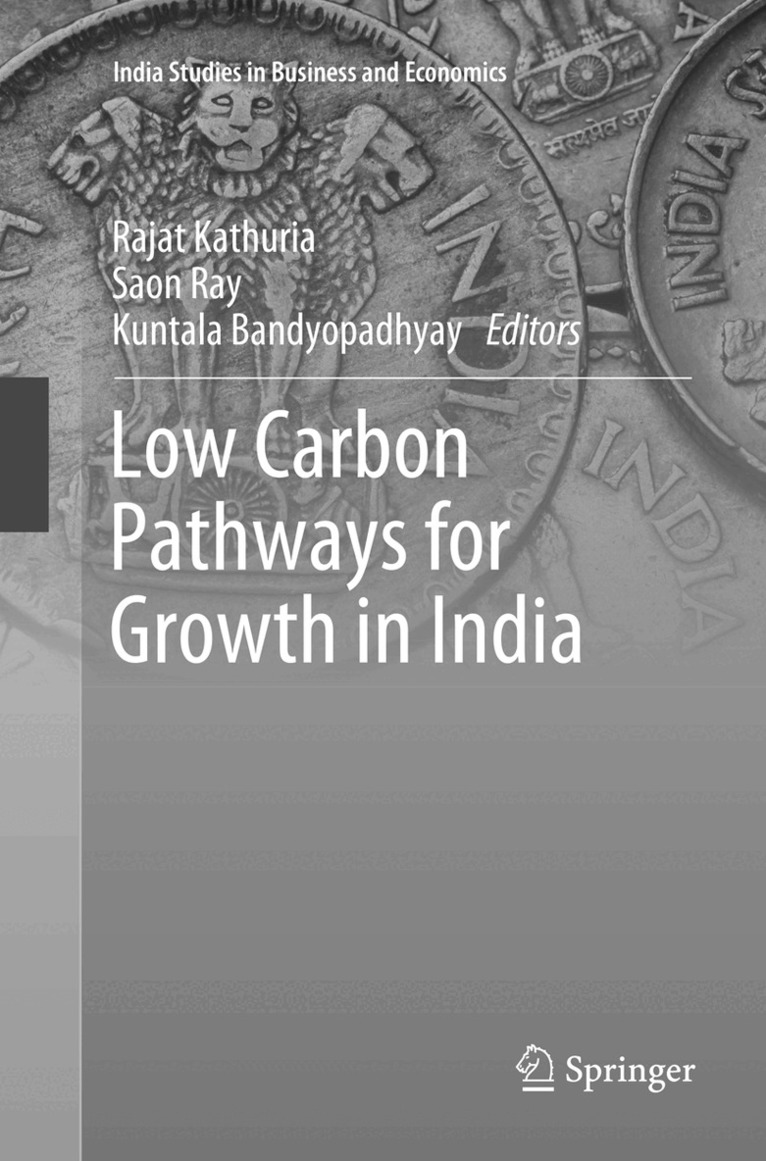
    Low Carbon Pathways for Growth in India

    AvRajat Kathuria,Saon Ray

    Häftad, Engelska, 2019

    Del i serien India Studies in Business and Economics

    1 194 kr

    Beställningsvara. Skickas inom 10-15 vardagar. Fri frakt över 249 kr.

    Beskrivning

    This book explores ways in which India can negotiate the low carbon path  up until 2030, when it is expected to be the largest economy after the US and China. It comprehensively reviews the low climate pathways for India and provides a guide to the pathways that the country can adopt. India’s population, energy demands and emissions will increase significantly, and the challenge is to restrict its CO2 emissions and walk the low carbon path. Through its Intended Nationally Determined Contributions (INDCs), India has pledged to reduce its emissions significantly.Addressing the question of which low carbon paths India can adhere to without compromising its growth, the book identifies the key factors that feed into existing models of climate change and discusses the cost of action versus inaction. It also examines key issues concerning India’s environment through the lens of the transport, industry and water sectors. The book concludes by looking at policy implications for lowcarbon growth in India.

    Produktinformation

    • Utgivningsdatum:2019-02-01
    • Mått:155 x 235 x 12 mm
    • Vikt:324 g
    • Format:Häftad
    • Språk:Engelska
    • Serie:India Studies in Business and Economics
    • Antal sidor:188
    • Förlag:Springer Verlag, Singapore
    • ISBN:9789811345289

    Utforska kategorier

    • Energiteknik inom Naturvetenskap och teknik
    • Miljövetenskap och miljöpolitik inom Naturvetenskap och teknik

    Mer om författaren

    Rajat Kathuria is Director and Chief Executive at the Indian Council for Research on International Economic Relations (ICRIER), New Delhi. He has over 20 years experience in teaching and 15 years experience in economic policy, besides research interests on a range of issues relating to regulation and competition policy. He has worked with the World Bank, Washington DC as a Consultant and carried out research assignments for a number of international organizations, including ILO, UNCTAD, LirneAsia, World Bank and ADB. He has published in international and national journals, besides in popular magazines and newspapers. He is founder member of Broadband Society for Universal Access and served on the Board of Delhi Management Association. He is on several government committees and on the research advisory council of SBI. He has an undergraduate degree in Economics from St. Stephens College, a Masters from Delhi School of Economics and a PhD degree from the University of Maryland, College Park. Saon Ray is Senior Fellow, Indian Council for Research on International Economic Relations (ICRIER), New Delhi. An economist specializing in industry and international trade issues, her areas of interest include global value chains, technological upgrading of Indian industries, free trade agreements and trade creation effects. She has worked in the area of trade policy, technology transfer, foreign direct investment, efficiency and productivity of firms, energy and climate change related issues. She has published widely on these issues in books and journal articles. Her Ph.D. in Economics from the Jawaharlal Nehru University examined the role of intellectual property rights in transferring technology to developing countries.Kuntala Bandyopadhyay is a Research Associate with ICRIER. Her research interests include development economics, particularly in the areas of energy and climate, and trade and labour issues. She is currently involved in the New Climate Economy project, which is investigating the feasibility of de-carbonization of Indian Railways. She has an M.Phil. in Economics from Jawaharlal Nehru University and is currently pursuing her Ph.D. at the same university.

    Innehållsförteckning

    • India’s Energy Demand and Supply.- Low Carbon Pathways for Growth in India: Assessment of Climate Models.- Low Carbon Pathways.- Cost of Inaction on Mitigating Climate change.- Sectoral Perspectives.- Low Carbon Pathways for Urban Development and Mobility in India.-  Strategies to Lower Carbon Emissions in Industry.-  Energy Efficiency Approach to Urban Water Supply.- Water, Ecosystem Services, and Food Security.- De-carbonization of the Indian Railways.- Advent of Solar in India.- Conclusion.