• Fri frakt över 249 kr
  • •
  • Snabba leveranser
  • •
  • Billiga böcker
Kundservice

Du är på sajten för privatpersoner.

Företag, bibliotek eller offentlig verksamhet?

Du handlar på classic.bokus.com, där alla dina funktioner finns intakta.
Till classic.bokus.com
Bokus logotyp. Gå till startsidan.
  • Erbjudanden
  • Nyheter
  • Student
  • Topplistor
  • Barn & ungdom
  • Bokus Play
  • E-böcker
  • Pocketböcker
  • Spel & pussel

10% rabatt på allt med kod NYSTART10 →

Sidfot

Mina sidor

    Hjälp

    • Kundservice
    • Vanliga frågor och svar
    • Frakt och leverans
    • Retur vid ångerrätt
    • Reklamera vara
    • Betalning
    • Köpvillkor
    • Allmänna villkor
    • Information om webbplatsens tillgänglighet

    Om Bokus

    • Om oss
    • Pressrum
    • För studenter
    • För företag
    • För bibliotek och offentlig verksamhet
    • För leverantörer
    • Hållbarhet

    Populärt

    • Aktuella erbjudanden
    • Presentkort
    • Studentlitteratur
    • Nya böcker
    • Topplistor
    • Signerade böcker
    • Engelska böcker

    Inspiration

    • Boktips
    • BookTok
    • Populära bokserier
    • Barnbokskaraktärer
    • Populära författare
    Logotyp för Bokus
    Följ oss på Facebook (extern länk)Följ oss på Instagram (extern länk)Följ oss på YouTube (extern länk)Följ oss på TikTok (extern länk)
    bokus @ CookiesAnpassa cookiesIntegritetspolicyKöpvillkor
    Till Citymail hemsida (extern länk)Till Budbee hemsida (extern länk)Till Postnord hemsida (extern länk)Till Schenker hemsida (extern länk)Till Early Bird hemsida (extern länk)Till Walleys hemsida (extern länk)
    1. Psykologi och pedagogik
    2. Pedagogik

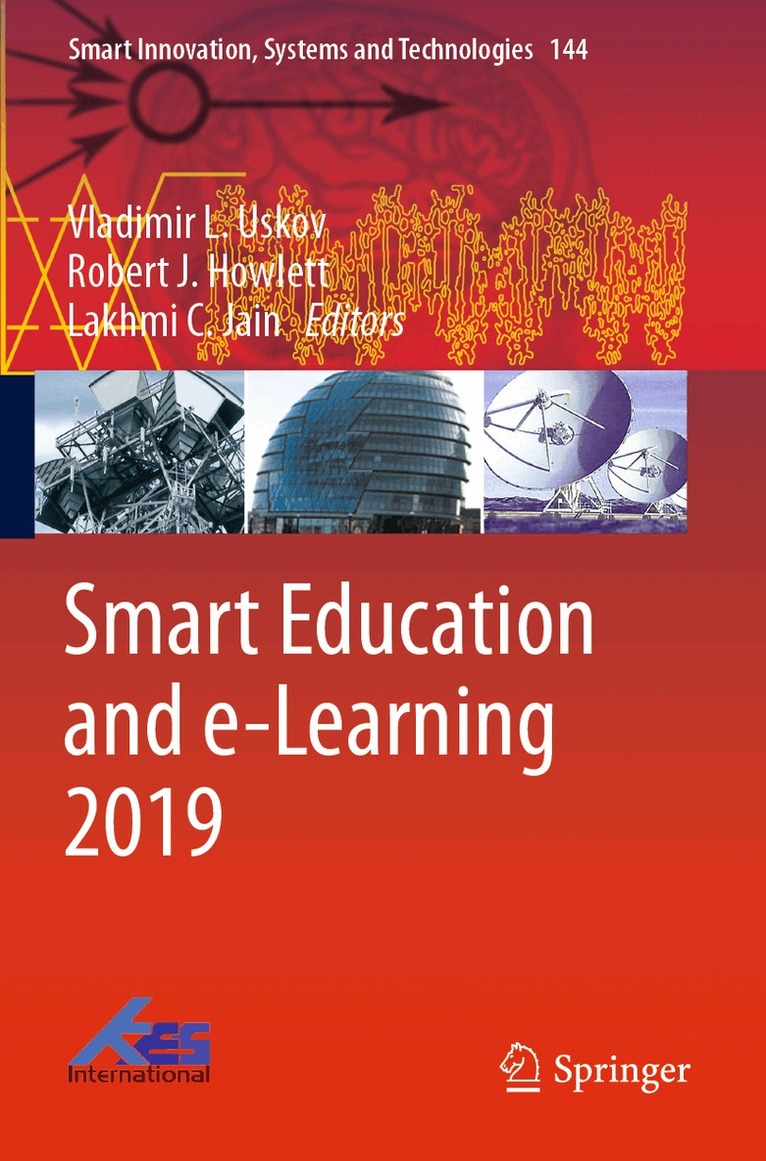
    Smart Education and e-Learning 2019

    AvVladimir L. Uskov,Robert J. Howlett

    Häftad, Engelska, 2020

    Del i serien Smart Innovation, Systems and Technologies

    2 103 kr

    Beställningsvara. Skickas inom 10-15 vardagar. Fri frakt över 249 kr.

    Beskrivning

    This book contains the contributions presented at the 6th international KES conference on Smart Education and e-Learning (KES SEEL-2019), which took place at St. Julian’s, Malta, June 17–19, 2019. It contains fifty-five high-quality peer-reviewed papers that are grouped into several interconnected parts: Part 1 – Smart Education, Part 2 – Smart e-Learning, Part 3 – Smart Pedagogy, Part 4 – Smart Education: Systems and Technology, Part 5 – Smart Education: Case Studies and Research, Part 6 – Students with Disabilities and Smart Education/University, and Part 7 – Mathematical Modelling of Smart Education and Economics of Smart University. Smart education and smart e-learning are emerging and rapidly growing areas with the potential to transform existing teaching strategies, learning environments, and educational activities and technology in the classroom. Smart education and smart e-learning focus on enabling instructors to develop new ways of achieving excellence in teaching in highly technological smart classrooms, and providing students with new opportunities to maximize their success and select the best options for their education, location and learning style, as well as the mode of content delivery. This book serves as a useful source of research data and valuable information on current research projects, best practices and case studies for faculty, scholars, Ph.D. students, administrators, and practitioners – all those who are interested in smart education and smart e-learning.

    Produktinformation

    • Utgivningsdatum:2020-08-14
    • Mått:155 x 235 x 36 mm
    • Vikt:990 g
    • Format:Häftad
    • Språk:Engelska
    • Serie:Smart Innovation, Systems and Technologies
    • Antal sidor:645
    • Förlag:Springer Verlag, Singapore
    • ISBN:9789811382628

    Utforska kategorier

    • Pedagogik inom Psykologi och pedagogik
    • Artificiell intelligens inom Data och IT
    • Ekonomiska system inom Ekonomi och Ledarskap

    Mer om författaren

    Dr. Vladimir Uskov is a Professor of Computer Science and Information Systems and Director of the InterLabs Research Institute at Bradley University. He obtained his Ph.D. and M.Sc. in Computer Science from Moscow Aviation Institute – Technical University, Russia. He has previously worked at the University of Cincinnati and Michigan State University (USA), Moscow State Technical University and Moscow Aviation Institute – Technical University (Russia), and various other universities in Japan, Italy, Germany, the Netherlands and France. His current research is focused on engineering of software/hardware systems and tools for Smart University, Smart Education, Smart Classroom and design of innovative teaching and learning strategies for highly technological Smart Pedagogy. He has published 3 textbooks, 5 chapter books and more than 330 papers in international journals and conference proceedings. Dr. Robert Howlett is the Executive Chair of KES International, a non-profit organization that facilitates knowledge transfer and the dissemination of research results in areas including Intelligent Systems, Sustainability, and Knowledge Transfer. He is a Visiting Professor at Bournemouth University in the UK. His technical expertise is in the use of intelligent systems to solve industrial problems. He has been successful in applying artificial intelligence, machine learning and related technologies to sustainability and renewable energy systems; condition monitoring, diagnostic tools and systems; and automotive electronics and engine management systems. His current research work is focussed on the use of smart microgrids to achieve reduced energy costs and lower carbon emissions in areas such as housing and protected horticulture. Dr. Lakhmi C. Jain is currently serving at the Faculty of Engineering and Information Technology, University of Technology, Sydney, Australia. A Fellow of the Institution of Engineers, Australia, Professor Jain founded KES International in order to provide the professional community with enhanced opportunities for publication, knowledge exchange, cooperation and teambuilding. Bringing together over 5,000 researchers from universities and companies worldwide, KES facilitates international cooperation and generates synergies in teaching and research. Further, it regularly provides networking opportunities for the professional community through one of the largest conferences of its kind. Professor Jain’s main interests lie in artificial intelligence paradigms and their applications to complex systems, security, e-education, e-healthcare, unmanned aerial vehicles and intelligent agents.

    Innehållsförteckning

    • Part 1: Smart Education.- Chapter 1. Smart University: A Validation of “Smartness Features – Main Components” Matrix by Real World Examples and Best Practices from Universities Worldwide.- Chapter 2. Quantitative Follow-up of MOOC Students Using Big Data Techniques.- Chapter 3. Classification of University Students Attending Computing Classes Using a Self-Assessment Questionnaire.- Chapter 4. Smart Education in an Interconnected World: Virtual, Collaborative, Project-Based Courses to Teach Global Software Engineering.- Chapter 5. Smarter Education: Leveraging Stakeholder Inputs to Develop Work Ready Curricula.- Part 2: Smart e-Learning.- Chapter 6. Teaching Culture and Literature of German-Speaking Countries with the Support of Virtual Learning Environment in Reflection and Self-Reflection of Students of Management of Tourism – A Case Study.- Chapter 7. Sampling and Analyzing Statistical Data to Predict the Performance of MOOC.- Chapter 8. The Development of Classroom Research Skills of Online Lessons Usage of a Google Classroom.- Chapter 9. Interculturality in Blended Learning: Challenges of Electronic Communication.- Chapter 10. Machine Learning Approach of Predicting Learning Outcomes of MOOCs to Increase Its Performance.- Chapter 11. A Development of Instructional Games for Education Students.- Chapter 12. The Methodology of Development of Electronic Educational Resources for Learning of General Scientific Disciplines in Non-Native Language.- Chapter 13. Visualization of Learning Activities in Classroom Blended with e-Learning System.- Chapter 14. Dosage Effects of CAI on Literacy Skills.- Chapter 15. Construction of a Socio-Affective Profile Model of Students in a Virtual Learning Environment.