• Fri frakt över 249 kr
  • •
  • Snabba leveranser
  • •
  • Billiga böcker
Kundservice

Du är på sajten för privatpersoner.

Företag, bibliotek eller offentlig verksamhet?

Du handlar på classic.bokus.com, där alla dina funktioner finns intakta.
Till classic.bokus.com
Bokus logotyp. Gå till startsidan.
  • Erbjudanden
  • Nyheter
  • Student
  • Topplistor
  • Barn & ungdom
  • Bokus Play
  • E-böcker
  • Pocketböcker
  • Spel & pussel

10% rabatt på allt med kod: NYSTART10 →

Sidfot

Mina sidor

    Hjälp

    • Kundservice
    • Vanliga frågor och svar
    • Frakt och leverans
    • Retur vid ångerrätt
    • Reklamera vara
    • Betalning
    • Köpvillkor
    • Allmänna villkor
    • Information om webbplatsens tillgänglighet

    Om Bokus

    • Om oss
    • Pressrum
    • För studenter
    • För företag
    • För bibliotek och offentlig verksamhet
    • För leverantörer
    • Hållbarhet

    Populärt

    • Aktuella erbjudanden
    • Presentkort
    • Studentlitteratur
    • Nya böcker
    • Topplistor
    • Signerade böcker
    • Engelska böcker

    Inspiration

    • Boktips
    • BookTok
    • Populära bokserier
    • Barnbokskaraktärer
    • Populära författare
    Logotyp för Bokus
    Följ oss på Facebook (extern länk)Följ oss på Instagram (extern länk)Följ oss på YouTube (extern länk)Följ oss på TikTok (extern länk)
    bokus @ CookiesAnpassa cookiesIntegritetspolicyKöpvillkor
    Till Citymail hemsida (extern länk)Till Budbee hemsida (extern länk)Till Postnord hemsida (extern länk)Till Schenker hemsida (extern länk)Till Early Bird hemsida (extern länk)Till Walleys hemsida (extern länk)
    1. Ekonomi och Ledarskap
    2. Företagsekonomi
    3. Organisationsteori

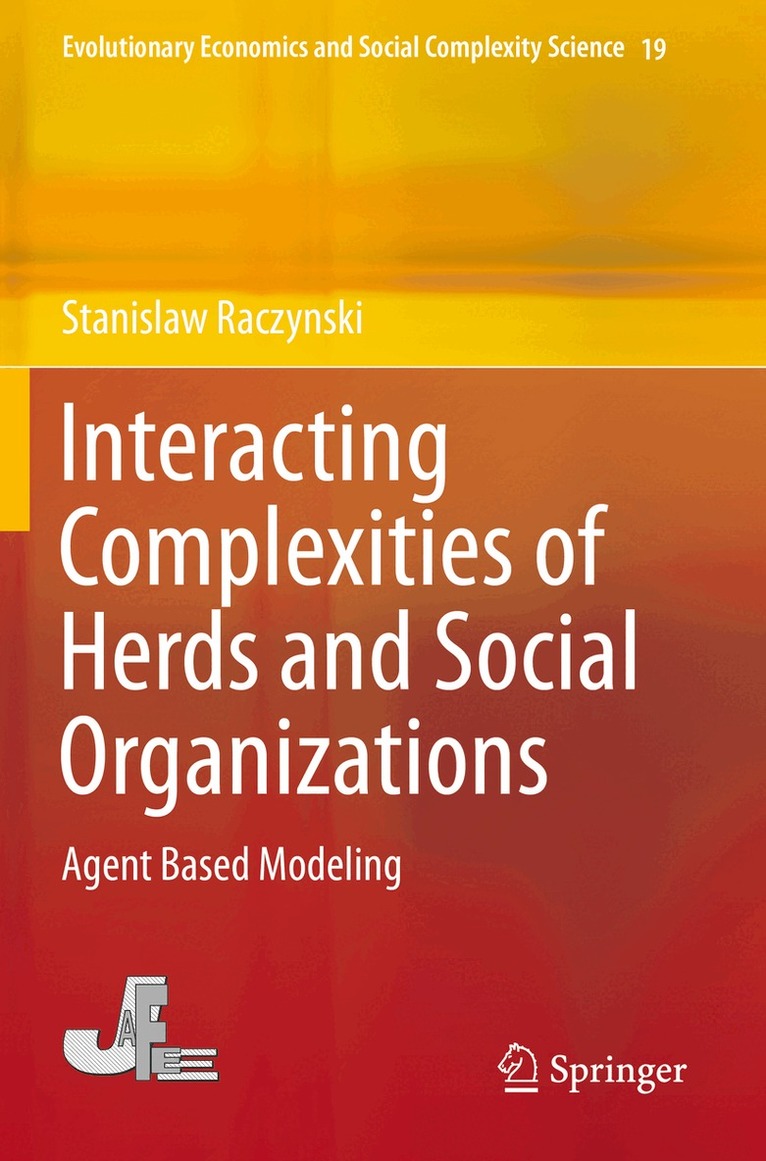
    Interacting Complexities of Herds and Social Organizations

    Agent Based Modeling

    AvStanislaw Raczynski

    Häftad, Engelska, 2020

    Del 19 i serien Evolutionary Economics and Social Complexity Science

    622 kr

    Beställningsvara. Skickas inom 10-15 vardagar. Fri frakt över 249 kr.

    Fler format och utgåvor

    Inbunden

    870 kr

    E-bok

    789 kr

    Beskrivning

    This book presents examples of and the latest simulation studies on artificial societies and populations, highlighting innovative implementations of various models of artificial societies and populations using a new, C++-related simulation tool. It demonstrates that the prey-predator models—including spatial distribution, moving patterns, limited renewable food, fear, gregarious (herd) instinct, clustering, epidemics, and competition—are more complex than other publications have suggested, and highlights the great discrepancy between agent-based and conventional continuous models. The book also discusses the modeling and simulation of self-organization and interactions between organizations, including terror organizations, offering fascinating insights into organizational dynamics.The book provides a broad range of examples and comparisons with the classical dynamics approach, showing readers how to construct models of complex systems. It starts with descriptions ofthe behavior of interacting individuals and also includes important information on the macro-behavior of the whole system.

    Produktinformation

    • Utgivningsdatum:2020-09-19
    • Mått:155 x 235 x 10 mm
    • Vikt:260 g
    • Format:Häftad
    • Språk:Engelska
    • Serie:Evolutionary Economics and Social Complexity Science
    • Antal sidor:150
    • Förlag:Springer Verlag, Singapore
    • ISBN:9789811393396

    Utforska kategorier

    • Organisationsteori inom Ekonomi och Ledarskap
    • Informationsteknik: allmänt inom Data och IT
    • Sociologi inom Samhälle och politik

    Mer om författaren

    Stanislaw Raczynski received his master’s degree (1964) from the Electrical Engineering Department of the Academy of Mining and Metallurgy (AGH) in Krakow Poland, his Ph.D. (1969) and his “habilitation” degree (1977) in the field of control theory and optimization methods from the same academy. In 1964 Dr.Raczynski joined the AGH’s Institute for Automatics and Industrial Electronics, and from 1971 to 1972 he was head of the Computer Center at the AGH. Between 1973 and 1976 he worked as a researcher in the International Research Group in Moscow, USSR. In 1976 he became Head of the Systems Analysis Group at the AGH. From 1980 through 1983 he participated in the activities of the European Workshop on Industrial Computer Systems. Between 1983 and 1986 he was a Visiting Professor at the National University of Mexico, and in 1986 he joined the Panamericana University in Mexico City. From 1996 to 2000 and from 2002 to 2004 he was the International Director of The Society for Computer Simulation. He has written two books on computer simulation (Wiley, UK and LIMUSA, Mexico) and has published more than 80 articles and papers in professional journals and conference proceedings

    Innehållsförteckning

    • Chapter 1. Agent based models, tools.- Chapter 2. Simulating self-organization and interference between certain hierarchical structures.- Chapter 3. Interactions between terror and anti-terror organizations.- Chapter 4. Organization growth and decay: simulating interactions of hierarchical structures, corruption and gregarious effect.- Chapter 5. The spontaneous rise of the herd instinct: agent based simulation.- Chapter 6. Influence of the gregarious instinct and individuals’ behavior patterns on macro migrations: Simulation experiments.- Chapter 7. Simulating our self-destruction.- Chapter 8. Prey-predator models revisited: uncertainty, herd instinct, fear, limited food, epidemics, evolution and competition.- Chapter 9. Discret event simulation vs continuous system dynamics.