• Fri frakt över 249 kr
  • •
  • Snabba leveranser
  • •
  • Billiga böcker
Kundservice

Du är på sajten för privatpersoner.

Företag, bibliotek eller offentlig verksamhet?

Du handlar på classic.bokus.com, där alla dina funktioner finns intakta.
Till classic.bokus.com
Bokus logotyp. Gå till startsidan.
  • Erbjudanden
  • Nyheter
  • Student
  • Topplistor
  • Barn & ungdom
  • Bokus Play
  • E-böcker
  • Pocketböcker
  • Spel & pussel

10% rabatt på allt med kod NYSTART10 →

Sidfot

Mina sidor

    Hjälp

    • Kundservice
    • Vanliga frågor och svar
    • Frakt och leverans
    • Retur vid ångerrätt
    • Reklamera vara
    • Betalning
    • Köpvillkor
    • Allmänna villkor
    • Information om webbplatsens tillgänglighet

    Om Bokus

    • Om oss
    • Pressrum
    • För studenter
    • För företag
    • För bibliotek och offentlig verksamhet
    • För leverantörer
    • Hållbarhet

    Populärt

    • Aktuella erbjudanden
    • Presentkort
    • Studentlitteratur
    • Nya böcker
    • Topplistor
    • Signerade böcker
    • Engelska böcker

    Inspiration

    • Boktips
    • BookTok
    • Populära bokserier
    • Barnbokskaraktärer
    • Populära författare
    Logotyp för Bokus
    Följ oss på Facebook (extern länk)Följ oss på Instagram (extern länk)Följ oss på YouTube (extern länk)Följ oss på TikTok (extern länk)
    bokus @ CookiesAnpassa cookiesIntegritetspolicyKöpvillkor
    Till Citymail hemsida (extern länk)Till Budbee hemsida (extern länk)Till Postnord hemsida (extern länk)Till Schenker hemsida (extern länk)Till Early Bird hemsida (extern länk)Till Walleys hemsida (extern länk)
    1. Naturvetenskap och teknik
    2. Teknik och industri
    3. Agronomi och lantbruk
    4. Djurhållning

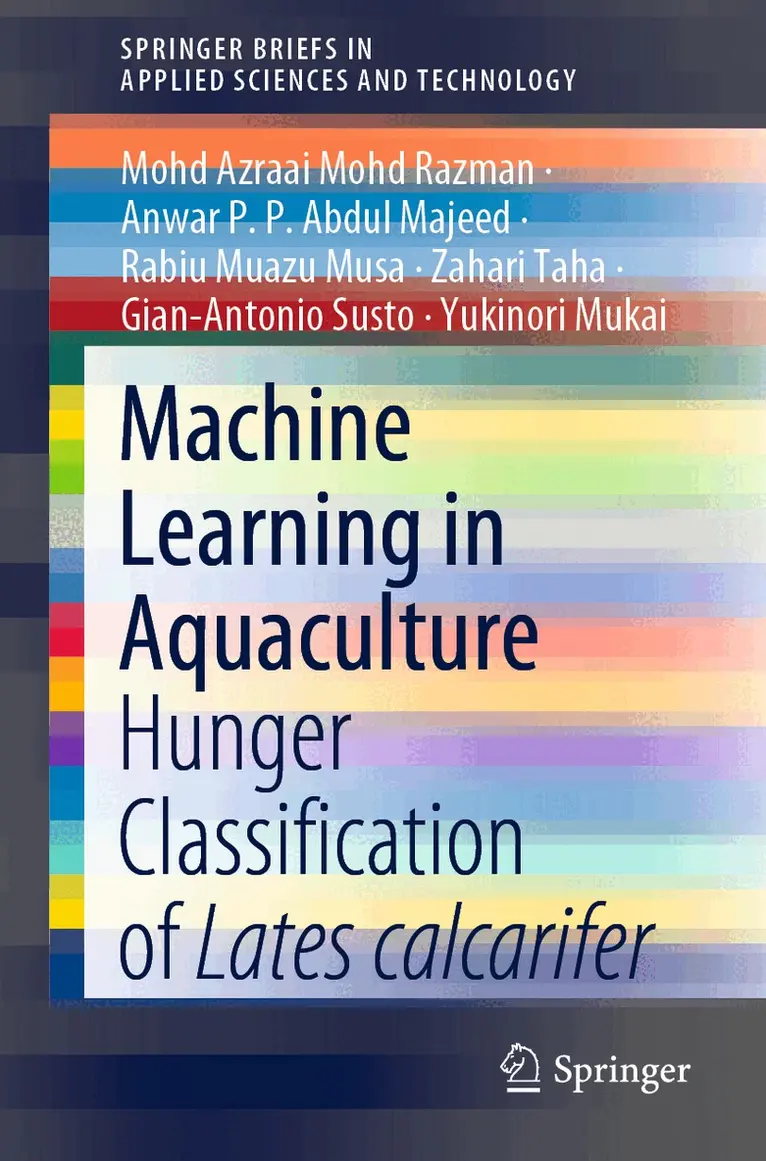
    Machine Learning in Aquaculture

    Hunger Classification of Lates calcarifer

    AvMohd Azraai Mohd Razman,Anwar P. P. Abdul Majeed

    Häftad, Engelska, 2020

    Del i serien SpringerBriefs in Applied Sciences and Technology

    546 kr

    Beställningsvara. Skickas inom 10-15 vardagar. Fri frakt över 249 kr.

    Beskrivning

    This book highlights the fundamental association between aquaculture and engineering in classifying fish hunger behaviour by means of machine learning techniques. Understanding the underlying factors that affect fish growth is essential, since they have implications for higher productivity in fish farms. Computer vision and machine learning techniques make it possible to quantify the subjective perception of hunger behaviour and so allow food to be provided as necessary. The book analyses the conceptual framework of motion tracking, feeding schedule and prediction classifiers in order to classify the hunger state, and proposes a system comprising an automated feeder system, image-processing module, as well as machine learning classifiers. Furthermore, the system substitutes conventional, complex modelling techniques with a robust, artificial intelligence approach. The findings presented are of interest to researchers, fish farmers, and aquaculture technologist wanting to gain insights into the productivity of fish and fish behaviour.

    Produktinformation

    • Utgivningsdatum:2020-01-04
    • Mått:155 x 235 x 5 mm
    • Vikt:119 g
    • Format:Häftad
    • Språk:Engelska
    • Serie:SpringerBriefs in Applied Sciences and Technology
    • Antal sidor:60
    • Förlag:Springer Verlag, Singapore
    • ISBN:9789811522369

    Utforska kategorier

    • Djurhållning inom Naturvetenskap och teknik
    • Elektronik och kommunikationer inom Naturvetenskap och teknik
    • Systemvetenskap och AI inom Data och IT

    Mer om författaren

    Mr. Mohd Azraai Mohd Razman graduated his first degree from the University of Sheffield, United Kingdom, in Mechatronics Engineering in 2010. He then obtained his M.Eng. by 2014 from Universiti Malaysia Pahang (UMP) in Mechatronics Engineering and currently pursuing his Ph.D. at UMP as well. He did his visiting Ph.D. at University of Padova, Italy, in 2018 where he focuses on computer vision and machine learning. His research interests include optimization techniques, control systems, signal processing, instrumentation in aquaculture, sports engineering, as well as machine learning.Dr. Anwar P.P. Abdul Majeed graduated with a first-class honours B.Eng. in Mechanical Engineering from Universiti Teknologi MARA (UiTM), Malaysia. He obtained an M.Sc. in Nuclear Engineering from Imperial College London, United Kingdom. He then received his Ph.D. in Rehabilitation Robotics under the supervision of Prof. Dr. Zahari Taha from Universiti Malaysia Pahang (UMP). He is currently serving as a senior lecturer at the Faculty of Manufacturing and Mechatronics Engineering Technology, UMP. He is an active research member at the Innovative Manufacturing, Mechatronics and Sports Laboratory, UMP. His research interests include rehabilitation robotics, computational mechanics, applied mechanics, sports engineering, renewable and nuclear energy, sports performance analysis, as well as machine learning.Dr Rabiu Muazu Musa holds a Ph.D. degree from Universiti Sultan Zainal Abidin (UniSZA), Malaysia. He obtained his M.Sc. in Sports Science from UniSZA in 2015 and his B.Sc. in Physical and Health Education at Bayero University, Kano, Nigeria, in 2011. His Ph.D. research focuses on the development of multivariate and machine learning models for athletic performance. His research interests include performance analysis, health promotion, sports psychology, exercise science, talent identification, test, and measurement, as well as machine learning. He iscurrently a lecturer at the Centre for Fundamental and Liberal Education, Universiti Malaysia Terengganu.Dr. Zahari Taha graduated with a B.Sc. in Aeronautical Engineering with Honours from the University of Bath, United Kingdom. He obtained his Ph.D. in Dynamics and Control of Robots from the University of Wales Institute of Science and Technology in 1987. He is the founder and advisor of the Innovative Manufacturing, Mechatronics and Sports Laboratory (IMAMS), UMP, and formerly a Professor at the Faculty of Engineering, Universiti Malaya, and Faculty of Manufacturing Engineering, UMP. Dr Zahari teaches and conducts research in the areas of industrial automation, robotics, ergonomics, sustainable manufacturing, machine learning, and sports engineering and provides consultation and training under Dzuki Consultancy and Training.Prof. Gian Antonio Susto received the M.S. degree (cum laude) in control systems engineering and the Ph.D. degree in informationengineering from the University of Padova, Padua, Italy, in 2009 and 2013, respectively. He was a Visiting Student with the University of California San Diego, San Diego, CA, USA, and the National University of Ireland (NUIM), Maynooth, Ireland, an Intern Researcher with Infineon Technologies Austria AG, Villach, Austria, and a Postdoctoral Associate with NUIM in 2013. He is currently an Assistant Professor with the University of Padova and the co-founder of Statwolf Ltd., Dublin, Ireland. His current research interests include deep and machine learning, industry 4.0, activity/gesture recognition, and natural language processing. Dr. Susto received the IEEE-CASE Best Student Conference Paper Award in 2011, the IEEE/SEMI-ASMC Best Student Paper Award in 2012, and the IEEE-MSC Best Student Paper Award in 2012.Dr Yukinori Mukai obtained his B.Sc. and M.Sc. in Kagoshima University, Japan, and Ph.D. degree from Kinki University, Japan. He studied fish larvae and their sensory organs in order to improve larval rearing methods. He then became a lecturer of Aquaculture Course in Universiti Malaysia Sabah (UMS). He is currently an Associate Professor since 2011 in the Department of Marine Science, Kulliyyah of Science, International Islamic University Malaysia (IIUM). He has studied demand feeding system, optimum light wavelength and intensity for larval and juvenile rearing, infusoria culture as live feed, and genetic diversity in wild fish and has cultured fishes in UMS and IIUM.

    Innehållsförteckning

    • 1 Introduction.- 2 Monitoring and feeding integration of demand feeder systems.- 3 Image processing features extraction on fish behaviour.- 4 Time-series identification of fish feeding behaviour.