• Fri frakt över 249 kr
  • •
  • Snabba leveranser
  • •
  • Billiga böcker
Kundservice

Du är på sajten för privatpersoner.

Företag, bibliotek eller offentlig verksamhet?

Du handlar på classic.bokus.com, där alla dina funktioner finns intakta.
Till classic.bokus.com
Bokus logotyp. Gå till startsidan.
  • Erbjudanden
  • Nyheter
  • Student
  • Topplistor
  • Barn & ungdom
  • Bokus Play
  • E-böcker
  • Pocketböcker
  • Spel & pussel

10% rabatt på allt med kod: NYSTART10 →

Sidfot

Mina sidor

    Hjälp

    • Kundservice
    • Vanliga frågor och svar
    • Frakt och leverans
    • Retur vid ångerrätt
    • Reklamera vara
    • Betalning
    • Köpvillkor
    • Allmänna villkor
    • Information om webbplatsens tillgänglighet

    Om Bokus

    • Om oss
    • Pressrum
    • För studenter
    • För företag
    • För bibliotek och offentlig verksamhet
    • För leverantörer
    • Hållbarhet

    Populärt

    • Aktuella erbjudanden
    • Presentkort
    • Studentlitteratur
    • Nya böcker
    • Topplistor
    • Signerade böcker
    • Engelska böcker

    Inspiration

    • Boktips
    • BookTok
    • Populära bokserier
    • Barnbokskaraktärer
    • Populära författare
    Logotyp för Bokus
    Följ oss på Facebook (extern länk)Följ oss på Instagram (extern länk)Följ oss på YouTube (extern länk)Följ oss på TikTok (extern länk)
    bokus @ CookiesAnpassa cookiesIntegritetspolicyKöpvillkor
    Till Citymail hemsida (extern länk)Till Budbee hemsida (extern länk)Till Postnord hemsida (extern länk)Till Schenker hemsida (extern länk)Till Early Bird hemsida (extern länk)Till Walleys hemsida (extern länk)
    1. Medicin
    2. Klinisk medicin och internmedicin
    3. Sjukdomar och rubbningar
    4. Onkologi

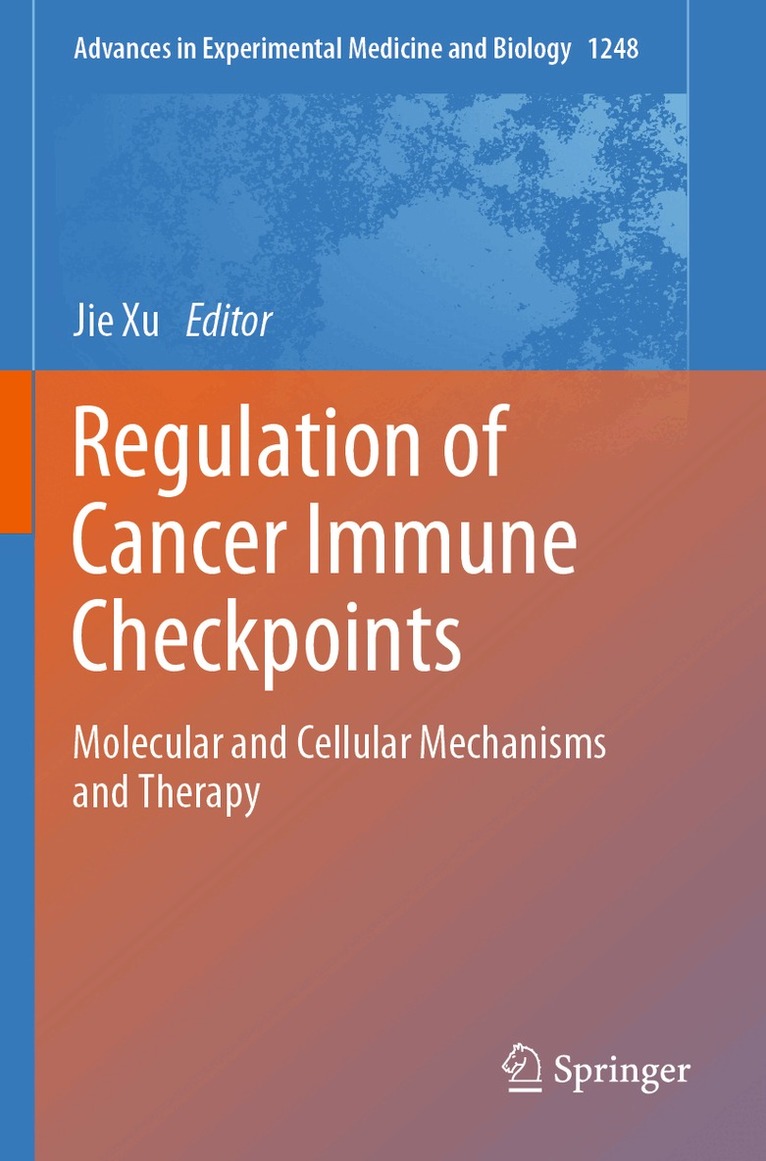
    Regulation of Cancer Immune Checkpoints

    Molecular and Cellular Mechanisms and Therapy

    AvJie Xu

    Häftad, Engelska, 2021

    Del 1248 i serien Advances in Experimental Medicine and Biology

    2 230 kr

    Beställningsvara. Skickas inom 10-15 vardagar. Fri frakt över 249 kr.

    Beskrivning

    This book systematically reviews the most important findings on cancer immune checkpoints, sharing essential insights into this rapidly evolving yet largely unexplored research topic. The past decade has seen major advances in cancer immune checkpoint therapy, which has demonstrated impressive clinical benefits. The family of checkpoints for mediating cancer immune evasion now includes CTLA-4, PD-1/PD-L1, CD27/CD70, FGL-1/LAG-3, Siglec-15, VISTA (PD-1L)/VSIG3, CD47/SIRPA, APOE/LILRB4, TIGIT, and many others. Despite these strides, most patients do not show lasting remission, and some cancers have been completely resistant to the therapy. The potentially lethal adverse effects of checkpoint blockade represent another major challenge, the mechanisms of which remain poorly understood. Compared to the cancer signaling pathways, such as p53 and Ras, mechanistic studies on immune checkpoint pathways are still in their infancy. To improve the responses to checkpoint blockade therapy and limit the adverse effects, it is essential to understand the molecular regulation of checkpoint molecules in both malignant and healthy cells/tissues. This book begins with an introduction to immune checkpoint therapy and its challenges, and subsequently describes the regulation of checkpoints at different levels. In closing, it discusses recent therapeutic developments based on mechanistic findings, and outlines goals for future translational studies. The book offers a valuable resource for researchers in the cancer immunotherapy field, helping to form a roadmap for checkpoint regulation and develop safer and more effective immunotherapies.

    Produktinformation

    • Utgivningsdatum:2021-03-18
    • Mått:155 x 235 x 36 mm
    • Vikt:990 g
    • Format:Häftad
    • Språk:Engelska
    • Serie:Advances in Experimental Medicine and Biology
    • Antal sidor:653
    • Upplaga:21001
    • Förlag:Springer Verlag, Singapore
    • ISBN:9789811532689

    Utforska kategorier

    • Onkologi inom Medicin
    • Medicinsk utrustning och medicinska tekniker inom Medicin

    Mer om författaren

    Dr. Jie Xu is a Professor at the Institute of Biological Sciences, Fudan University. He is also an associate editor of BMC Cancer, guest associate editor of Frontiers in Pharmacology, and editorial board member of the Journal of Digestive Disease and Gastrointestinal Tumors. Dr. Xu was selected for an Excellent Young Scholar Award by the National Natural Science Foundation of China, Top-Notch Young Talents in China Award by the Chinese Government, and Tang Scholar Award by the Tang International Foundation. Also serving as a review expert for the Changjiang Scholar Program and National Natural Science Foundation of China, his research focuses on mechanisms that control the functions of cytosolic and transmembrane proteins in the contexts of tumor signaling and interactions with immune cells. Dr. Xu has published more than 50 articles in international journals, with relevant patents transferred to major pharmaceutical groups.

    Innehållsförteckning

    • Introduction.- Molecular and cellular functions of CTLA-4 pathway.- Roles of PD-1/PD-L1 pathway: signaling, cancer, and beyond.- Discovery of new immune checkpoints: family grows up.- Mechanisms of resistance to checkpoint blockade therapy.- Molecular events behind adverse effects.- Rational discovery of response biomarkers.- Spatiotemporal changes in checkpoint molecule expression.- Functions of checkpoint molecules beyond immune evasion.- Genetic alterations and checkpoint expression.- Regulations on messenger RNA: wires and nodes.- Folded or degraded in endoplasmic reticulum.- Mono- and poly-ubiquitination: tags for fates.- Lysosome as the black hole for checkpoint molecules.- Phosphorylation: a fast switch for checkpoint signalling.- Palmitoylation as a signal for delivery.- Checkpoints under traffic control: from and to organelles.- Exosome and secretion: action on?.- Macromolecules and antibody-based drugs.- Mechanisms inspired targeting peptides.- Small molecular inhibitors.- Therapeutic development of immune checkpoint blockers.- Concluding remarks