
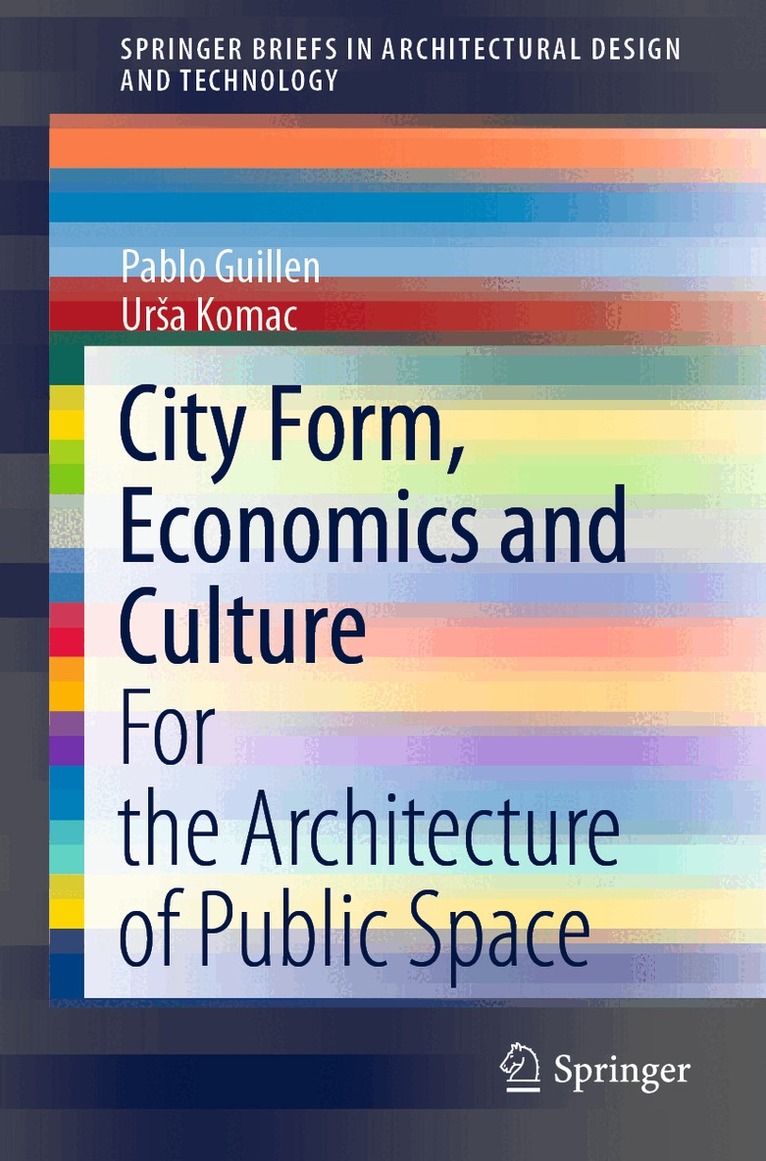
City Form, Economics and Culture
For the Architecture of Public Space
E-bok
PDF, Engelska, 2020718 kr
Läs direkt i Bokus Reader – eller ladda ned till din enhet (PDF kräver ofta zoom och scroll på små skärmar).
Beskrivning
This is a book about how cities occupy space. We are not interested in architectural masterpieces, but the tools for reinventing city life. We try to provide a framework for the architecture and design of public space without aesthetic considerations. We identify several defining factors. First of all, history as the city today very much depends on how it was yesterday. The geographical location and the technology available at a point of time both play a constraining role in what can be done as well. Culture, in the form of social norms, laws and regulations, also restricts what is possible to do. On the other hand, culture is also important in guiding the ideas and aspirations that together inform what society wants the city to be. The city needs government intervention, or regulation, to ameliorate the problem posed by a tangle of externalities and public goods. We focus on two comparative case studies: the evolution of urban form in the US and how it stands in a sharp contrast withthe evolution of urban form in Japan. We emphasise the difference in regulations between both jurisdictions. We study how differences in technological choices driven by culture (i.e. racial segregation), geography (i.e. the availability of land) and history (i.e. the mobility restrictions of the Tokugawa period) result in vast differences in mobility regarding the share of public transport, walking and cycling versus motorised private transport. American cities are constrained by rules that are much further from the neoliberal economic idea of free and competitive markets than the Japanese ones. Japanese planning promotes competition and through a granular, walkable city dotted with small shops, fosters variety in the availability of goods and services. We hypothesise how changing regulations could change the urban form to generate a greater variety of goods and to foster the access to those goods through a more equitable distribution of wealth. Critically, we point out that a desirably denser city must rely on public transport, and we also study how a less-dense city can be made to work with public transport. We conclude by claiming that changes in regulations are very unlikely to happen in the US, as it would require deep cultural changes to move from local to a more universal and less excluding public good provision, but they are both possible and desirable in other jurisdictions.
Produktinformation
Utforska kategorier
Hoppa över listan





Du kanske också är intresserad av
- Nyhet
Del 11
- Signerad!
Del 3
- Nyhet
Del 11
- Nyhet
Del 3
- Nyhet
- Nyhet
- Nyhet
Del 11
- -30%
- -17%