• Fri frakt över 249 kr
  • •
  • Snabba leveranser
  • •
  • Billiga böcker
Kundservice

Du är på sajten för privatpersoner.

Företag, bibliotek eller offentlig verksamhet?

Du handlar på classic.bokus.com, där alla dina funktioner finns intakta.
Till classic.bokus.com
Bokus logotyp. Gå till startsidan.
  • Erbjudanden
  • Nyheter
  • Student
  • Topplistor
  • Barn & ungdom
  • Bokus Play
  • E-böcker
  • Pocketböcker
  • Spel & pussel

10% rabatt på allt med kod: NYSTART10 →

Sidfot

Mina sidor

    Hjälp

    • Kundservice
    • Vanliga frågor och svar
    • Frakt och leverans
    • Retur vid ångerrätt
    • Reklamera vara
    • Betalning
    • Köpvillkor
    • Allmänna villkor
    • Information om webbplatsens tillgänglighet

    Om Bokus

    • Om oss
    • Pressrum
    • För studenter
    • För företag
    • För bibliotek och offentlig verksamhet
    • För leverantörer
    • Hållbarhet

    Populärt

    • Aktuella erbjudanden
    • Presentkort
    • Studentlitteratur
    • Nya böcker
    • Topplistor
    • Signerade böcker
    • Engelska böcker

    Inspiration

    • Boktips
    • BookTok
    • Populära bokserier
    • Barnbokskaraktärer
    • Populära författare
    Logotyp för Bokus
    Följ oss på Facebook (extern länk)Följ oss på Instagram (extern länk)Följ oss på YouTube (extern länk)Följ oss på TikTok (extern länk)
    bokus @ CookiesAnpassa cookiesIntegritetspolicyKöpvillkor
    Till Citymail hemsida (extern länk)Till Budbee hemsida (extern länk)Till Postnord hemsida (extern länk)Till Schenker hemsida (extern länk)Till Early Bird hemsida (extern länk)Till Walleys hemsida (extern länk)
    1. Naturvetenskap och teknik
    2. Matematik och naturvetenskap
    3. Biologi
    4. Biovetenskap

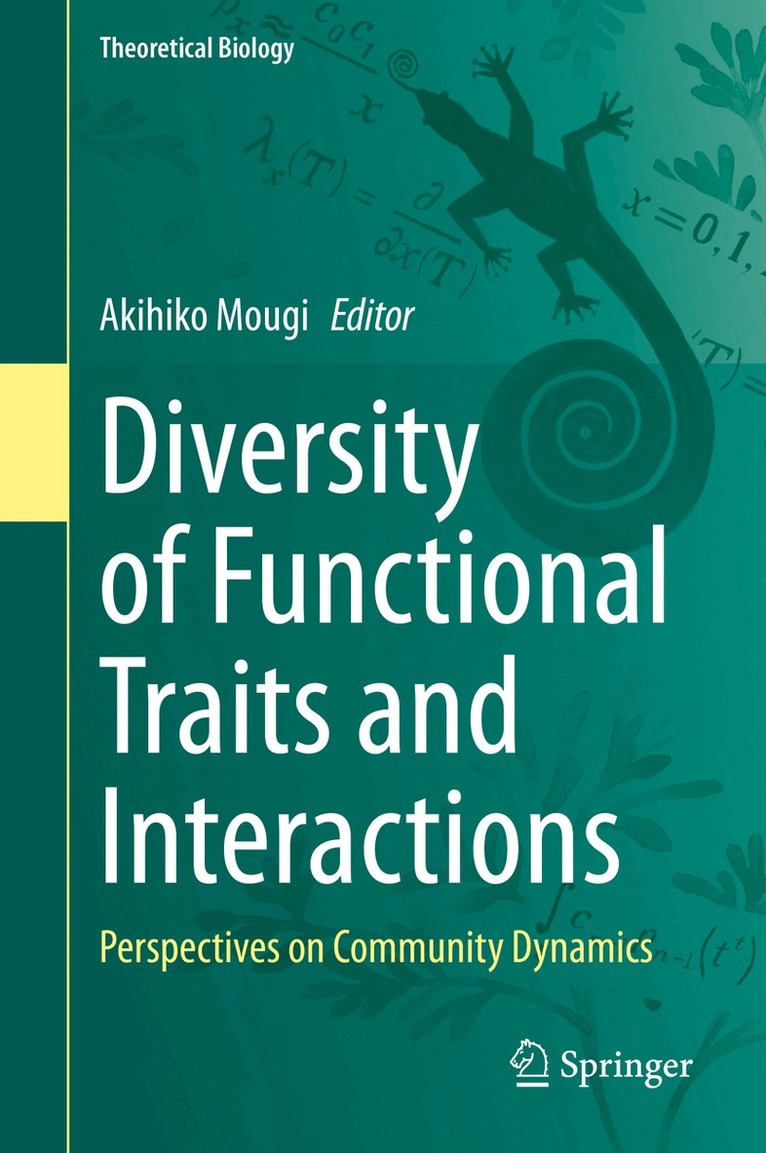
    Diversity of Functional Traits and Interactions

    Perspectives on Community Dynamics

    AvAkihiko Mougi

    Inbunden, Engelska, 2020

    Del i serien Theoretical Biology

    1 086 kr

    Beställningsvara. Skickas inom 10-15 vardagar. Fri frakt över 249 kr.

    Beskrivning

    This book presents new theoretical perspectives on ecological community dynamics and in so doing casts fresh light on the enduring complexity–stability debate. Real ecological communities do not simply comprise diverse species and interactions, which respectively represented the nodes and links of the classic network theory. Rather, they are characterized by different types of complexity, and this book explains how this diversity of complexity is key to understanding the dynamics of ecological communities. It is shown how various properties in natural communities, such as life history, adaptation, density dependence, sex, interaction types, space, functional traits, and microbial processes, can dramatically increase the complexity in ecological communities. Furthermore, innovative methods are introduced that may be applied to cast light on very complex communities. With each chapter presenting the latest advances and approaches, the book sets the direction for future researchon ecological community dynamics. It will be a “must read” for researchers and students in the field of ecology.

    Produktinformation

    • Utgivningsdatum:2020-10-31
    • Mått:155 x 235 x 17 mm
    • Vikt:547 g
    • Format:Inbunden
    • Språk:Engelska
    • Serie:Theoretical Biology
    • Antal sidor:213
    • Förlag:Springer Verlag, Singapore
    • ISBN:9789811579523

    Utforska kategorier

    • Biovetenskap inom Naturvetenskap och teknik

    Mer om författaren

    Akihiko Mougi is an associate professor in the Faculty of Life and Environmental Sciences at the Shimane University. He completed his Ph.D. at Hokkaido University and did postdoctoral work at the Kyushu University and Ryukoku University. His research uses mathematical models to understand ecological and evolutionary dynamics of biological communities and the stability of ecosystems.

    Innehållsförteckning

    • Part 1. Intra-specific trait diversity.- Chapter 1. Incorporating ontogenetic niche shifts into hybrid community dynamics.- Chapter 2. Effects of rapid evolution on population cycles and extinction in predator-prey systems.-  Chapter 3. The possibility that the evolution of sexual traits stabilizes ecological communities.- Chapter 4. Spatiality and community stability.- Part 2.  Inter-specific trait and functional diversity.- Chapter 5. Direct and Indirect Effects of Facilitation and Competition in Ecological.-  Chapter 6. Mathematical modeling on microbes and their roles in community and ecosystem: how to handle microbial diversity in modeling?.- Part 3. Diversity of inter-specific interaction.- Chapter 7. Ecology and evolution of density-dependence.- Chapter 8. Interaction-type diversity and community stability.- Part 4. A novel approach in community ecology.- Chapter 9. Forecasting ecological time series using empirical dynamic modeling: a tutorial for simplex projection and S-map.