• Fri frakt över 249 kr
  • •
  • Snabba leveranser
  • •
  • Billiga böcker
Kundservice

Du är på sajten för privatpersoner.

Företag, bibliotek eller offentlig verksamhet?

Du handlar på classic.bokus.com, där alla dina funktioner finns intakta.
Till classic.bokus.com
Bokus logotyp. Gå till startsidan.
  • Erbjudanden
  • Nyheter
  • Student
  • Topplistor
  • Barn & ungdom
  • Bokus Play
  • E-böcker
  • Pocketböcker
  • Spel & pussel

10% rabatt på allt med kod: NYSTART10 →

Sidfot

Mina sidor

    Hjälp

    • Kundservice
    • Vanliga frågor och svar
    • Frakt och leverans
    • Retur vid ångerrätt
    • Reklamera vara
    • Betalning
    • Köpvillkor
    • Allmänna villkor
    • Information om webbplatsens tillgänglighet

    Om Bokus

    • Om oss
    • Pressrum
    • För studenter
    • För företag
    • För bibliotek och offentlig verksamhet
    • För leverantörer
    • Hållbarhet

    Populärt

    • Aktuella erbjudanden
    • Presentkort
    • Studentlitteratur
    • Nya böcker
    • Topplistor
    • Signerade böcker
    • Engelska böcker

    Inspiration

    • Boktips
    • BookTok
    • Populära bokserier
    • Barnbokskaraktärer
    • Populära författare
    Logotyp för Bokus
    Följ oss på Facebook (extern länk)Följ oss på Instagram (extern länk)Följ oss på YouTube (extern länk)Följ oss på TikTok (extern länk)
    bokus @ CookiesAnpassa cookiesIntegritetspolicyKöpvillkor
    Till Citymail hemsida (extern länk)Till Budbee hemsida (extern länk)Till Postnord hemsida (extern länk)Till Schenker hemsida (extern länk)Till Early Bird hemsida (extern länk)Till Walleys hemsida (extern länk)
    1. Naturvetenskap och teknik
    2. Teknik och industri
    3. Teknik: allmänt

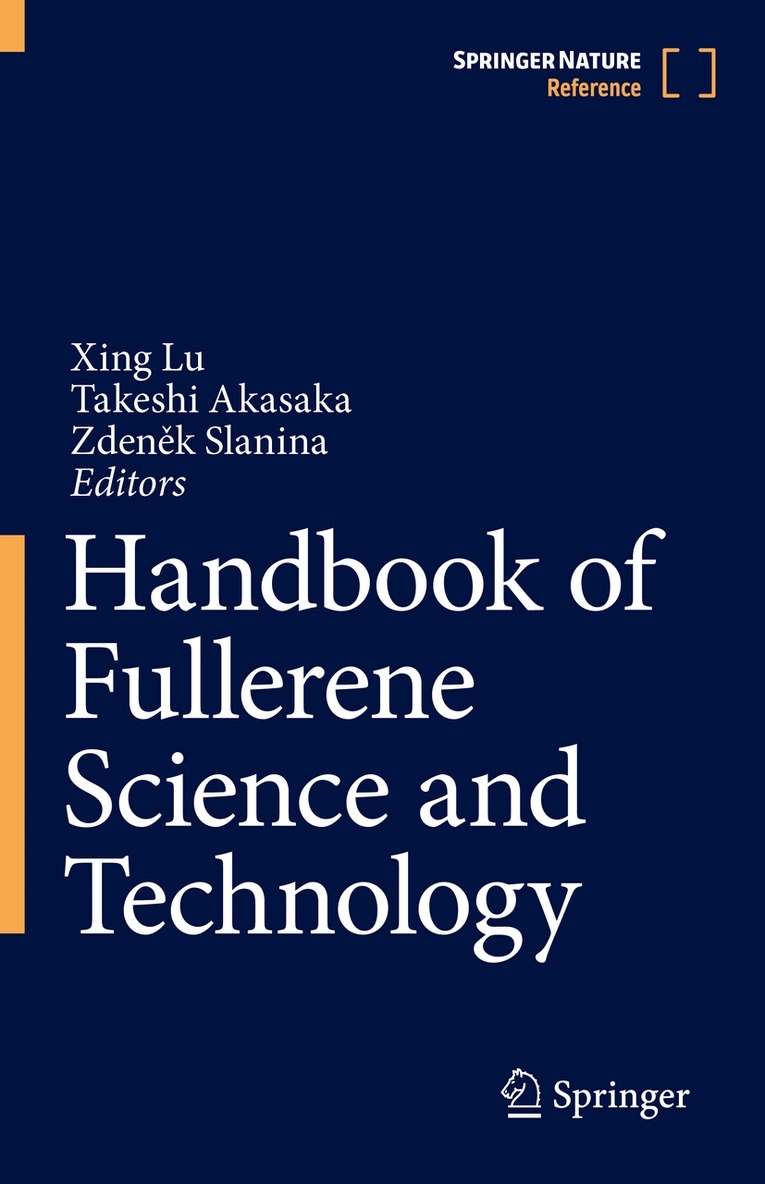
    Handbook of Fullerene Science and Technology

    AvXing Lu,Takeshi Akasaka

    Inbunden, Engelska, 2022

    Del i serien Handbook of Fullerene Science and Technology

    5 942 kr

    Beställningsvara. Skickas inom 10-15 vardagar. Fri frakt över 249 kr.

    Beskrivning

    Nanocarbon chemistry and physics is a fast-developing, broad research area – the Nobel prizes in 1996 and 2010 awarded to two key discoveries in the field, and several other nanocarbon achievements of comparable importance. Owing to this rapid growth, the nanocarbon landscape fundamentally changes every few years, creating a need to survey the field on a regular basis to update the books that have become incomplete or even obsolete. As such, this book focuses on fullerenes and metallofullerenes and also on the related areas of nanotubes and graphenes. All the covered research topics provide important fundamental knowledge for the natural sciences, but also for applications in molecular electronics, superconductivity, catalysis, photovoltaics and medical diagnostics. The current nanocarbon research activities have particularly high application potential in the conversion of solar energy, future molecular memories, non-conventional materials for optoelectronics,and new treatments for civilization diseases. Offering a truly up-to-date critical survey of nanocarbon science, its concepts and highlights, it follows the concept of a handbook: it addresses key topics systematically, from historical background, methodological aspects, current important issues, and application potential, all supplied with extensive referencing. With individual chapters written by leading experts with extensive research experience, it is a comprehensive reference resource for graduate students and active researchers alike.

    Produktinformation

    • Utgivningsdatum:2022-09-25
    • Mått:155 x 235 x 58 mm
    • Vikt:1 916 g
    • Format:Inbunden
    • Språk:Engelska
    • Serie:Handbook of Fullerene Science and Technology
    • Antal sidor:1 035
    • Förlag:Springer Verlag, Singapore
    • ISBN:9789811689932

    Utforska kategorier

    • Teknik: allmänt inom Naturvetenskap och teknik
    • Fysikalisk kemi inom Naturvetenskap och teknik
    • Naturvetenskap:allmänt inom Naturvetenskap och teknik

    Mer om författaren

    Xing Lu is a Full Professor at Huazhong University of Science and Technology. He received his Ph.D. from Peking University (2004) and then he worked as a COE Postdoctoral researcher at Nagoya University, Japan. During 2006-2013, he was a Senior Scientist at The University of Tsukuba, Japan. He is the recipient of The Ambassador Award from the Chinese Embassy in Japan (2009), The Osawa Award from Fullerenes and Nanotubes Research Society of Japan (2011), and The National Science Fund for Distinguished Young Scholars (2019). His research interests lie in the rational design and facile generation of novel hybrid carbon materials with applications in energy storage and conversion. He has published more than 180 peer-reviewed papers in international journals with ~40 at J. Am. Chem. Soc. and Angew. Chem. Int. Ed.Takeshi Akasaka was born in Kyoto. He received his Ph.D. Degree from University of Tsukuba, Japan, in 1979. After working as a Postdoctoral Fellowat Brookhaven National Laboratory, he returned to the University of Tsukuba in 1981. In 1996, he began work at Niigata University as a professor. During 2001-2013, he was a Professor at the TARA Center and Department of Chemistry, University of Tsukuba. After his retirement from the University of Tsukuba in 2013, he was appointed a senior researcher at the Foundation for Advancement of International Science (FAIS) and a Professor Emeritus of the University of Tsukuba. He received the Chemical Society of Japan Award for Creative Work (2000), the Commendation of Science and Technology (Research Category) from the Ministry of Education, Culture, Sports, Science and Technology of Japan in 2011, and the Chemical Society of Japan Award for 2013. His research interests include the chemistry of nanocarbons.Zdenek Slanina was born in the former Czechoslovakia. He received his MA degree from Charles University in Prague and Ph.D. from the (former) Czechoslovak Academy of Sciences where he was also employed between 1971 and 1991, up to the principal-senior-scientist level. After the fullerene-era beginning, he has been active in computational research and teaching at various fullerene research centers like: Hokkaido University, Sapporo; Max-Planck Institute for Chemistry, Mainz; University of Arizona, Tucson; Institute for Molecular Science, Okazaki; University of Tsukuba; Huazhong University of Science and Technology, Wuhan.

    Innehållsförteckning

    • 1. Our Road to Fullerenes – a personal Account.- 2. Preparation, Extraction/isolation From Soot, and Solubility of Fullerenes.- 3. Total synthesis of C60.- 4. Structural characteristics of fullerenes.- 5. Theoretical Predictions of Fullerene Stabilities.- 6. Fullerenes violating the isolated-pentagon-rule.- 7. Merging Carbon Nanostructures with Porphyrins.- 8. Connecting Fullerenes with Carbon Nanotubes and Graphene.- 9. Chemical reactivity and addition pattern on C60 and C70.- 10. Functionalization of Fullerenes: Addition Reactions.- 11. Radical and photo reactions.- 12. Electrochemistry and Organic Electrochemistry of Fullerenes.- 13. Complexation with Transition Metals.- 14. Optically active fullerene derivatives.- 15. Transition-metal-catalyzed reactions of fullerenes and metallofullerenes.