• Fri frakt över 249 kr
  • •
  • Snabba leveranser
  • •
  • Billiga böcker
Kundservice

Du är på sajten för privatpersoner.

Företag, bibliotek eller offentlig verksamhet?

Du handlar på classic.bokus.com, där alla dina funktioner finns intakta.
Till classic.bokus.com
Bokus logotyp. Gå till startsidan.
  • Erbjudanden
  • Nyheter
  • Student
  • Topplistor
  • Barn & ungdom
  • Bokus Play
  • E-böcker
  • Pocketböcker
  • Spel & pussel

10% rabatt på allt med kod: NYSTART10 →

Sidfot

Mina sidor

    Hjälp

    • Kundservice
    • Vanliga frågor och svar
    • Frakt och leverans
    • Retur vid ångerrätt
    • Reklamera vara
    • Betalning
    • Köpvillkor
    • Allmänna villkor
    • Information om webbplatsens tillgänglighet

    Om Bokus

    • Om oss
    • Pressrum
    • För studenter
    • För företag
    • För bibliotek och offentlig verksamhet
    • För leverantörer
    • Hållbarhet

    Populärt

    • Aktuella erbjudanden
    • Presentkort
    • Studentlitteratur
    • Nya böcker
    • Topplistor
    • Signerade böcker
    • Engelska böcker

    Inspiration

    • Boktips
    • BookTok
    • Populära bokserier
    • Barnbokskaraktärer
    • Populära författare
    Logotyp för Bokus
    Följ oss på Facebook (extern länk)Följ oss på Instagram (extern länk)Följ oss på YouTube (extern länk)Följ oss på TikTok (extern länk)
    bokus @ CookiesAnpassa cookiesIntegritetspolicyKöpvillkor
    Till Citymail hemsida (extern länk)Till Budbee hemsida (extern länk)Till Postnord hemsida (extern länk)Till Schenker hemsida (extern länk)Till Early Bird hemsida (extern länk)Till Walleys hemsida (extern länk)
    1. Samhälle och politik
    2. Samhälle och kultur
    3. Sociala grupper och identitet

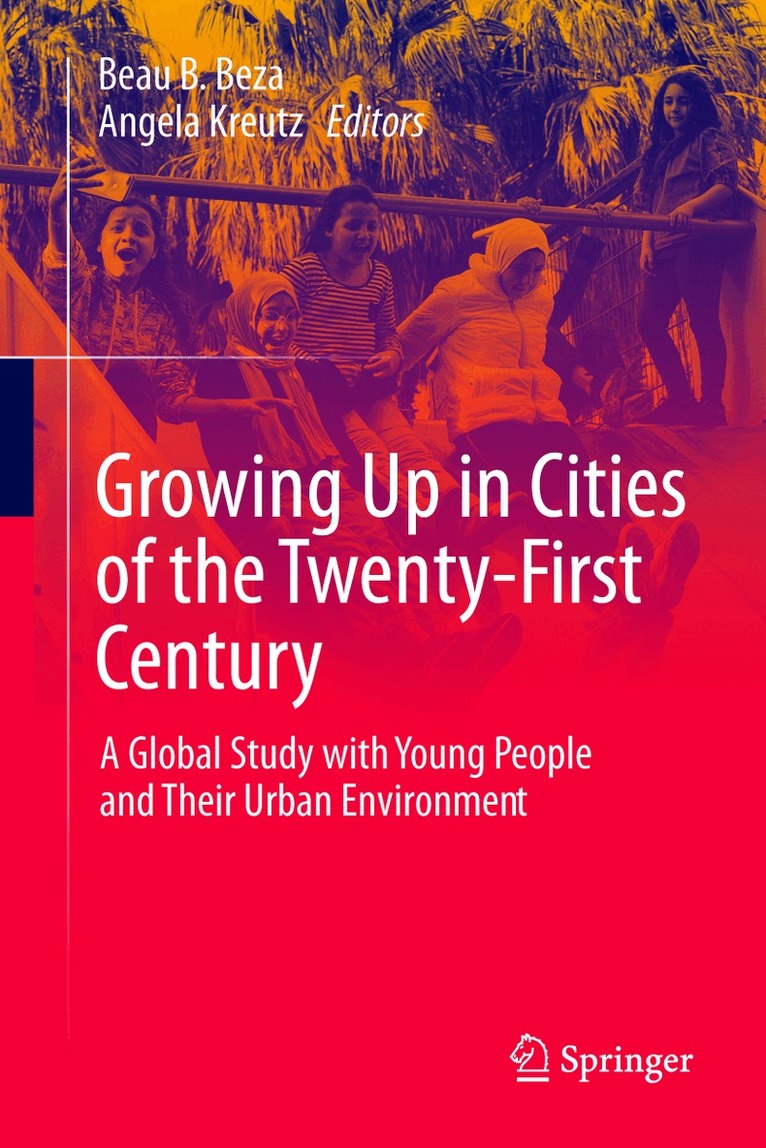
    Growing Up in Cities of the Twenty-First Century

    A Global Study with Young People and Their Urban Environment

    AvBeau B. Beza,Angela Kreutz

    Inbunden, Engelska, 2026

    1 461 kr

    Kommande

    Beskrivning

    This edited volume explores how global issues such as urbanisation, globalisation, digital practice, and global warming are experienced and interpreted by young people in their local contexts. Drawing on research from 13 countries and 20 study sites, this volume examines how adolescents perceive urban space and how their environments shape their daily lives. The broader research in this volume builds upon participatory action research practices and principles that aim to empower young people by giving them a voice and supporting their agency in decision making. These approaches are used to advocate for youth health and wellbeing in contemporary urban contexts across Australia, Canada, Chile, China, Colombia, Germany, Lebanon, Nepal, the Netherlands, Aotearoa (New Zealand), Nigeria, the Philippines and the United States of America. The research project focuses on low-income communities undergoing rapid change, examining ways to engage minority and youth populations in informal settlements who are particularly reliant on the resources of their immediate environments and whose circumstances hold significant implications for urban policy. Providing a broad-ranging and comparative perspective on young people’s experience of urban life, this volume offers valuable insights for students, researchers, social workers and policymakers concerned with youth wellbeing, urban and community development and related fields.

    Produktinformation

    • Utgivningsdatum:2026-10-07
    • Mått:155 x 235 x undefined mm
    • Format:Inbunden
    • Språk:Engelska
    • Antal sidor:494
    • Förlag:Springer Verlag, Singapore
    • ISBN:9789819553426

    Utforska kategorier

    • Sociala grupper och identitet inom Samhälle och politik
    • Sociologi inom Samhälle och politik
    • Geografi inom Naturvetenskap och teknik

    Mer om författaren

    Beau B. Beza was a 1990s Growing Up In Cities (GUIC) team member and is now co-project lead and co‐ordinator with the GUIC III research project. Beau is Associate Professor, Planning (School of Architecture and Built Environment, Deakin University) and registered landscape architect in Australia. He has published widely regarding the social production, perception and use of urban / natural space(s) in both applied and theoretical contexts. An academic and studio teaching passion of his is collaborating with undergraduate and postgraduate university students that supports their questioning of established Anglo-Western perspectives / approaches to realising built environments, which is then used as a mechanism to broaden their design thinking. Underpinning this ‘philosophy’ are cross-discipline and cultural collaborations with design practitioners and communities that lead to the co-production of projects. He provides his Doctor of Philosophy students with a learning support structure that facilitates a two-way transfer of knowledge and scholarship development, enabling successful research outputs and, importantly, study completions on topics such as landscape architecture, heritage and conservation, brownfield redevelopment and young people’s perceptions of the urban environment. Angela Kreutz is an interdisciplinary scholar whose work lies at the intersection of architecture, anthropology, and environmental psychology, focusing on how children and young people experience and help shape their environments. She is particularly interested in cross-cultural and participatory approaches that inform human-centred architectural and urban design. Through collaborative work with young people, communities, and interdisciplinary teams, she explores how spatial design can enhance wellbeing, identity, and belonging. Angela’s research has engaged children from diverse contexts, including Indigenous and rapidly changing urban communities worldwide. She is the author of Children and the Environment in an Australian Indigenous Community: A Psychological Approach (Routledge, 2015) and has contributed widely to international scholarship on child–environment relations, cultural diversity, and participatory design. Her work continues to shape global understandings of how environments support children’s health and agency. Angela is a Senior Lecturer in the School of Architecture and Built Environment at Deakin University.

    Innehållsförteckning

    • Growing Up In Cities III: Introduction and Background.- Introduction: Growing Up in Cities – A New Generation in the Early 21st Century.- Involving Children and Young People in Participatory Research.- The History of Growing Up In Cities: 50 Years of Young People Telling Us What Works, What Doesn't and What Needs to Change.- Growing Up In Cities III: Collaborations.- Growing Up In Braybrook, Australia: A Setting of Youth and Urban Change.- Growing Up In Geelong, Australia: Together in the Face of Inequality.- Growing Up In Logan, Australia: Beenleigh’s Young People Urge for a Greener, more Walkable, Diverse and Affordable Future.- Growing Up In Montreal, Canada: Comm(unity) in the City, Cultivating the Change.- Growing Up In La Ermita de San Antonio, Chile: Invisible Nature.- Growing Up In Chengdu, China.- Growing Up in Tianjin, China: How Do Young People Play in the Community Neighbourhoods?.- Growing Up In Bogotá, Colombia: Urban Narratives and Political Subjectivities in Informal Settlements.- Growing Up In Soacha, Colombia: Exploring the Impact of Public Spaces on Young People in Informal Settlements in the Altos del Pino Neighbourhood.- Growing Up In Berlin, Germany: Online, Offline and Hybrid Spatial Practices of Young People.- Growing Up In Karantina, Lebanon: Young People Growing Up In Lebanon Amidst Multiple Crises.- Growing Up In Banshighat, Nepal: Voices of Young People in a Marginalised Community.- Growing Up In Tanthof, the Netherlands: Playing Outdoors in a Middle-class, Low-rise District.- Growing Up In Tāmaki Makaurau / Auckland, Aotearoa / New Zealand.- Growing Up In Lagos, Nigeria: Place Attachment, Place Making and Urban Aspirations in Makoko.- Growing Up In Manila, Philippines.- Growing Up in Urban United States: Young People in Public Spaces.- Cities and Young People: Global Learning from GUIC Projects and Applying this Knowledge for Positive Change.- Appendix.