• Fri frakt över 249 kr
  • •
  • Snabba leveranser
  • •
  • Billiga böcker
Kundservice

Du är på sajten för privatpersoner.

Företag, bibliotek eller offentlig verksamhet?

Du handlar på classic.bokus.com, där alla dina funktioner finns intakta.
Till classic.bokus.com
Bokus logotyp. Gå till startsidan.
  • Erbjudanden
  • Student
  • Topplistor
  • Barn & ungdom
  • Bokus Play
  • E-böcker
  • Ljudböcker
  • Pocketböcker
  • Spel och pussel

5% studentrabatt – använd koden KURSBOK27 →

Sidfot

Mina sidor

    Hjälp

    • Kundservice
    • Vanliga frågor och svar
    • Frakt och leverans
    • Retur vid ångerrätt
    • Reklamera vara
    • Betalning
    • Köpvillkor
    • Allmänna villkor
    • Information om webbplatsens tillgänglighet

    Om Bokus

    • Om oss
    • Pressrum
    • För studenter
    • För företag
    • För bibliotek och offentlig verksamhet
    • För leverantörer
    • Hållbarhet

    Populärt

    • Aktuella erbjudanden
    • Presentkort
    • Studentlitteratur
    • Nya böcker
    • Topplistor
    • Signerade böcker
    • Engelska böcker

    Inspiration

    • Boktips
    • BookTok
    • Barnbokskaraktärer
    • Populära författare
    Logotyp för Bokus
    Följ oss på Facebook (extern länk)Följ oss på Instagram (extern länk)Följ oss på YouTube (extern länk)Följ oss på TikTok (extern länk)
    bokus @ CookiesAnpassa cookiesIntegritetspolicyKöpvillkor
    Till Citymail hemsida (extern länk)Till Budbee hemsida (extern länk)Till Postnord hemsida (extern länk)Till Schenker hemsida (extern länk)Till Early Bird hemsida (extern länk)Till Walleys hemsida (extern länk)
    1. Naturvetenskap och teknik
    2. Matematik och naturvetenskap
    3. Matematik
    4. Tillämpad matematik
    • Nyhet

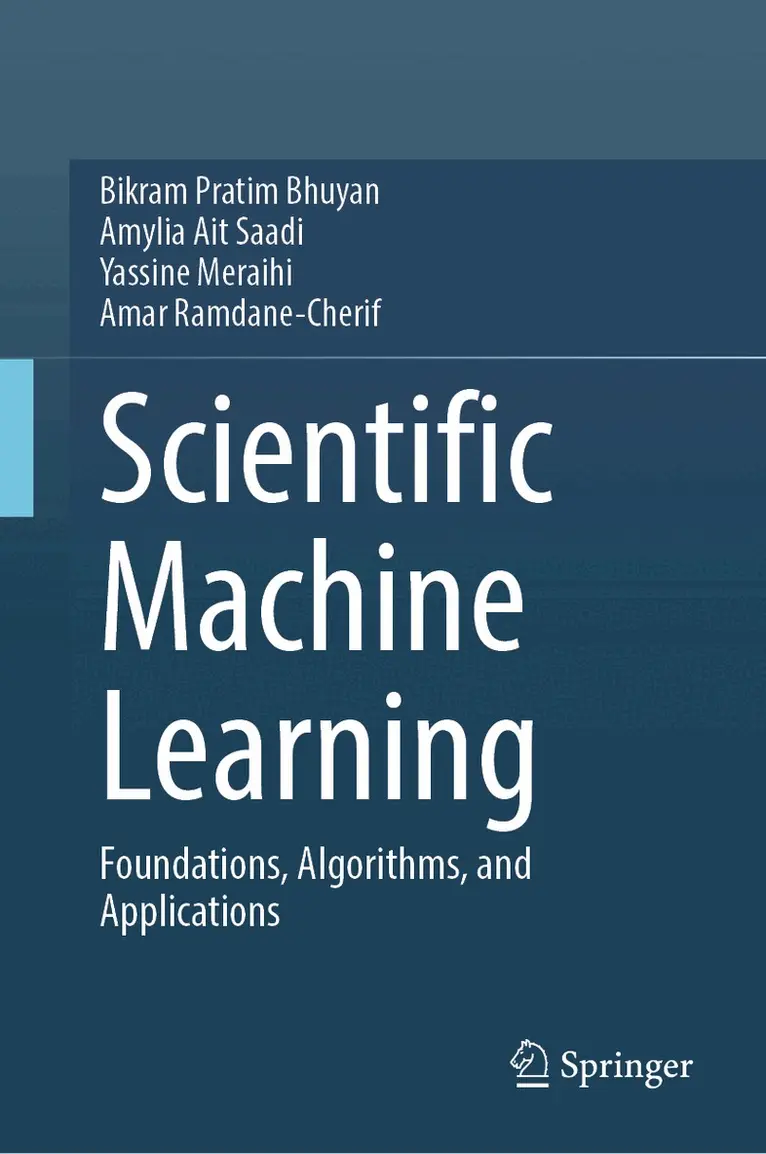
    Scientific Machine Learning

    Foundations, Algorithms, and Applications

    AvBikram Pratim Bhuyan,Amylia Ait Saadi

    Inbunden, Engelska, 2026

    1 828 kr

    Beställningsvara. Skickas inom 10-15 vardagar. Fri frakt över 249 kr.

    Beskrivning

    This book highlights and addresses a crucial need in the emerging field of Scientific Machine Learning (SciML) by offering a comprehensive and accessible guide that blends theory, algorithms, and applications. It explores how the synergy between machine learning and scientific computing can lead to more accurate, interpretable, and efficient models for scientific discovery. The book covers foundational mathematical principles, physics-informed neural networks, optimization techniques, uncertainty quantification, deep learning for scientific data, transformer-based foundational models, and neuro-symbolic reasoning. By combining domain knowledge with modern AI, SciML opens new frontiers in disciplines such as physics, biology, and engineering. This book is an essential resource for students, researchers, and professionals aiming to apply AI in scientific domains.

    Produktinformation

    • Utgivningsdatum:2026-07-24
    • Mått:155 x 235 x 50 mm
    • Vikt:1 394 g
    • Format:Inbunden
    • Språk:Engelska
    • Antal sidor:813
    • Förlag:Springer Verlag, Singapore
    • ISBN:9789819578559

    Utforska kategorier

    • Tillämpad matematik inom Naturvetenskap och teknik
    • Matematisk fysik inom Naturvetenskap och teknik
    • Systemvetenskap och AI inom Data och IT

    Mer om författaren

    Dr. Bikram Pratim Bhuyan is a researcher at the LISV Laboratory, Université Paris-Saclay, France, and currently serves as the head of MSc in Data and Artificial Intelligence programs at École Centrale d'Électronique, Paris, France. His research focuses on Knowledge Representation and Reasoning, Knowledge Graphs, Artificial Intelligence, Scientific Machine Learning, and Neuro-Symbolic AI. With over eight years of teaching experience and three years in industry, he brings both academic depth and practical insight to his work. He has been awarded multiple scholarships in recognition of academic excellence during his master's and doctoral studies. Bikram is actively involved in interdisciplinary AI research and aims to bridge foundational theory with real-world applications.Amylia Ait Saadi is a researcher at the LISV Laboratory, Université Paris-Saclay, France, and currently serves as an Assistant Professor at ESME Engineering School, Paris. She holds a Master’s degree in Networks and Telecommunications from the University of Science and Technology Houari Boumediene (USTHB), Algeria. Her research interests span Unmanned Aerial Vehicles (UAVs), intelligent path planning, the application of meta-heuristics in optimization, Scientific Machine Learning, and Artificial Intelligence. She is also actively involved in developing intelligent systems for autonomous navigation and real-time decision-making. Her work integrates algorithmic innovation with real-world applications in robotics and cyber-physical systems.Dr. Yassine Meraihi received his Ph.D. in Computer Science from the University of M’Hamed Bougara Boumerdes, Algeria. He is currently a Professor at the University of Boumerdes, where he is actively involved in research and teaching in the areas of optimization and artificial intelligence. His primary research interests include the development and application of meta-heuristic algorithms to complex optimization problems and their integration with machine learning techniques. He has authored several papers in international journals and conferences and contributes to advancing hybrid and nature-inspired algorithms. His work is recognized for bridging theoretical innovation with real-world applications in engineering and decision systems.Dr. Amar Ramdane-Cherif received his Ph.D. from Pierre and Marie Curie University, Paris, and his HDR from the University of Versailles. He served as an Associate Professor at the University of Versailles, before becoming a Full Professor at Université Paris-Saclay, where he is affiliated with the LISV Laboratory. His research spans ambient intelligence, semantic knowledge representation, multimodal human-machine interaction, and software architecture for real-time systems.

    Innehållsförteckning

    • Introduction to Scientific Machine Learning.- Mathematical and Computational Foundations.- Scientific Computing Fundamentals.- Machine Learning Essentials for Scientists.- Physics-Informed Machine Learning and Hybrid Modeling.- Optimization in Scientific ML.