• Fri frakt över 249 kr
  • •
  • Snabba leveranser
  • •
  • Billiga böcker
Kundservice

Du är på sajten för privatpersoner.

Företag, bibliotek eller offentlig verksamhet?

Du handlar på classic.bokus.com, där alla dina funktioner finns intakta.
Till classic.bokus.com
Bokus logotyp. Gå till startsidan.
  • Erbjudanden
  • Nyheter
  • Student
  • Topplistor
  • Barn & ungdom
  • Bokus Play
  • E-böcker
  • Pocketböcker
  • Spel & pussel

10% rabatt på allt med kod: NYSTART10 →

Sidfot

Mina sidor

    Hjälp

    • Kundservice
    • Vanliga frågor och svar
    • Frakt och leverans
    • Retur vid ångerrätt
    • Reklamera vara
    • Betalning
    • Köpvillkor
    • Allmänna villkor
    • Information om webbplatsens tillgänglighet

    Om Bokus

    • Om oss
    • Pressrum
    • För studenter
    • För företag
    • För bibliotek och offentlig verksamhet
    • För leverantörer
    • Hållbarhet

    Populärt

    • Aktuella erbjudanden
    • Presentkort
    • Studentlitteratur
    • Nya böcker
    • Topplistor
    • Signerade böcker
    • Engelska böcker

    Inspiration

    • Boktips
    • BookTok
    • Populära bokserier
    • Barnbokskaraktärer
    • Populära författare
    Logotyp för Bokus
    Följ oss på Facebook (extern länk)Följ oss på Instagram (extern länk)Följ oss på YouTube (extern länk)Följ oss på TikTok (extern länk)
    bokus @ CookiesAnpassa cookiesIntegritetspolicyKöpvillkor
    Till Citymail hemsida (extern länk)Till Budbee hemsida (extern länk)Till Postnord hemsida (extern länk)Till Schenker hemsida (extern länk)Till Early Bird hemsida (extern länk)Till Walleys hemsida (extern länk)
    1. Medicin
    2. Medicin: allmänt
    3. Samhällsmedicin och preventiv medicin
    4. Folkhälsa och hälsopedagogik

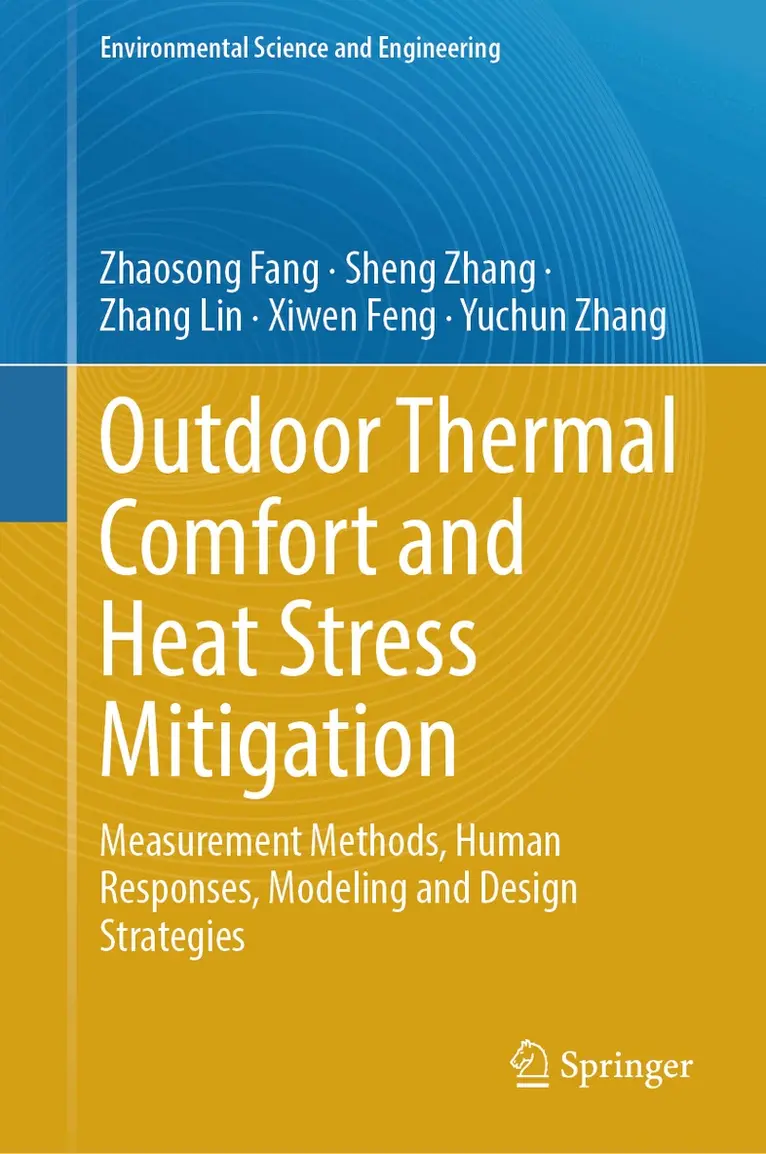
    Outdoor Thermal Comfort and Heat Stress Mitigation

    Measurement Methods, Human Responses, Modeling and Design Strategies

    AvZhaosong Fang,Sheng Zhang

    Inbunden, Engelska, 2026

    Del i serien Environmental Science and Engineering

    1 896 kr

    Beställningsvara. Skickas inom 10-15 vardagar. Fri frakt över 249 kr.

    Beskrivning

    This book provides a comprehensive exploration of methods and insights for understanding and improving thermal comfort in outdoor environments. Outdoor thermal comfort has become an increasingly critical area of research, especially in the context of climate change and urbanization. It presents cutting-edge techniques for measuring environmental parameters, such as radiant temperature and ground temperature, while introducing innovative modifications to established thermal indices like the Physiological Equivalent Temperature Index (PET) and the Universal Thermal Climate Index (UTCI). The book also delves into human factors such as metabolic rates and behavioral adaptations, offering a nuanced perspective on the interaction between individuals and their thermal environment. Distinguished by its integration of real-world case studies, validated models, and practical design guidelines, this book features a rich array of illustrations, comparative analyses, and novel frameworks for urban cooling and heat stress mitigation. Its value lies in equipping readers with the tools to assess thermal comfort more effectively, design climate-resilient spaces, and promote safer outdoor environments. Targeted at researchers, urban planners, environmental engineers, and policymakers, this book serves as both a foundational resource for academic study and a practical guide for professionals addressing the challenges of outdoor thermal comfort.

    Produktinformation

    • Utgivningsdatum:2026-05-23
    • Mått:155 x 235 x 30 mm
    • Vikt:973 g
    • Format:Inbunden
    • Språk:Engelska
    • Serie:Environmental Science and Engineering
    • Antal sidor:463
    • Förlag:Springer Verlag, Singapore
    • ISBN:9789819588985

    Utforska kategorier

    • Folkhälsa och hälsopedagogik inom Medicin
    • Maskinteknik och material inom Naturvetenskap och teknik
    • Byggnadsteknik inom Naturvetenskap och teknik

    Mer om författaren

    Dr. Zhaosong Fang received his B.E. degree in Building Environment and Equipment Engineering from Guangzhou University in 2005, his M.E. and Ph.D. degree in the same field from Chongqing University in 2008 and 2014, respectively. From May 2015 to May 2017, he served as a Postdoctoral Research Fellow at the City University of Hong Kong. Since July 2014, he has been with the School of Civil Engineering at Guangzhou University, now as a Professor and Deputy Director of the Building Equipment Engineering Department. Dr. Fang’s research focuses on thermal comfort and thermal safety evaluation in built environments, energy-efficient HVAC systems, and enhanced heat transfer mechanisms. His recent research includes studying human thermal stress adaptation in high-temperature environments, optimization of air-source heat pump systems, and the development of sustainable HVAC technologies. He contributed to the 2019 Guangdong Residential Building Energy-Saving Standards. Dr. Sheng Zhang received his B.E. degree in Energy and Environment Application Engineering from Zhejiang University in 2014, and his Ph.D. degree in Building Services from City University of Hong Kong in 2020. He has been at Xi’an Jiaotong University as a professor since February 2021. Dr. Zhang’ research interest focuses on indoor environment quality oriented low-carbon building technology, and his academic achievements include developing adaptive – rational thermal comfort models; developing systematic ventilation performance indices; proposing control principles and methods of non-uniform collective thermal environment for individual thermal preferences; proposing mechanisms and methods for non-pandemic and pandemic ventilation control; air source and ground source based renewable heating and cooling energy systems.Prof. Zhang Lin is the Chair Professor in Built Environment at City University of Hong Kong. Prof. Lin received his B.E. degree in Air Conditioning from Tsinghua University in 1983 and his Ph.D. degree in Processing and Environmental Technology from Massey University in 1995. Prof. Lin’s research interests are Built Environment and Renewable Energy Systems, including advanced air distribution, indoor and outdoor thermal comfort, indoor air quality, solar energy systems, etc. Prof. Lin is among the world’s Top 2% scientists. He is a member of the American Society of Heating, Refrigeration, and Air Conditioning Engineers, the Institution of Engineers of Australia, the Hong Kong Institution of Engineers, the Extended Building Committee, Building Department, the Hong Kong SAR government, etc. Prof. Lin is an editorial board member of the journals Building Simulation, and Buildings.Dr. Xiwen Feng received his B.Eng. and M.Eng. degree from Guangzhou University in 2015 and 2018, respectivel, and his Ph.D. in Heating, Ventilation, Air Conditioning, and Gas Supply Engineering at Tongji University, Shanghai, China, in 2023. Dr. Feng's research focuses on outdoor thermal environment, outdoor thermal comfort, and heat radiation transfer. He received National Scholarship, the Outstanding Graduate Award from Tongji University, and the Outstanding Design Award at the 15th MDV Central Air Conditioning Design Application Competition.Ms. Yuchun Zhang received her B.E. and M.E. degrees from Guangzhou University in 2018 and 2021, respectively and is currently pursuing her Ph.D. degree in Architecture and Civil Engineering at City University of Hong Kong, under the supervision of Professor John Z. Lin. She focuses on the research of thermal comfort and thermal safety evaluation in built environments, particularly in ventilation systems and airflow organization. Her recent research interests include: human thermal comfort under dynamic metabolic conditions, optimization of thermal index models, and the performance of ventilation systems in transitional and stratified environments.

    Innehållsförteckning

    • Part I: Overview of outdoor thermal comfort research.- 1. Research progress in outdoor thermal comfort.- Part II: Measurement of outdoor thermal environment parameters.- 2. Measuring disturbed wind speed around people outdoors: Differences from natural wind in thermal comfort evaluation.- 3. Ground temperature and ground view factor in outdoor thermal environment evaluations.- 4. Techniques for radiant temperature measurement: Validation and comparative analysis.- Part III: Human factors in outdoor thermal comfort.- 5. Role of human factors in thermal comfort: Metabolic rate and activity levels.- 6. Influence of clothing insulation on thermal comfort in outdoor thermal environments.- 7. Impact of seasonal variations on human outdoor thermal comfort.- 8. Exploring thermal comfort and pleasure in outdoor thermal environments.- Part IV: Modification/calibration methods of outdoor thermal comfort model.- 9. Exploring the applicability of the classic PMV model in outdoor thermal environments and proposing correction suggestions.- 10. Comparative analysis of outdoor thermal indices and their applicability in evaluating outdoor thermal sensations.- 11. Adaptive-rational outdoor thermal comfort model.- 12. Improved thermal index models for outdoor thermal comfort evaluation: calibration of simulation results using experimental data.- Part V: Exploring thermal comfort and safety in various outdoor scenarios.- 13. Thermal comfort and safety in outdoor commuting activities.- 14. Thermal comfort and safety for high-intensity outdoor laborers.- 15. Thermal comfort and safety for outdoor high-intensity student military training.- Part VI: Design strategies and implications.- 16. The mitigating effect of shaded spaces (including solar-induced shadows from trees and buildings) on thermal discomfort in urban construction.- 17. Practical strategy to generate a cooling effect for mitigating outdoor heat stress.- 18. The role of building overhead layer in improving thermal comfort in urban planning.- 19.  Concluding remarks and future prospects for outdoor thermal comfort research.