• Fri frakt över 249 kr
  • •
  • Snabba leveranser
  • •
  • Billiga böcker
Kundservice

Du är på sajten för privatpersoner.

Företag, bibliotek eller offentlig verksamhet?

Du handlar på classic.bokus.com, där alla dina funktioner finns intakta.
Till classic.bokus.com
Bokus logotyp. Gå till startsidan.
  • Erbjudanden
  • Nyheter
  • Student
  • Topplistor
  • Barn & ungdom
  • Bokus Play
  • E-böcker
  • Pocketböcker
  • Spel & pussel

10% rabatt på allt med kod NYSTART10 →

Sidfot

Mina sidor

    Hjälp

    • Kundservice
    • Vanliga frågor och svar
    • Frakt och leverans
    • Retur vid ångerrätt
    • Reklamera vara
    • Betalning
    • Köpvillkor
    • Allmänna villkor
    • Information om webbplatsens tillgänglighet

    Om Bokus

    • Om oss
    • Pressrum
    • För studenter
    • För företag
    • För bibliotek och offentlig verksamhet
    • För leverantörer
    • Hållbarhet

    Populärt

    • Aktuella erbjudanden
    • Presentkort
    • Studentlitteratur
    • Nya böcker
    • Topplistor
    • Signerade böcker
    • Engelska böcker

    Inspiration

    • Boktips
    • BookTok
    • Populära bokserier
    • Barnbokskaraktärer
    • Populära författare
    Logotyp för Bokus
    Följ oss på Facebook (extern länk)Följ oss på Instagram (extern länk)Följ oss på YouTube (extern länk)Följ oss på TikTok (extern länk)
    bokus @ CookiesAnpassa cookiesIntegritetspolicyKöpvillkor
    Till Citymail hemsida (extern länk)Till Budbee hemsida (extern länk)Till Postnord hemsida (extern länk)Till Schenker hemsida (extern länk)Till Early Bird hemsida (extern länk)Till Walleys hemsida (extern länk)
    1. Samhälle och politik
    2. Samhälle och kultur
    3. Kultur och medier
    4. Referensverk och tvärvetenskap

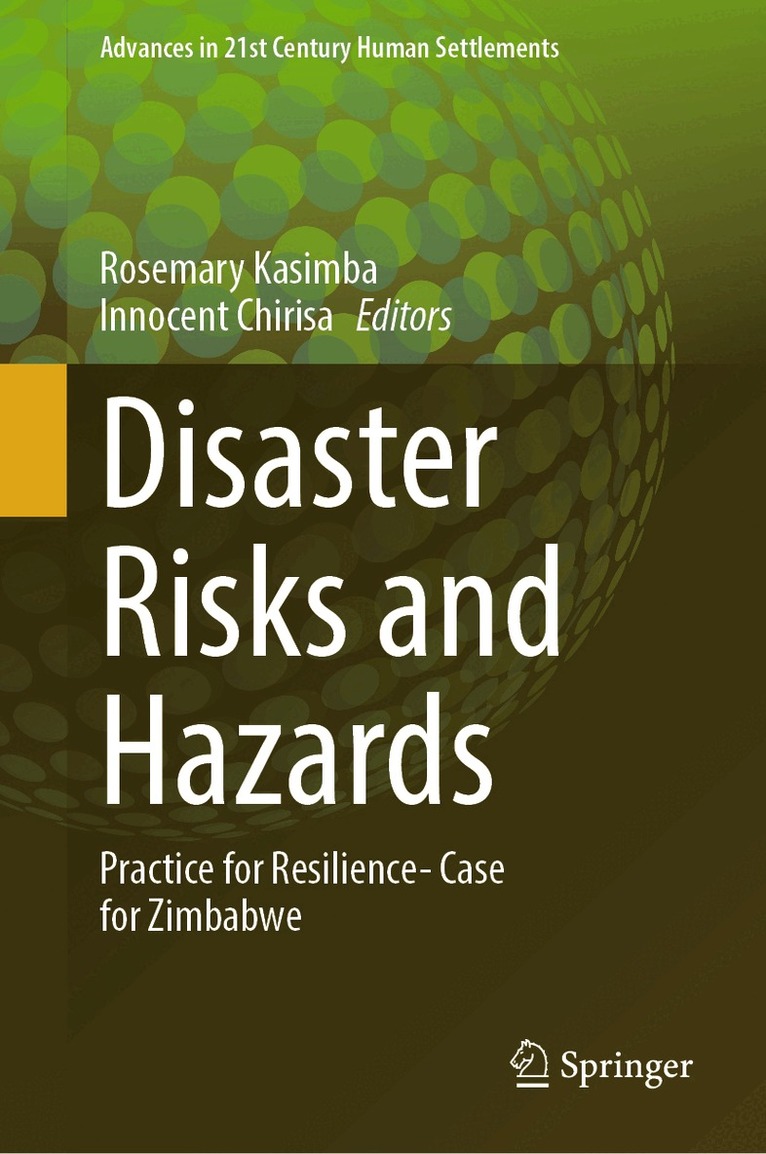
    Disaster Risks and Hazards

    Practice for Resilience- Case for Zimbabwe

    AvRosemary Kasimba,Innocent Chirisa

    Inbunden, Engelska, 2025

    Del i serien Advances in 21st Century Human Settlements

    1 731 kr

    Beställningsvara. Skickas inom 10-15 vardagar. Fri frakt över 249 kr.

    Beskrivning

    This book discusses disaster risks and hazards as well as measures to increase people’s resilience. The 21st Century has experienced a number of disasters that resulted in hampering socio-economic development, the loss of lives and property, hence they are a threat to sustainable development. Disaster risk management efforts and practices have failed to arrest the underlying drivers of increased global risk. No country is immune to disaster risk; thus, resilience has become a critical component of disaster management. It provides an opportunity to confront the social-ecological foundations of disasters. However, it has been vaguely conceptualised, and lacks a concrete approach to operationalization. Some developing countries are gradually coming to realise that preparedness, hazard mapping, prediction, risk and vulnerability assessment and   planning are critical for increasing resilience and reducing losses following disasters. A paradigm shift is required from reactionary to proactive measures in disaster management as the later focuses more on increasing the resilience of the community. Zimbabwe’s disaster management policy of 1979  is in the process of review following Cyclone Idai in March 2019 and the Corona Virus 19 (COVID-19). Furthermore, the consequences of climate change disaster are being felt with across the world, particularly, developing countries, whose preparatory measures for such disasters are inadequate. Disasters have become inevitable and no country is every country is vulnerable to them. In the event of these disasters, the vulnerable people are at risk  and are affected more as majority of them are not able to cope. In developed countries measures are in place to assist the vulnerable in the event that a disaster strikes. However, Zimbabwe, being a developing country is not able to deal with unpredictable disasters due to lack of resources, hence the need for it to adopt mitigatory and transformative measures to reduce the impact of any form of disasters.

    Produktinformation

    • Utgivningsdatum:2025-06-14
    • Mått:155 x 235 x 23 mm
    • Vikt:633 g
    • Format:Inbunden
    • Språk:Engelska
    • Serie:Advances in 21st Century Human Settlements
    • Antal sidor:298
    • Förlag:Springer Nature Switzerland AG
    • ISBN:9789819645763

    Utforska kategorier

    • Referensverk och tvärvetenskap inom Samhälle och politik
    • Ledarskapsböcker inom Ekonomi och Ledarskap
    • Miljövetenskap och miljöpolitik inom Naturvetenskap och teknik

    Mer om författaren

    Dr. Rosemary Kasimba holds a PhD in Sociology  from Rhodes University, and a Post-Graduate Diploma in Social Work. Her research interests include but not limited to disaster management, peace and security, Sociology and Gender, Migration, Population and Development, Social Policy and Vulnerable Population.Professor Innocent Chirisa is a Full Professor in Social Sciences focusing on Governance, Human Rights, Child Rights, Gender, food security, livelihoods, Environmental Planning and Management in Urban and Regional Planning is currently Vice Chancellor for the Zimbabwe Ezekiel Guti University. Has a keen interest in Human Rights in urban and peri-urban dynamics. Innocent holds a DPhil in Social Sciences (University of Zimbabwe) and PhD in Urban and Regional Planning (University of the Free State, South Africa).

    Innehållsförteckning

    • Chapter 1. Consilience for Resilience for Disaster Risks and Hazards: An Overview.- Chapter 2. Understanding Social Networks and Community Resilience to Pandemics in Zimbabwe.- Chapter 3. Community Based Resilience to Climate Change in Chimanimani District, Zimbabwe.- Chapter 4. Geo-Spatial Science Use for Disaster Risk Management.- Chapter 5. Linking and Mapping Resilience to Strategies for Management of Disasters and Risks in Zimbabwe.- Chapter 6. The Ubiquity of Politics and its effect on Disaster Resilience in Zimbabwe.- Chapter 7. Gender and Disaster Resilience.- Chapter 8. Cyclone Damage Assessment Using High Resolution Satellite Imagery, Drone Technology and GIS: Lessons Learnt.- Chapter 9. The Resilience of Child Protection Systems During the Covid-19 Pandemic: Perspectives of Social Work Practitioners in Zimbabwe.- Chapter 10. Zimbabwe’s Disaster Preparedness, Readiness and Response: Juxtaposing the COVID-19 Pandemic to the 2019 Cyclone Idai.- Chapter 11. COVID-19 Insights on Geriatric Care Systems’ Vulnerabilities and Utility.- Chapter 12. Harnessing Local Knowledge for Resilience Building:  The Case Study of Lower Muzarabani.- Chapter 13. The Impact of Tropical Cyclones on Human Security: A Case of Mozambique and Zimbabwe (2000-2019).- Chapter 14. Natural Resource Governance and Disaster Risk Management in Zimbabwe: Lessons from past experiences.- Chapter 15. Hurdles to Achievement of Climate Justice in Southern Africa and the Search for Possible Solutions.- Chapter 16. Nuancing Urban Informality in light of policy to contain COVID-19 in Zimbabwe.- Chapter 17. The Future of Managing Disasters and Risks in Zimbabwe And Beyond.