• Fri frakt över 249 kr
  • •
  • Snabba leveranser
  • •
  • Billiga böcker
Kundservice

Du är på sajten för privatpersoner.

Företag, bibliotek eller offentlig verksamhet?

Du handlar på classic.bokus.com, där alla dina funktioner finns intakta.
Till classic.bokus.com
Bokus logotyp. Gå till startsidan.
  • Erbjudanden
  • Nyheter
  • Student
  • Topplistor
  • Barn & ungdom
  • Bokus Play
  • E-böcker
  • Pocketböcker
  • Spel & pussel

10% rabatt på allt med kod: NYSTART10 →

Sidfot

Mina sidor

    Hjälp

    • Kundservice
    • Vanliga frågor och svar
    • Frakt och leverans
    • Retur vid ångerrätt
    • Reklamera vara
    • Betalning
    • Köpvillkor
    • Allmänna villkor
    • Information om webbplatsens tillgänglighet

    Om Bokus

    • Om oss
    • Pressrum
    • För studenter
    • För företag
    • För bibliotek och offentlig verksamhet
    • För leverantörer
    • Hållbarhet

    Populärt

    • Aktuella erbjudanden
    • Presentkort
    • Studentlitteratur
    • Nya böcker
    • Topplistor
    • Signerade böcker
    • Engelska böcker

    Inspiration

    • Boktips
    • BookTok
    • Populära bokserier
    • Barnbokskaraktärer
    • Populära författare
    Logotyp för Bokus
    Följ oss på Facebook (extern länk)Följ oss på Instagram (extern länk)Följ oss på YouTube (extern länk)Följ oss på TikTok (extern länk)
    bokus @ CookiesAnpassa cookiesIntegritetspolicyKöpvillkor
    Till Citymail hemsida (extern länk)Till Budbee hemsida (extern länk)Till Postnord hemsida (extern länk)Till Schenker hemsida (extern länk)Till Early Bird hemsida (extern länk)Till Walleys hemsida (extern länk)
    1. Djur och Natur
    2. Naturböcker
    3. Växtböcker

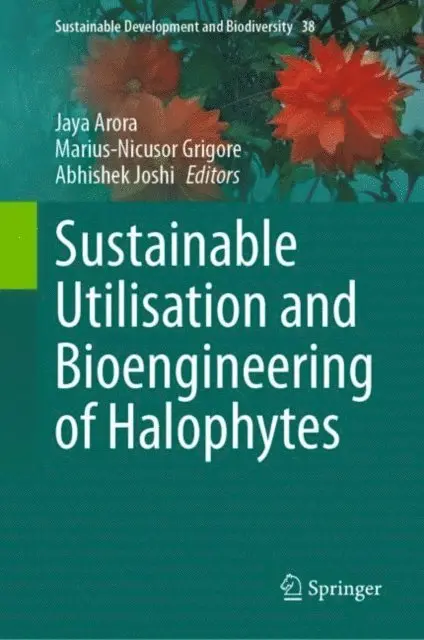
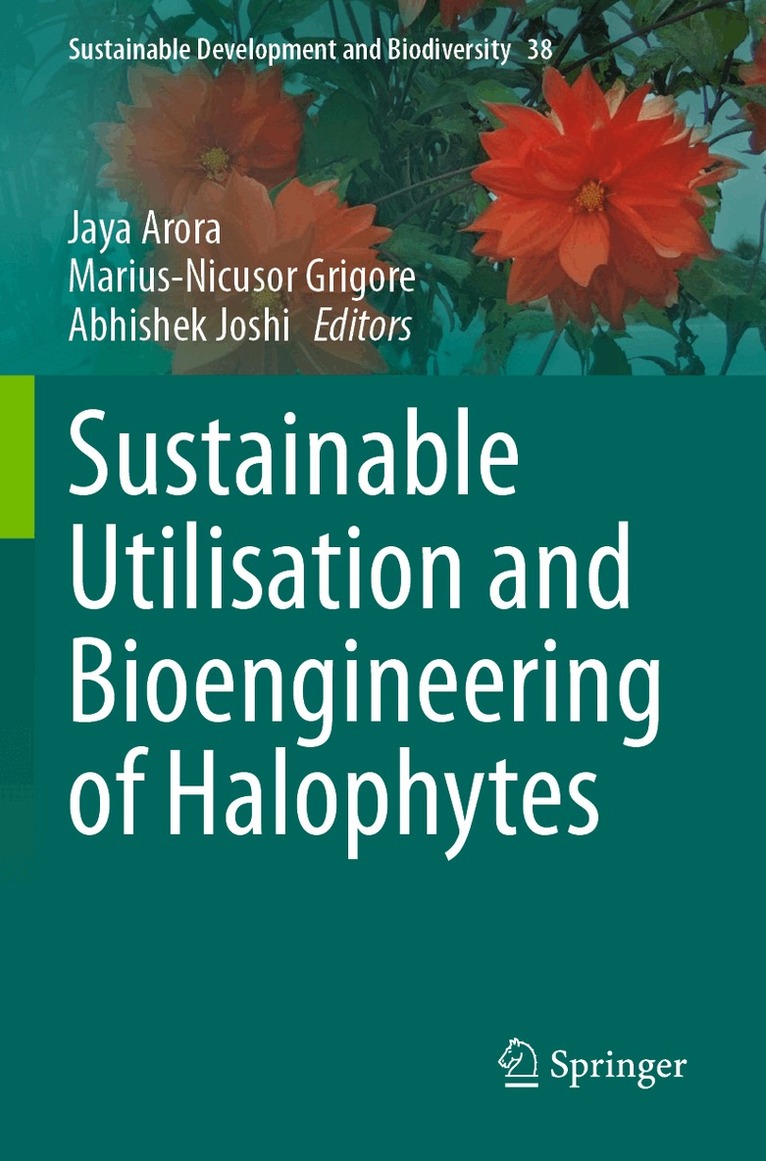
    Sustainable Utilisation and Bioengineering of Halophytes

    AvJaya Arora,Marius-Nicusor Grigore

    Inbunden, Engelska, 2025

    Del 38 i serien Sustainable Development and Biodiversity

    3 243 kr

    Beställningsvara. Skickas inom 10-15 vardagar. Fri frakt över 249 kr.

    Beskrivning

    This book provides a comprehensive overview of the cutting-edge research in the bioengineering of halophytes, with a particular focus on advancements in biotechnology, transcriptomics, proteomics, metabolomics, and genomics.Halophytes are a unique group of plants that have adapted to grow in extreme environmental conditions such as high salt, low water, and high temperatures. In desert conditions, these plants are crucial for supporting animal and human life. However, overexploitation of these plants degrades the ecosystem. Sustainable utilization and improvement of these plants through modern tools are essential for the sustainability of both the plants and the environment. Halophytes possess unique metabolic and physiological features, making them an attractive target for bioengineering. Recent advancements in bioengineering have significantly enhanced the study and manipulation of halophytes. By exploring the intricacies of these technologies, this book addresses key questions and challenges in harnessing the potential of halophytes for sustainable plant resources, environmental remediation, and novel biotechnological applications.This book will be valuable for researchers in plant biology, environmental studies, desertification, plant improvement, and biotechnology.

    Produktinformation

    • Utgivningsdatum:2025-02-15
    • Mått:155 x 235 x 31 mm
    • Vikt:867 g
    • Format:Inbunden
    • Språk:Engelska
    • Serie:Sustainable Development and Biodiversity
    • Antal sidor:454
    • Förlag:Springer Verlag, Singapore
    • ISBN:9789819798186

    Utforska kategorier

    • Växtböcker inom Djur och Natur
    • Biokemi inom Naturvetenskap och teknik
    • Botanik inom Naturvetenskap och teknik

    Mer om författaren

    Dr. Jaya Arora, Assistant Professor, Department of Botany, Mohanlal Sukhadia University, Udaipur, India has been teaching Botany since 2012. She did her M.Sc and Ph.D. in Botany with a specialization in plant tissue culture and secondary metabolite production from Mohanlal Sukhadia University. She had qualified CSIR-NET-SRF and was awarded the Maharana Fateh Singh Award in 2000 for meritorious performance during her matriculation and the Gargi Award and Scholarship for matriculation by Govt. of Rajasthan, India, 2000. She has 14 years of research experience with one UGC start-up completed project (2013-2015) and mentored one Women Scientists Scheme-A project (2016-2019) funded by the Ministry of Science and Technology, Department of Science and Technology, Govt. of India. Currently, she is Co-PI in two different projects funded by MHRD RUSA 2.0, India. Her research group has published research papers in various international repute journals with high impact factors such as Acta Physiologiae Plantarum, In Vitro Cellular & Developmental Biology – Plant, Bioengineered, Frontiers in Plant Science, Nanomaterials, Biofuels, Biologia Futura, Horticulturae, Plants, etc. dealing with plant biotechnology, proteomics (bioactive peptides), natural products, secondary metabolite production, seed biology studies and conservation of medicinal plants. Dr. Arora has edited and authored 6 books including publications with prestigious publishing houses mainly Springer, Cham. This work was funded by various funding agencies like U.G.C., C.S.I.R, and D.S.T. Currently, she is supervising 4 Ph.D. Students and 2 students have been awarded Ph.D. degree.Dr. Marius-Nicusor Grigore is an editor PhD at the ”Alexandru Ioan Cuza” University Press and adjunct professor at the Faculty of Psychology and Educational Sciences and Doctoral School of Biology, from ”Alexandru Ioan Cuza” University of Iași. He received his BSc and PhD in Biology, and M.Sc in Educational Sciences from Alexandru Ioan Cuza University of Iași, Romania. He was subsequently a postdoctoral fellow in the field of halophytes’ ecophysiology at the same university, as well as an invited researcher at the Polytechnic University of Valencia, Spain. His primary research interests are in the ecology, anatomy and physiology of halophytes and plant responses to abiotic (salt, drought) stress, as well as in Didactics of Biology. He has published 11 books, 9 book chapters, and over 80 peer-reviewed papers on halophytes. In 2016, he was awarded the Romanian Academy’s `Emil Racoviță` prize for the book - Halophytes: An Integrative Anatomical Study, published with Springer in 2014; Handbook of Halophytes: From Molecules to Ecosystems towards Biosaline Agriculture, Springer, was awarded the scientific merit `Nicolae Giosan` by The Academy of Agricultural and Forestry Sciences ”Gheorghe Ionescu-Șișești” București, Romania, in November 2022. He coordinated national projects and conducted many scientific missions abroad, at Polytechnic University of Valencia, Spain, in the field of biochemistry and ecophysiology of halophytes and plant responses to salt stress.Dr. Abhishek Joshi is currently associated with research and teaching at the Department of Botany, Mohanlal Sukhadia University, Udaipur, India. He did his M.Sc and Ph.D. in Botany with a specialization in plant tissue culture and secondary metabolite production from Department of Botany, Mohanlal Sukhadia University. Joshi's doctoral research was focused on unravelling the biochemical and molecular mechanisms that enable halophytes to thrive in saline conditions. He has 10 years of research experience on halophytes occurring in Southern Rajasthan of Indian subcontinent with 1 e-book, and 34 publications in international repute journals and books, with one edited book published with a prestigious publishing house.

    Innehållsförteckning

    • Section I. Biology and Biotechnology of Halophytes.- Chapter 1. Introduction to Halophytes.- Chapter 2. Common Halophytes of Western India and their Utilisation.- Chapter 3. Halophyte Biotechnology for Environmental Restoration.- Chapter 4. Halophyte Bioengineering for Crop Improvement.- Chapter 5. Bioengineering of Halophytes for Bioactive Molecules and Bioenergy production.- Chapter 6. Biological and Ecological aspects of Halophyte-Microbiome Interaction: Adaptation versus Climate change.- Chapter 7. Applications of endophytes associated with Halophyte for sustainable agriculture.- Chapter 8. Bioengineering of Halophytes in Türkiye: A Case Study on the Leguminous Halophytes and their Economic Potential.- Chapter 9. Salinity Stress Response in some Romanian Tree Species: A Case Study.- Section II. Genomics of Halophytes.- Chapter 10. Genetic manipulation in Halophytes for abiotic stress tolerance: An overview.- Chapter 11. Molecular Networks and Signalling Pathways in Halophytes.- Chapter 12. Mangroves: Biodiversity and Omics Insights.- Section III. Metabolomics, Proteomics and of Nanomaterials of Halophytes.- Chapter 13. Metabolomic insights into salt adaptation in halophytes.- Chapter 14. Synthesis and applications of Phytonanoparticle: Perspective on Halophytes.- Chapter 15. Green Synthesis of Metal and Metal Oxide Nanoparticles using Halophytes and Other Salt-Tolerant Plants and Their Applications.- Chapter 16. Halophytes in the Bioeconomy - new opportunity and challenge for Agriculture.- Chapter 17. Bioengineering of Halophytes: Recent advancements and Future Perspective.