Beställningsvara. Skickas inom 10-15 vardagar. Fri frakt över 249 kr.
Beskrivning
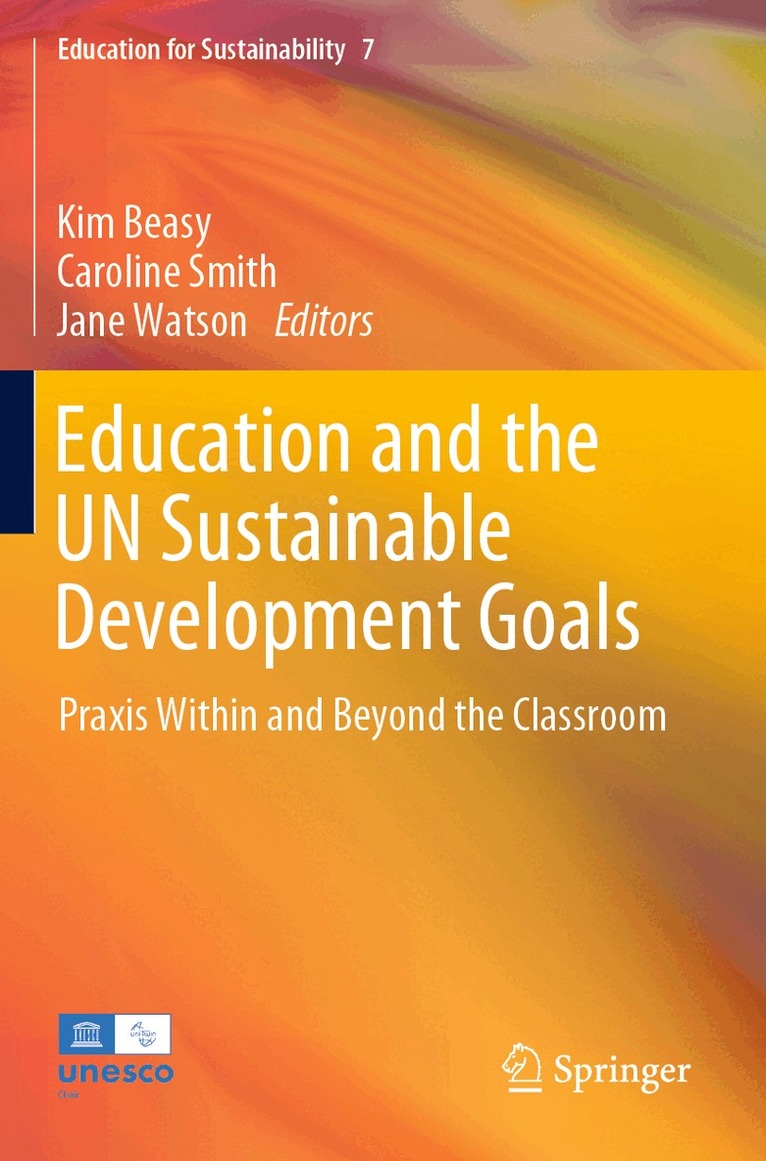
This book focuses on the complex relationship between education and the Sustainable Development Goals (SDGs) and highlights how important context is for both critiquing and achieving the Goals though education, given the critical role teachers, schools and curriculum play in young people’s lives.
Dr Kim Beasy is Senior Lecturer in education at the University of Tasmania, specialising in equitable education and education for sustainability. Kim began her career teaching environmental sustainability in a vocational education institution before undertaking a PhD exploring interpretations and practices of sustainability across diverse social contexts. She has developed and taught sustainability education in higher education now for over 10 years.Kim has published extensively on education for sustainable development and has delivered a number of research and publication initiatives. Since 2018, she has published 20 peer-reviewed publications and in 2019 was University of Tasmania Early Career Researcher Award Recipient. Kim was instrumental in Tasmania’s establishment of Education for Sustainability Tasmania, a United Nations University Recognised Centre of Expertise in Education for Sustainable Development, is Co-Director of the international program—Global ClimateChange Week and a core team member of Curious Climate Schools.Dr Caroline Smith is Senior Lecturer in education at the University of Tasmania, specialising in science and sustainability education. Previously, Caroline was instrumental in developing and teaching sustainability-focused courses at Australian Catholic University and at the National Centre for Sustainability at Swinburne University. With others, her work has resulted in a number of sustainability education-related awards, including Green Gowns at the University of Tasmania; Swinburne University of Technology’s Vice Chancellor's Award for Teaching Excellence, and an Australian Learning and Teaching Council (ALTC) citation award for leadership in the development and implementation of Education for Sustainability within pre-service and in-service teacher education.Caroline has written extensively on a variety of aspects sustainability education in peer-reviewed papers and articles for the education profession and was the regular science writer for EarthSong Journal for 10 years. She has been active in the permaculture community for some 30 years as a teacher and designer, and co-edited a book on Permaculture Pioneers.Currently, she is working with a University of Queensland-based agriculture project developing Plant Health Clinic training for the Pacific Islands, that aims to help farmers reduce their dependence on pesticides.Dr Jane Watson is a Professor Emeritus in the School of Education at the University of Tasmania and a Fellow of the Academy of the Social Sciences in Australia, with 50 years of teaching and research in mathematics and statistics education. She believes that numeracy and statistical literacy are critical to participation in decision-making in the complex world facing climate change and the issues of the other areas addressed in the SDGs. Jane’s work in this area has included classroom research with Grade 5 students, who devised their own measures, based on an Australian Bureau of Statistics student survey, for determining whether Australian students are “environmentally friendly”. They carried out the investigations with their classes, as well as with random samples from across Australia. A paper based on this activity won the Best Paper of 2016 award in the Journal of Statistics Education, sponsored by the American Statistical Association. Jane’s background in educational research and producing resources for teachers complements the work of the other two editors.
Innehållsförteckning
Why write a book on SDG education.- The SDGs in a post liberal world.- Indigenous knowledges and the SDGs.- Shooting for the STARS: Implementation of the SDGs at a university through a whole of organisation approach.- Systemic sidelining of sustainability education in secondary schools: Learning from student voices.- Searching for Sustainability in a digital world: a closer look at the United Nations SDG website.- The role of language education in sustainable development.- Developing sustainable approaches with pre-service teachers: Reflection on a teacher education unit on classroom management.- ICT and social media literacy for sustainable development.- What does this graph mean and why should we care.- Genre-based literacy through gradual release of responsibility: Promoting social justice and quality education.- Awareness levels of SDG 4.7 in Indian teachers: A small qualitative study.- Key findings and implications.- A summary of the main points and issues.