• Fri frakt över 249 kr
  • •
  • Snabba leveranser
  • •
  • Billiga böcker
Kundservice

Du är på sajten för privatpersoner.

Företag, bibliotek eller offentlig verksamhet?

Du handlar på classic.bokus.com, där alla dina funktioner finns intakta.
Till classic.bokus.com
Bokus logotyp. Gå till startsidan.
  • Erbjudanden
  • Nyheter
  • Student
  • Topplistor
  • Barn & ungdom
  • Bokus Play
  • E-böcker
  • Pocketböcker
  • Spel & pussel

10% studentrabatt med kod TERM26

Sidfot

Mina sidor

    Hjälp

    • Kundservice
    • Vanliga frågor och svar
    • Frakt och leverans
    • Retur vid ångerrätt
    • Reklamera vara
    • Betalning
    • Köpvillkor
    • Allmänna villkor
    • Information om webbplatsens tillgänglighet

    Om Bokus

    • Om oss
    • Pressrum
    • För studenter
    • För företag
    • För bibliotek och offentlig verksamhet
    • För leverantörer
    • Hållbarhet

    Populärt

    • Aktuella erbjudanden
    • Presentkort
    • Studentlitteratur
    • Nya böcker
    • Topplistor
    • Signerade böcker
    • Engelska böcker

    Inspiration

    • Boktips
    • BookTok
    • Populära bokserier
    • Barnbokskaraktärer
    • Populära författare
    Logotyp för Bokus
    Följ oss på Facebook (extern länk)Följ oss på Instagram (extern länk)Följ oss på YouTube (extern länk)Följ oss på TikTok (extern länk)
    bokus @ CookiesAnpassa cookiesIntegritetspolicyKöpvillkor
    Till Citymail hemsida (extern länk)Till Budbee hemsida (extern länk)Till Postnord hemsida (extern länk)Till Schenker hemsida (extern länk)Till Early Bird hemsida (extern länk)Till Walleys hemsida (extern länk)
    1. Naturvetenskap och teknik
    2. Geovetenskap
    3. Miljövetenskap och miljöpolitik

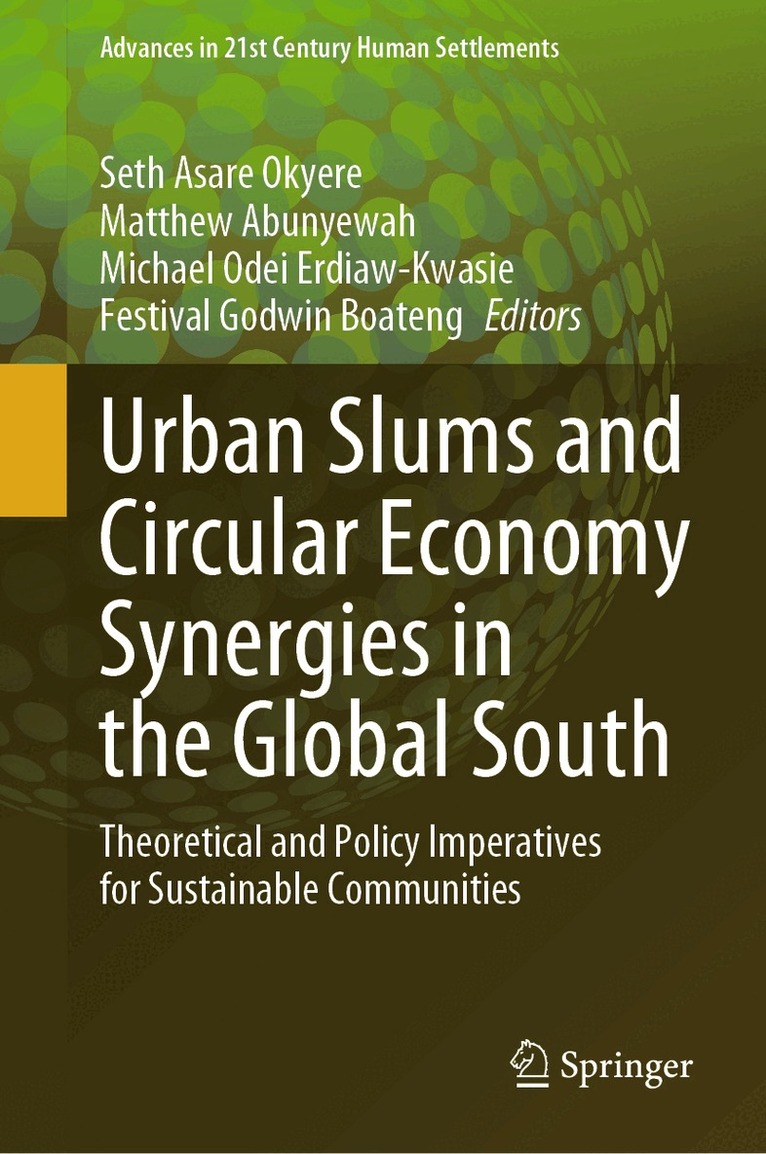
    Urban Slums and Circular Economy Synergies in the Global South

    Theoretical and Policy Imperatives for Sustainable Communities

    AvSeth Asare Okyere,Matthew Abunyewah

    Inbunden, Engelska, 2024

    Del i serien Advances in 21st Century Human Settlements

    1 526 kr

    Beställningsvara. Skickas inom 10-15 vardagar. Fri frakt över 249 kr.

    Beskrivning

    This book takes a theoretical and empirical distance from urban slums/low-income settlements as a threat to environmental sustainability and recast them as places where environmentally rehabilitative and circular practices occur—drawing on the theoretical lens of the circular economy (CE). CE is defined as regenerative system that minimizes waste, emission, and energy leakage by slowing, closing, and narrowing material and energy loops. In principle, CE departs from the traditional linear model of take-make-use-dispose. As conceived in urban contexts, circular cities offer possibilities to regenerate natural systems, design out waste, and keep products in use. While the CE key principles of reduce, repair, and reuse are essential to the sustainable and inclusive interventions in urban slums, there is lack of case studies exploring the role of place and agency, especially the slum living-CE nexus in global south contexts. In inequitable urban transitions, a nuanced understanding of thesynergies between urban slums and the circular economy is not only theoretically relevant for reconceptualizing the slum in urban sustainability discourses but also exert policy and practice ramifications to decidedly figure out how the urban slum phenomenon can foster the sustainable and inclusive development of marginal areas through contextual and people-centered initiatives.

    Produktinformation

    • Utgivningsdatum:2024-04-16
    • Mått:155 x 235 x 19 mm
    • Vikt:518 g
    • Format:Inbunden
    • Språk:Engelska
    • Serie:Advances in 21st Century Human Settlements
    • Antal sidor:207
    • Upplaga:2024
    • Förlag:Springer Verlag, Singapore
    • ISBN:9789819990245

    Utforska kategorier

    • Miljövetenskap och miljöpolitik inom Naturvetenskap och teknik
    • Regionalt styre och förvaltning inom Samhälle och politik
    • Digital ekonomi inom Ekonomi och Ledarskap

    Mer om författaren

    Dr. Seth Asare Okyere is an international development planner whose work thematically cuts across social equity, resilience, and sustainability to cross-pollinate ideas and action for just and sustainable communities in the global south. He has extensive experience across academia, policy agencies, and non-governmental organisations conducting transformative research, leading international expert teams, coordinating international joint projects, and engaging local communities to build capacity for sustainable development. The breadth and depth of experiences span cities and communities in Africa, Europe, Asia, and North America. Seth is in pursuit of the sustainable development of vulnerable communities within mission-focused approaches to co-producing equitable, resilient, and place-based solutions. Seth holds a Ph.D. in Urban Development Planning (Osaka University, Japan) and an MSc in Urban Planning and Policy Design (Polytechnic University of Milan, Italy). He is currently a Visiting Assistant Professor (University of Arizona, USA) and an adjunct Associate Professor (Osaka University, Japan). Dr. Matthew Abunyewah is a research-focused lecturer at the Australasian Centre for Resilience Implementation for Sustainable Communities within the College of Health and Human Sciences, Charles Darwin University. He leverages participatory and interdisciplinary research approaches to inform government policies on disaster management and resilience, circular economy and sustainability, community development, industry and business development, and climate change and variability. Before joining Charles Darwin University, Dr. Abunyewah worked as a community and industry development practitioner researching workforce and training development, public policy development and disaster resilience across Africa and Australia for over eight years. Notable industry research outputs/reports produced by Dr. Abunyewah in collaboration with industry partners and government agencies include the Northern Territory Central Five Mines Report and Northern Territory Circular Economy Strategy. Dr. Michael Odei works at the intersection of global development and business sustainability.  For ten years, in industry and academia, he has applied a multi-disciplinary lens to business sustainability and global development approaches to identify the tools, models, metrics, and indicators that create the greatest value for businesses, society, and the environment. Prior to joining Charles Darwin University, Dr. Odei worked on Transparency International (TI)’s Mining for Sustainable Development (M4SD) Programme as a research and policy coordinator.Dr. Festival Godwin Boateng is a critical postcolonial institutional political economist, specializing in sustainable development in Africa. He approaches questions about Africa’s development by linking dots discursively and systematically from the past to the present and from the local to the global toprovide a critical account of the inherited/historical, internal, and external factors which intersecting interplays and resulting transformations are determining socio-legal-cultural and political-economic outcomes in the continent. Some of his works have appeared in prestigious journals like World Development; International Journal of Disaster Risk Reduction and Nature: Humanities and Social Sciences Communications. His current research at Columbia University’s Earth Institute focuses on cleaner, safer, and affordable mobility in Africa.

    Innehållsförteckning

    • Introduction: The embeddedness of circularity in everyday slum living in Global South cities.- Linking informal settler practices and circular principles in Global South: Lessons from Asian and Latin American Cities.- Modern Vernacular Architecture and Circular Economy in Informal Settlements.- Exploring Circular Economy Awareness, Perceptions and Practices in Selected Urban Slums in Kigali City of Rwanda.- Recycling from Construction and Demolition (C&D) Waste: Exploring the Scope of Circular Management in Constructing Slum Dwellings of Dhaka.- Circularities in Housing Transformation Practices: A Synergetic Review.- Circular economy in Africa’s informal cities: A review of residents' value retention practices and their implications for participatory urban planning.- Circularizing livelihoods: Transforming agricultural residues to electricity in low-income periurban areas of Uganda.- Metropolitan Cartography: A novel approach for assessing how new morpho-types solutions impact the circular city agenda. The Ouagadougou Case Study.- Closing the policy-implementation gaps in e-waste management: Implications for circular economy and sustainability in urban Ghana.- Towards Just Circular Transitions in the of Slums Global South Cities.