A.C. Stickland – författare
Visar alla böcker från författaren A.C. Stickland. Handla med fri frakt och snabb leverans.
3 produkter
3 produkter
E-bok
PDF, Engelska, 2013356 kr
Läs direkt efter köp
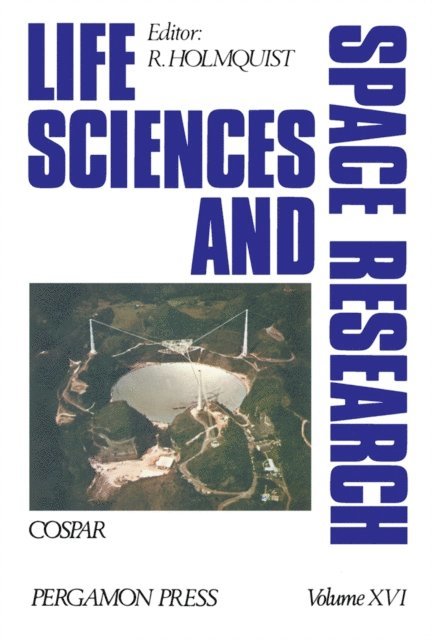
Cospar Life Sciences and Space Research, Volume XVI covers the proceedings of the Open Meetings of the Working Group on Space Biology of the 20th Plenary Meeting of COSPAR, held in Tel Aviv, Israel, on June 7-18, 1977. The book focuses on the developments in space explorations; approaches for the creation of extraterrestrial intelligence; and biochemical mechanism of the visual-light-flash phenomena.The selection first discusses the Viking Lander biology experiments on Mars. The experiments returned detailed picture of the Martian soil surface chemistry. The text also takes a look at a preliminary search for narrowband signals at microwave frequencies; observational program options and system requirements for the search of extraterrestrial intelligence; and public health considerations related to a Mars surface sample return mission. The book reviews planetary protection guidelines for outer planet missions, including Viking clean room technology, efficacy of clean room assembly, and Jupiter Orbiter Probe PP appraisal. The text also focuses on the effects of temperature, salinity, and other factors on the growth and formation of UV-absorbing substances by the fungus aspergillus; effects of gravitational and magnetic fields on transplanted neuroblastoma vascularity; and the roles of body mass and gravity in identifying the energy requirements of homoiotherms.The selection is a dependable reference for readers interested in space research.
E-bok
PDF, Engelska, 20131 416 kr
Läs direkt efter köp
This volume includes original papers presented at the 4th Symposium on Satellite Dynamics held at the XII Annual Plenary Meeting of COSPAR. At a time where it might be thought that very few problems were left un solved in celestial mechanics, we discover that new and more challenging questions must be answered. The pre cision of observations reaches the centimeter level and physical phenomena which had been disregarded come into play. We need a better treatment of atmospheric drag, radiation forces, and a better knowledge of the earth''s gravitational field. Time has to be precisely defined as well as reference systems, including improved values for precision and nutation. The question of resonances introduced by nonzonal harmonics was to be carefully in vestigated. Numerical integration techniques must be optimized and means of controlling their errors improved. Analytical techniques must be made appropriate for com puter processing. Presently existing methods of solu tions of differential equations of interest to celestial mechanics are getting cumbersome as all these new facts come to light. It is clear that entirely new and more effective methods are necessary. These methods must, among other requirements, take into account the essential nonlinear character of the equations. Finally, the mo tion about the center of mass of a satellite is becoming an essential need for the thorough understanding and de scription of the orbital motion.
Häftad, Engelska, 2012
1 084 kr
Skickas inom 10-15 vardagar
This volume includes original papers presented at the 4th Symposium on Satellite Dynamics held at the XII Annual Plenary Meeting of COSPAR. At a time where it might be thought that very few problems were left un solved in celestial mechanics, we discover that new and more challenging questions must be answered. The pre cision of observations reaches the centimeter level and physical phenomena which had been disregarded come into play. We need a better treatment of atmospheric drag, radiation forces, and a better knowledge of the earth's gravitational field. Time has to be precisely defined as well as reference systems, including improved values for precision and nutation. The question of resonances introduced by nonzonal harmonics was to be carefully in vestigated. Numerical integration techniques must be optimized and means of controlling their errors improved. Analytical techniques must be made appropriate for com puter processing. Presently existing methods of solu tions of differential equations of interest to celestial mechanics are getting cumbersome as all these new facts come to light. It is clear that entirely new and more effective methods are necessary. These methods must, among other requirements, take into account the essential nonlinear character of the equations. Finally, the mo tion about the center of mass of a satellite is becoming an essential need for the thorough understanding and de scription of the orbital motion.