A.D. Boardman - Böcker
Visar alla böcker från författaren A.D. Boardman. Handla med fri frakt och snabb leverans.
4 produkter
4 produkter
Del 61 - NATO Science Partnership Subseries: 3
Advanced Photonics with Second-Order Optically Nonlinear Processes
Häftad, Engelska, 1998
536 kr
Skickas inom 10-15 vardagar
The community of research workers interested in solitons and signal processing came to realize that there is more to the behaviour of crystals displaying second-order nonlinearity than creating second-harmonic sources. It turns out that there are also soliton - or, more correctly, solitary wave - solutions to the coupled equations which involve a balance between the fundamental wave and the co-propagating second-harmonic wave. Second-order nonlinearity, then, is attracting a lot of interest, both in the more traditional phase-matching requirements needed to generate second-harmonic waves very efficiently - see the drive to the blue laser or its alternatives - and in the new area of solitary waves. This volume is devoted to three main themes: solitons, quasi-phase matching, frequency conversion and parametric interactions. The material has been written by distinguished contributors and the range of topics, together with the emphasis put on them, should give the reader a depth of understanding firmly rooted in the basic material.
Del 31 - NATO Science Series II: Mathematics, Physics and Chemistry
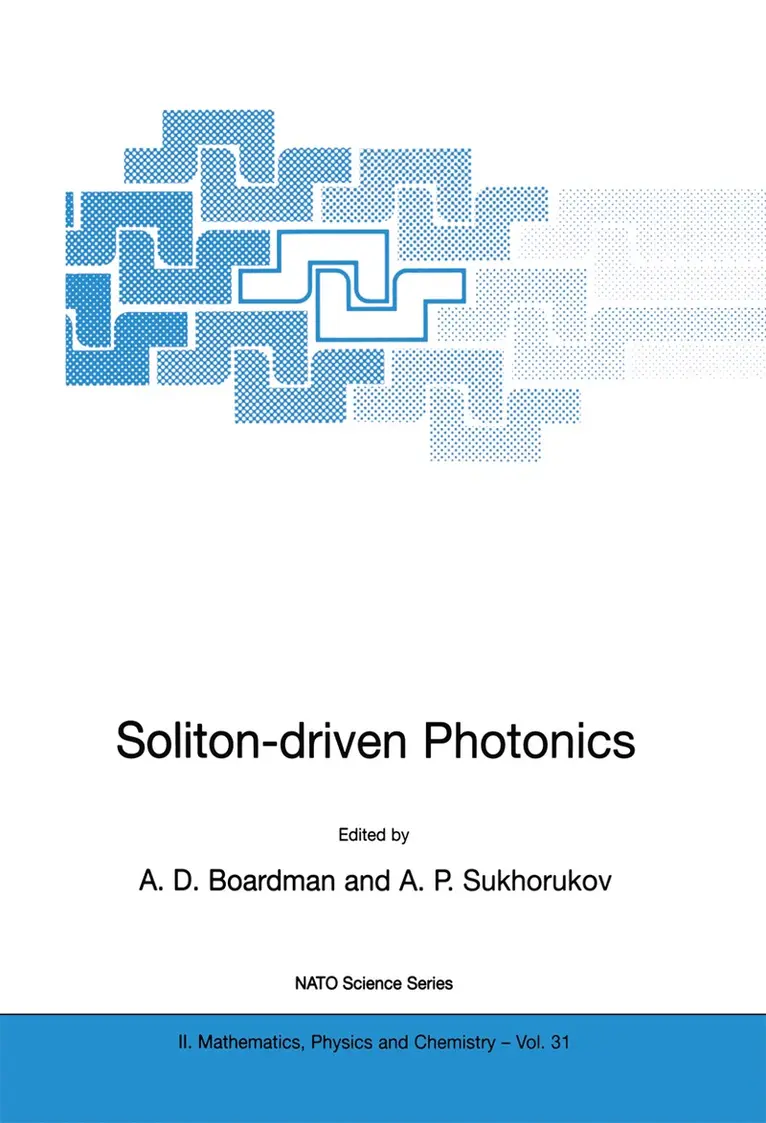
Soliton-driven Photonics
Inbunden, Engelska, 2001
2 101 kr
Skickas inom 10-15 vardagar
This text provides basic and novel ideas on how to use spatial solitons. The emphasis is on both mathematical and physical formulations, concentrating on diffraction-based spatial effects. The text shows how important self-focusing is, and how to see it in operation, in simulation and experimentally. The use of spatial solitons is driven by the need for all-optical, chip-based processing. With its wide-ranging treatment, from magneto-optics to fascinating vortex phenomena, the book is a repository of information. It should prove a valuable asset in any research laboratory interested in all-optical, chip-level processing.
2 101 kr
Skickas inom 10-15 vardagar
This text provides basic and novel ideas on how to use spatial solitons. The emphasis is on both mathematical and physical formulations, concentrating on diffraction-based spatial effects. The text shows how important self-focusing is, and how to see it in operation, in simulation and experimentally. The use of spatial solitons is driven by the need for all-optical, chip-based processing. With its wide-ranging treatment, from magneto-optics to fascinating vortex phenomena, the book is a repository of information. It should prove a valuable asset in any research laboratory interested in all-optical, chip-level processing.
536 kr
Skickas inom 10-15 vardagar
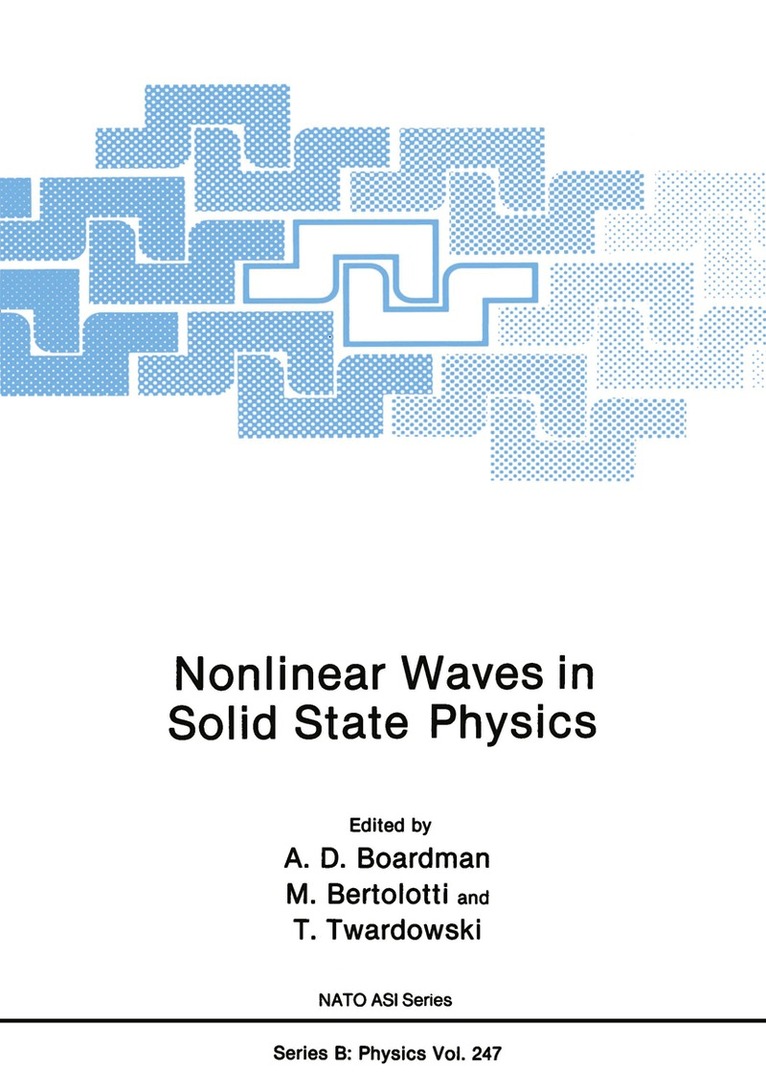
This book is based on the contributions to the 17th International School of Materials Sci ence and Technology, entitled Nonlinear Waves in Solid State Physics. This was held as a NATO Advanced Study Institute at the Ettore Majorana Centre in Erice, Sicily between the st th 1 and 15 July 1989, and attracted almost 100 participants from over 20 different countries. The book covers the fundamental properties of nonlinear waves in solid state materials, dealing with both theory and experiment. The aim is to emphasise the methods underpinning the important new developments in this area. The material is organised into subject areas that can broadly be classified into the following groups: the theory of nonlinear surface and guided waves in self-focusing magnetic and non-magnetic materials; nonlinear effects at in terfaces; nonlinear acoustoelectronic and surface acoustic waves; Lagrangian and Hamiltonian formulations of nonlinear problems; nonlinear effects in optical fibres; resonance phenomena; and nonlinear integrated optics. The chapters have been grouped together according to these classifications as closely as possible, but it should be borne in mind that although there is much overlap of ideas, each chapter is essentially independent of the others. We would like to acknowledge the sponsorship of the NATO Scientific Affairs Division, the European Physical Society, the National Science Foundation of the USA, the European Research Office, the Italian Ministry of Education, the Italian Ministry of Scientific and Technological Research, the Sicilian Regional Government and the Ugo Bordoni Foundation.