Adrienne HA(c)ritier – författare
Visar alla böcker från författaren Adrienne HA(c)ritier. Handla med fri frakt och snabb leverans.
3 produkter
3 produkter
E-bok
PDF, Engelska, 2012626 kr
Läs direkt efter köp
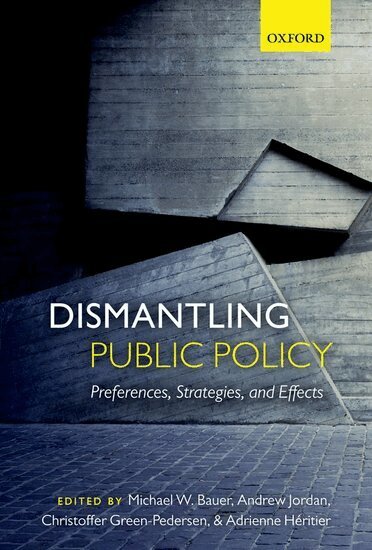
Policy dismantling is a distinctive form of policy change, which involves the cutting, reduction, diminution or complete removal of existing policies. The perceived need to dismantle existing policies normally acquires particular poignancy during periods of acute economic austerity. Dismantling is thought to be especially productive of political conflict, pitting those who benefit from the status quo against those who, for whatever reason, seek change. However,scholars of public policy have been rather slow to offer a comprehensive account of the precise conditions under which particular aspects of policy are dismantled, grounded in systematic empirical analysis. Although our overall understanding of what causes policy to change has accelerated a lot inrecent decades, there remains a bias towards the study of either policy expansion or policy stability. Dismantling does not even merit a mention in most public policy textbooks. Yet without an account of both expansion and dismantling, our understanding of policy change in general, and the politics surrounding the cutting of existing policies, will remain frustratingly incomplete.This book seeks to develop a more comparative approach to understanding policy dismantling, by looking in greater detail at the dynamics of cutting in two different policy fields: one (social policy) which has been subjected to study before and the other (environmental policy) which has not. On the basis of a systematic analysis of the existing literatures in these two fields, it develops a new analytical framework for measuring and explaining policy dismantling. Through an analysis of six,fresh empirical cases of dismantling written by leading experts, it reveals a more nuanced picture of change, focusing on what actually motivates actors to dismantle, the strategies they use to secure their objectives and the politically significant effects they ultimately generate.Dismantling Public Policy is essential reading for anyone wanting to better understand a hugely important facet of contemporary policy and politics. It will inform a range of student courses in comparative public policy, politics, social and environmental policy.
E-bok
PDF, Engelska, 20131 099 kr
Läs direkt efter köp
With each legislative issue, legislators have to decide whether to delegate decision-making to the executive and/or to expert bodies in order to flesh out the details of this legislation, or, alternatively, to spell out all aspects of this decision in legislation proper. The reasons why to delegate have been of prime interest to political science. The debate has concentrated on principal-agent theory to explain why politicians delegate decision-making to bureaucrats,to independent regulatory agencies, and to others actors and how to control these agents. By contrast, Changing Rules of Delegation focuses on these questions: Which actors are empowered by delegation? Are executive actors empowered over legislative actors? How do legislative actors react to theloss of power? What opportunities are there to change the institutional rules governing delegation in order to (re)gain institutional power and, with it influence over policy outcomes? The authors analyze the conditions and processes of change of the rules that delegate decision-making power to the Commission''s implementing powers under comitology. Focusing on the role of the European Parliament the authors explain why the Commission, the Council, and increasingly the Parliament, delegateddecision-making to the Commission. If they chose delegation, they still have to determine under which institutional rule comitology should operate. These rules, too, distribute power unequally among actors and therefore raise the question of how they came about in the first place and whether and how the"losers" of a rule change seek to alter the rules at a later point in time.
Häftad, Engelska, 2014
539 kr
Skickas inom 5-8 vardagar
Policy dismantling is a distinctive form of policy change, which involves the cutting, reduction, diminution or complete removal of existing policies. The perceived need to dismantle existing policies normally acquires particular poignancy during periods of acute economic austerity. Dismantling is thought to be especially productive of political conflict, pitting those who benefit from the status quo against those who, for whatever reason, seek change. However, scholars of public policy have been rather slow to offer a comprehensive account of the precise conditions under which particular aspects of policy are dismantled, grounded in systematic empirical analysis. Although our overall understanding of what causes policy to change has accelerated a lot in recent decades, there remains a bias towards the study of either policy expansion or policy stability. Dismantling does not even merit a mention in most public policy textbooks. Yet without an account of both expansion and dismantling, our understanding of policy change in general, and the politics surrounding the cutting of existing policies, will remain frustratingly incomplete.This book seeks to develop a more comparative approach to understanding policy dismantling, by looking in greater detail at the dynamics of cutting in two different policy fields: one (social policy) which has been subjected to study before and the other (environmental policy) which has not. On the basis of a systematic analysis of the existing literatures in these two fields, it develops a new analytical framework for measuring and explaining policy dismantling. Through an analysis of six, fresh empirical cases of dismantling written by leading experts, it reveals a more nuanced picture of change, focusing on what actually motivates actors to dismantle, the strategies they use to secure their objectives and the politically significant effects they ultimately generate.Dismantling Public Policy is essential reading for anyone wanting to better understand a hugely important facet of contemporary policy and politics. It will inform a range of student courses in comparative public policy, politics, social and environmental policy.