Aggelos Katsaggelos - Böcker
Visar alla böcker från författaren Aggelos Katsaggelos. Handla med fri frakt och snabb leverans.
6 produkter
6 produkter
1 584 kr
Skickas inom 10-15 vardagar
This text aims to establish a bridge between the fields of signal recovery and image and video compression. Traditionally these fields have developed separately because the problems they examined were regarded as very different, and the techniques used appear unrelated. In the late 1990s though, there is growing consent among the research community that the two fields are quite closely related. Indeed, in both fields the objective is to reconstruct the best possible signal from limited information. The field of signal recovery, which is relatively mature, has long been associated with a wealth of powerful mathematical techniques such as Bayesian estimation and the theory of projects onto convex sets (to name just two). This book illustrates how these techniques can be brought to bear on the problems of image and video compression and transmission.
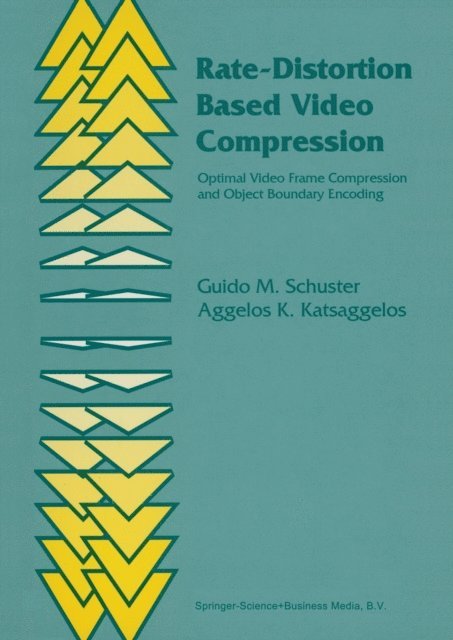
Rate-Distortion Based Video Compression
Optimal Video Frame Compression and Object Boundary Encoding
Inbunden, Engelska, 1996
1 584 kr
Skickas inom 10-15 vardagar
This work looks at the rapidly evolving field of operational rate distortion (ORD) based video compression. ORD is concerned with the allocation of available bits among the different sources of information in an established coding framework. Today's video compression standards leave great freedom in the selection of key parameters, such as quantizers and motion vectors. The main distinction among different vendors is in the selection of these parameters, and this book presents a mathematical foundation for this selection process. There is a review chapter on video compression, a background chapter on optimal bit allocation and the necessary mathematical tools, such as the Lagrangian multiplier method and dynamic programming. These two introductory chapters make the book self-contained and provide a fast way of entering this exciting field. Rate-Distortion Based Video Compression establishes a general theory for the optimal bit allocation among dependent quantizers. The minimum total (average) distortion and the minimum maximum distortion cases are discussed.This theory is then used to design efficient motion estimation schemes, video compression schemes and object boundary encoding schemes. For the motion estimation schemes, the theory is used to optimally trade the reduction of energy in the displaced frame difference (DFD) for the increase in the rate required to encode the displacement vector field (DVF). These optimal motion estimators are then used to formulate video compression schemes which achieve an optimal distribution of the available bit rate among DVF, DFD and segmentation. This optimal bit allocation results in very efficient video coders. In the last part of the book, the proposed theory is applied to the optimal encoding of object boundaries, where the bit rate needed to encode a given boundary is traded for the resulting geometrical distortion. Again, the resulting boundary encoding schemes are very efficient. Rate-Distortion Based Video Compression is ideally suited for anyone interested in this booming field of research and development, especially engineers who are concerned with the implementation and design of efficient video compression schemes.It also represents a foundation for future research, since all the key elements needed are collected and presented uniformly.
1 584 kr
Skickas inom 10-15 vardagar
Signal Recovery Techniques for Image and Video Compression and Transmission establishes a bridge between the fields of signal recovery and image and video compression. Traditionally these fields have developed separately because the problems they examined were regarded as very different, and the techniques used appear unrelated. Recently, though, there is growing consent among the research community that the two fields are quite closely related. Indeed, in both fields the objective is to reconstruct the best possible signal from limited information. The field of signal recovery, which is relatively mature, has long been associated with a wealth of powerful mathematical techniques such as Bayesian estimation and the theory of projects onto convex sets (to name just two). This book illustrates for the first time in a complete volume how these techniques can be brought to bear on the very important problems of image and video compression and transmission.Signal Recovery Techniques for Image and Video Compression and Transmission, which is written by leading practitioners in both fields, is one of the first references that addresses this approach and serves as an excellent information source for both researchers and practicing engineers.
Rate-Distortion Based Video Compression
Optimal Video Frame Compression and Object Boundary Encoding
Häftad, Engelska, 2010
1 584 kr
Skickas inom 10-15 vardagar
This is the first book about the rapidly evolving field of operational rate distortion (ORD) based video compression. ORD is concerned with the allocation of available bits among the different sources of information in an established coding framework. Today's video compression standards leave great freedom in the selection of key parameters, such as quantizers and motion vectors. The main distinction among different vendors is in the selection of these parameters, and this book presents a mathematical foundation for this selection process. The book contains a review chapter on video compression, a background chapter on optimal bit allocation and the necessary mathematical tools, such as the Lagrangian multiplier method and Dynamic Programming. These two introductory chapters make the book self-contained and provide a fast way of entering this exciting field. Rate-Distortion Based Video Compression establishes a general theory for the optimal bit allocation among dependent quantizers. The minimum total (average) distortion and the minimum maximum distortion cases are discussed.This theory is then used to design efficient motion estimation schemes, video compression schemes and object boundary encoding schemes. For the motion estimation schemes, the theory is used to optimally trade the reduction of energy in the displaced frame difference (DFD) for the increase in the rate required to encode the displacement vector field (DVF). These optimal motion estimators are then used to formulate video compression schemes which achieve an optimal distribution of the available bit rate among DVF, DFD and segmentation. This optimal bit allocation results in very efficient video coders. In the last part of the book, the proposed theory is applied to the optimal encoding of object boundaries, where the bit rate needed to encode a given boundary is traded for the resulting geometrical distortion. Again, the resulting boundary encoding schemes are very efficient. Rate-Distortion Based Video Compression is ideally suited for anyone interested in this booming field of research and development, especially engineers who are concerned with the implementation and design of efficient video compression schemes.It also represents a foundation for future research, since all the key elements needed are collected and presented uniformly. Therefore, it is ideally suited for graduate students and researchers working in this field.
634 kr
Skickas inom 5-8 vardagar
357 kr
Skickas inom 10-15 vardagar
This book deals with the problem of joint source-channel video transmission, i.e., the joint optimal allocation of resources at the application layer and the other network layers, such as data rate adaptation, channel coding, power adaptation in wireless networks, quality of service (QoS) support from the network, and packet scheduling, for efficient video transmission. Real-time video communication applications, such as videoconferencing, video telephony, and on-demand video streaming, have gained increased popularity. However, a key problem in video transmission over the existing Internet and wireless networks is the incompatibility between the nature of the network conditions and the QoS requirements (in terms, for example, of bandwidth, delay, and packet loss) of real-time video applications. To deal with this incompatibility, a natural approach is to adapt the end-system to the network. The joint source-channel coding approach aims to efficiently perform content-aware cross-layerresource allocation, thus increasing the communication efficiency of multiple network layers. Our purpose in this book is to review the basic elements of the state-of-the-art approaches toward joint source-channel video transmission for wired and wireless systems. In this book, we present a general resource-distortion optimization framework, which is used throughout the book to guide our discussions on various techniques of joint source-channel video transmission. In this framework, network resources from multiple layers are assigned to each video packet according to its level of importance. It provides not only an optimization benchmark against which the performance of other sub-optimal systems can be evaluated, but also a useful tool for assessing the effectiveness of different error control components in practical system design. This book is therefore written to be accessible to researchers, expert industrial R&D engineers, and university students who are interested in the cutting edge technologies in joint source-channel video transmission. Contents: Introduction / Elements of a Video Communication System / Joint Source-Channel Coding / Error-Resilient Video Coding / Channel Modeling and Channel Coding / Internet Video Transmission / Wireless Video Transmission / Conclusions