A.I. Sors – författare
Visar alla böcker från författaren A.I. Sors. Handla med fri frakt och snabb leverans.
3 produkter
3 produkter
E-bok
PDF, Engelska, 2013979 kr
Läs direkt efter köp
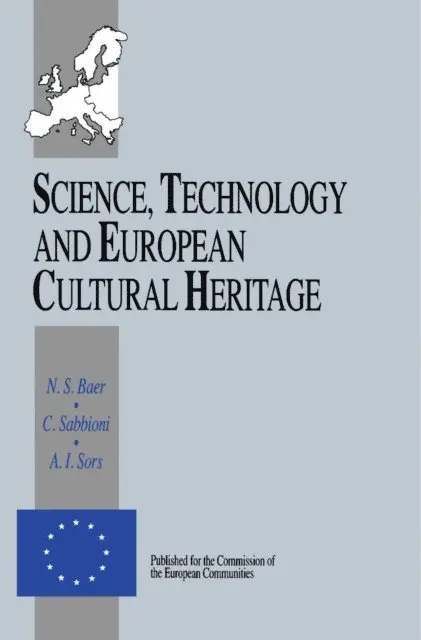
Science, Technology and European Cultural Heritage is a collection of papers from the Proceedings of the European Symposium of the same title held in Bologna, Italy on June13-16, 1989. The papers discuss the critical issues related to the scientific and technical aspects of the protection and conservation of the cultural heritage of Europe. Participants of the symposium identify and describe the main research and development issues that are common to cultural heritage problems, and increase cooperation in these areas. Other papers examine the applicability of research and development through better matching with the real needs of conservators, restorers, policy makers, and the general public. The participants also discuss specific research and development directions for the future, including the provision of a scientific basis for European Community policies on environment and culture. One paper presents some of the scientific research done both in the field and laboratory of specific historical areas, monuments, indoor objects. As an example, archaeologists can use infrared thermal image analysis as an enhanced tool to detect buried archeological and historical sites. Another paper analyzes the chemical and physical properties of deteriorated stones in historical monuments in Castile-Leon. The collection can prove useful for archaeologists, historians, museum curators, and policy makers involved in national and cultural preservation.
E-bok
PDF, Engelska, 2012734 kr
Läs direkt efter köp
This book arises out of a workshop on lead exposure and child development which was held at the University of Edinburgh on 8th-12th September 1986. It was organized jointly by the Commission of the European Communities (CEC) and the US Environmental Protection Agency (EPA), in association with the UK Department of the Environment and the Scottish Home and Health Department. It brought together most of the internationally recognized groups working on the effects of lead exposure on child development including child psychologists, psychiatrists, neurologists, epidemiologists, toxicologists, stati sticians, and medical practitioners. One of the unique features of the meeting was that it included workers from initially separate fields of lead research, in particular those undertaking studies in infants and in older children, and those carrying out behavioural research in animals, as well as those undertaking biochemical studies on mechanisms of lead effect. The structure of this book reflects the main elements of the meeting. As such it includes three main sections. The first consists of two major state-of the-art reviews, and two invited introductory papers. The reviews were prepared for the organizers of the conference by two of the Editors. The objectives were to assess critically the state of current knowledge in this field and to provide a scientific basis both for policy decisions and for further research. The review prepared by Marjorie Smith for the Commission of the European Communities focusses on methodological and design issues, and summarizes our present scientific knowledge in this area.
Häftad, Engelska, 2011
566 kr
Skickas inom 10-15 vardagar
This book arises out of a workshop on lead exposure and child development which was held at the University of Edinburgh on 8th-12th September 1986. It was organized jointly by the Commission of the European Communities (CEC) and the US Environmental Protection Agency (EPA), in association with the UK Department of the Environment and the Scottish Home and Health Department. It brought together most of the internationally recognized groups working on the effects of lead exposure on child development including child psychologists, psychiatrists, neurologists, epidemiologists, toxicologists, stati sticians, and medical practitioners. One of the unique features of the meeting was that it included workers from initially separate fields of lead research, in particular those undertaking studies in infants and in older children, and those carrying out behavioural research in animals, as well as those undertaking biochemical studies on mechanisms of lead effect. The structure of this book reflects the main elements of the meeting. As such it includes three main sections. The first consists of two major state-of the-art reviews, and two invited introductory papers. The reviews were prepared for the organizers of the conference by two of the Editors. The objectives were to assess critically the state of current knowledge in this field and to provide a scientific basis both for policy decisions and for further research. The review prepared by Marjorie Smith for the Commission of the European Communities focusses on methodological and design issues, and summarizes our present scientific knowledge in this area.