Alan Cameron - Böcker
Visar alla böcker från författaren Alan Cameron. Handla med fri frakt och snabb leverans.
10 produkter
10 produkter
2 249 kr
Skickas inom 3-6 vardagar
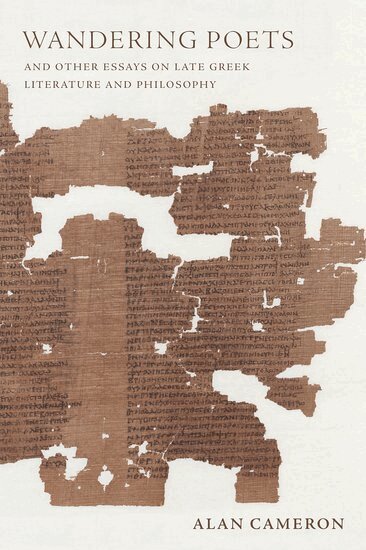
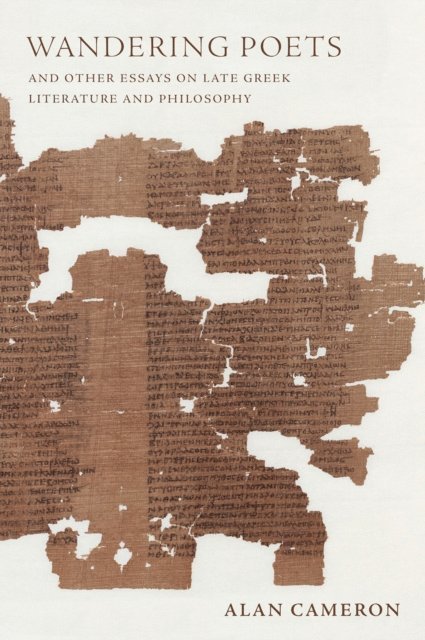
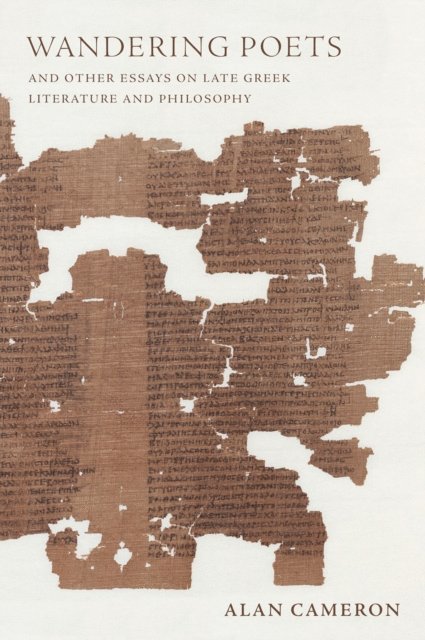
This book presents a radically revised version of some of the most important and innovative articles published by Alan Cameron in the field of late antique Greek poetry and philosophy. Much new material has been added to the account of the "Wandering Poets " from early Byzantine Egypt, and earlier judgment on their paganism is nuanced. The story of Cyrus of Panopolis and the empress Eudocia takes into count important recent work on the poetry of Eudocia. Several chapters discuss the date and identity of the influential poet Nonnus. The longest chapter reviews the celebrated story of the so-called closing of the Academy of Athens and the trip of its seven remaining philosophers to the court of the Persian king Chosroes, rejecting the fashionable current idea that they set up a new school at Harran on the Persian border. An entirely new chapter discusses a recently published papyrus containing poems of the Alexandrian epigrammatist Palladas, rejecting the editor's claim that Palladas wrote almost a century earlier than hitherto believed. A concluding chapter discusses recent claims about same-sex marriage in the Roman world.
1 801 kr
Skickas inom 5-8 vardagar
By the Roman age the traditional stories of Greek myth had long since ceased to reflect popular culture. Mythology had become instead a central element in elite culture. If one did not know the stories one would not understand most of the allusions in the poets and orators, classics and contemporaries alike; nor would one be able to identify the scenes represented on the mosaic floors and wall paintings in your cultivated friends' houses, or on the silverware on their tables at dinner. Mythology was no longer imbibed in the nursery; nor could it be simply picked up from the often oblique allusions in the classics. It had to be learned in school, as illustrated by the extraordinary amount of elementary mythological information in the many surviving ancient commentaries on the classics, notably Servius, who offers a mythical story for almost every person, place, and even plant Vergil mentions. Commentators used the classics as pegs on which to hang stories they thought their students should know. A surprisingly large number of mythographic treatises survive from the early empire, and many papyrus fragments from lost works prove that they were in common use. In addition, author Alan Cameron identifies a hitherto unrecognized type of aid to the reading of Greek and Latin classical and classicizing texts--what might be called mythographic companions to learned poets such as Aratus, Callimachus, Vergil, and Ovid, complete with source references. Much of this book is devoted to an analysis of the importance evidently attached to citing classical sources for mythical stories, the clearest proof that they were now a part of learned culture. So central were these source references that the more unscrupulous faked them, sometimes on the grand scale.
3 323 kr
Skickas inom 5-8 vardagar
The Greek Anthology is one of the great books of European literature, `a garden containing the flowers and weeds of 1500 years of Greek epigram'. This study adds a wealth of new information about its growth over an even longer period, from the earliest papyrus anthologies down to the rediscovery in 1606 of the Palatine Anthology (AP), our principal source for the entire history of the Greek epigram, from Simonides to the Byzantine age. It was a Byzantine schoolmaster, Constantine Cephalas, who excerpted all the major ancient collections in about 900. His work is reconstructed in this book from a close analysis of the Palatine Anthology at about 940 and the various later collections. Following a number of neglected clues, Professor Cameron identifies the compiler of AP as Constantine the Rhodian, and solves the mystery of the Manderings of AP during the Renaissance, showing that it once belonged to Sir Thomas More.
2 040 kr
Skickas inom 7-10 vardagar
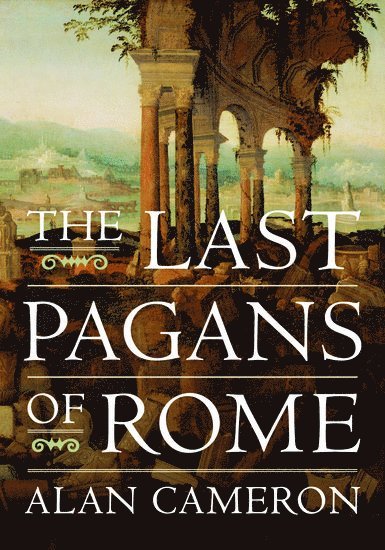
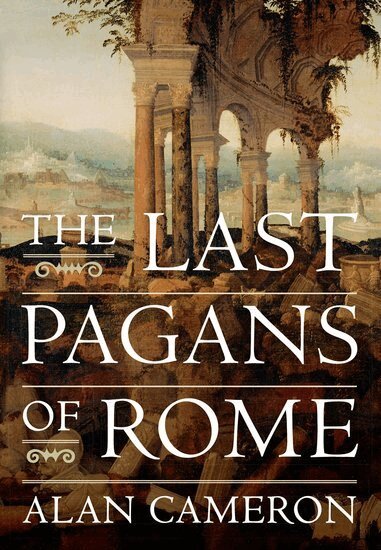
Eusebius' Ecclesiastical History (402/3 CE) gives a vivid account of the confrontation between the Eastern Roman Emperor Theodosius and the Western usurper Eugenius. To many, the defeat of Eugenius and his pagan followers along the Frigidus River in 394 was the last gasp of a vigorous pagan revolt in the late fourth century, one spearheaded by the Roman aristocracy. This elaborate campaign to derail Christianity, as the story goes, consisted of identifiable pagan literary circles, pagan patronage of the classics, and pagan propaganda in art and literature. Recently, however, scholars have shown this picture to be wanting in accuracy and nuance. Alan Cameron's The Last Pagans of Rome will replace this view with a richly detailed portrait of pagan society during the pivotal fourth and early fifth centuries.The subject of his book is not the conversion of the last pagans but rather the duration, nature, and consequences of their survival. It is widely believed that pagan aristocrats remained in the majority till at least the 380s, and continued to be a powerful force well into the fifth century. On this basis the main focus of much modern scholarship has been on their supposed stubborn resistance to Christianity. Rather surprisingly, these aristocrats have been transformed from the arrogant, philistine land-grabbers most of them were into fearless champions of senatorial privilege, literature lovers, and aficionados of classical (especially Greek) culture. The dismantling of this romantic myth is one of the main goals of Cameron's book. If a pagan aristocracy did not mount a defiant political and cultural rearguard action, what did they do? If elite culture at this time was not starkly divided between pagan and Christian, what did it look like? By sifting through the abundant textual evidence-from the Church Fathers Ambrose, Augustine, and Jerome to the classicizing authors Claudian, Macrobius, and Aullus Gellius-as well as the visual evidence (diptychs, illuminated manuscripts, silverware, and ivories), Cameron develops sophisticated and comprehensive answers to these questions. Among the provocative conclusions he makes is that the many activities and artifacts previously identified as hallmarks of a pagan revival were in fact just as important to the life of cultivated Christians. Far from being a subversive pagan activity designed to rally pagans, the promotion of classical literature, learning, and art-and its acceptance by many elite Christians-may actually have helped the last reluctant pagans to finally abandon the old cults and adopt Christianity. Throughout Cameron's careful analysis he engages, often with wit and pugnacity, with the mountain of scholarship on the subject. The culmination of several decades of research, The Last Pagans of Rome will be quite simply a landmark publication.
936 kr
Skickas inom 7-10 vardagar
Rufinus' vivid account of the battle between the Eastern Emperor Theodosius and the Western usurper Eugenius by the River Frigidus in 394 represents it as the final confrontation between paganism and Christianity. It is indeed widely believed that a largely pagan aristocracy remained a powerful and active force well into the fifth century, sponsoring pagan literary circles, patronage of the classics, and propaganda for the old cults in art and literature. The main focus of much modern scholarship on the end of paganism in the West has been on its supposed stubborn resistance to Christianity. The dismantling of this romantic myth is one of the main goals of Alan Cameron's book. Actually, the book argues, Western paganism petered out much earlier and more rapidly than hitherto assumed. The subject of this book is not the conversion of the last pagans but rather the duration, nature, and consequences of their survival. By re-examining the abundant textual evidence, both Christian (Ambrose, Augustine, Jerome, Paulinus, Prudentius) and "pagan" (Claudian, Macrobius, and Ammianus Marcellinus), as well as the visual evidence (ivory diptychs, illuminated manuscripts, silverware), Cameron shows that most of the activities and artifacts previously identified as hallmarks of a pagan revival were in fact just as important to the life of cultivated Christians. Far from being a subversive activity designed to rally pagans, the acceptance of classical literature, learning, and art by most elite Christians may actually have helped the last reluctant pagans to finally abandon the old cults and adopt Christianity. The culmination of decades of research, The Last Pagans of Rome overturns many long-held assumptions about pagan and Christian culture in the late antique West.
Del 19 - Transformation of the Classical Heritage
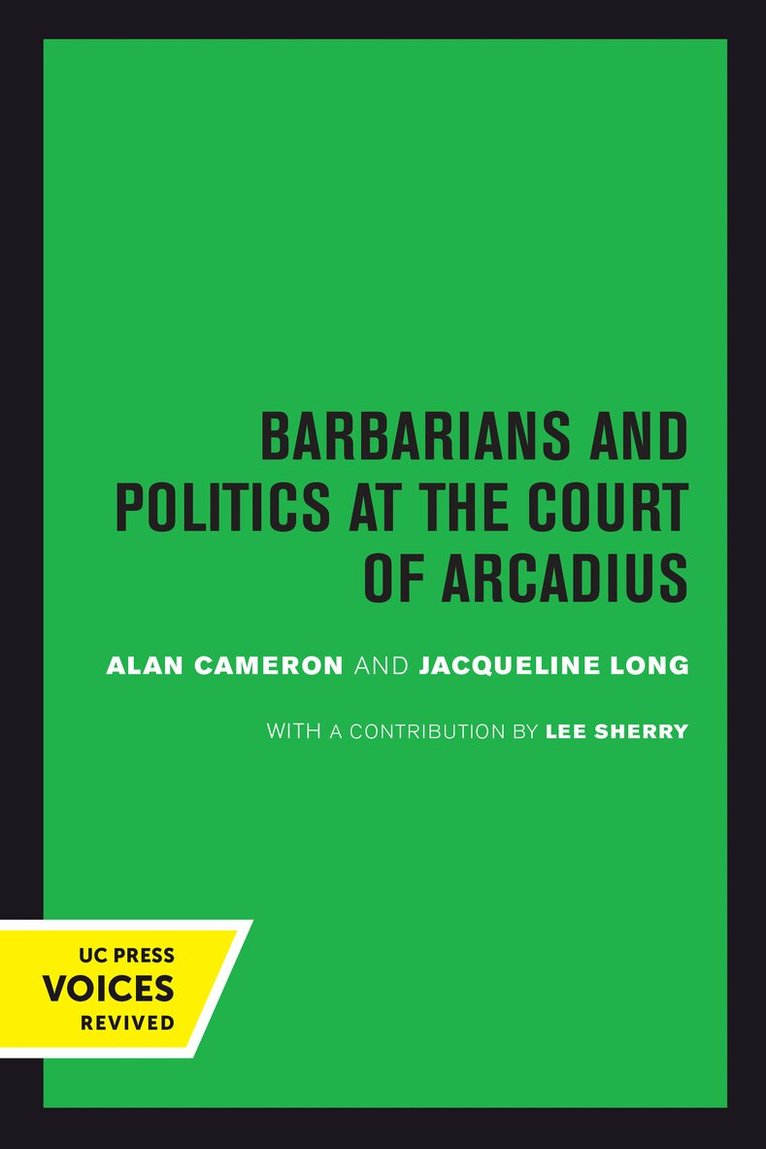
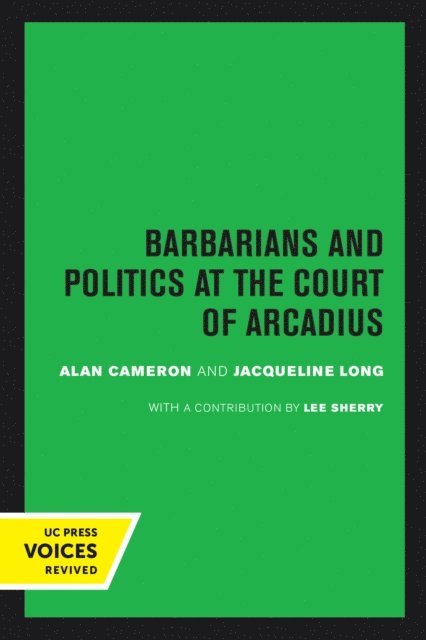
Barbarians and Politics at the Court of Arcadius
Häftad, Engelska, 2018
400 kr
Skickas inom 7-10 vardagar
The chaotic events of A.D. 395–400 marked a momentous turning point for the Roman Empire and its relationship to the barbarian peoples under and beyond its command. In this masterly study, Alan Cameron and Jacqueline Long propose a complete rewriting of received wisdom concerning the social and political history of these years. Our knowledge of the period comes to us in part through Synesius of Cyrene, who recorded his view of events in his De regno and De providentia. By redating these works, Cameron and Long offer a vital new interpretation of the interactions of pagans and Christians, Goths and Romans. In 394/95, during the last four months of his life, the emperor Theodosius I ruled as sole Augustus over a united Roman Empire that had been divided between at least two emperors for most of the preceding one hundred years. Not only did the death of Theodosius set off a struggle between Roman officeholders of the two empires, but it also set off renewed efforts by the barbarian Goths to seize both territory and office. Theodosius had encouraged high-ranking Goths to enter Roman military service; thus well placed, their efforts would lead to Alaric’s sack of Rome in 410. Though the authors’ interest is in the particularities of events, Barbarians and Politics at the Court Of Arcadius conveys a wonderful sense of the general time and place. Cameron and Long’s rebuttal of modern scholarship, which pervades the narrative, enhances the reader’s engagement with the complexities of interpretation. The result is a sophisticated recounting of a period of crucial change in the Roman Empire’s relationship to the non-Roman world.This title is part of UC Press's Voices Revived program, which commemorates University of California Press’s mission to seek out and cultivate the brightest minds and give them voice, reach, and impact. Drawing on a backlist dating to 1893, Voices Revived makes high-quality, peer-reviewed scholarship accessible once again using print-on-demand technology. This title was originally published in 1993.
Del 19 - Transformation of the Classical Heritage
Barbarians and Politics at the Court of Arcadius
Inbunden, Engelska, 2024
983 kr
Skickas
The chaotic events of A.D. 395–400 marked a momentous turning point for the Roman Empire and its relationship to the barbarian peoples under and beyond its command. In this masterly study, Alan Cameron and Jacqueline Long propose a complete rewriting of received wisdom concerning the social and political history of these years. Our knowledge of the period comes to us in part through Synesius of Cyrene, who recorded his view of events in his De regno and De providentia. By redating these works, Cameron and Long offer a vital new interpretation of the interactions of pagans and Christians, Goths and Romans. In 394/95, during the last four months of his life, the emperor Theodosius I ruled as sole Augustus over a united Roman Empire that had been divided between at least two emperors for most of the preceding one hundred years. Not only did the death of Theodosius set off a struggle between Roman officeholders of the two empires, but it also set off renewed efforts by the barbarian Goths to seize both territory and office. Theodosius had encouraged high-ranking Goths to enter Roman military service; thus well placed, their efforts would lead to Alaric’s sack of Rome in 410. Though the authors’ interest is in the particularities of events, Barbarians and Politics at the Court Of Arcadius conveys a wonderful sense of the general time and place. Cameron and Long’s rebuttal of modern scholarship, which pervades the narrative, enhances the reader’s engagement with the complexities of interpretation. The result is a sophisticated recounting of a period of crucial change in the Roman Empire’s relationship to the non-Roman world.This title is part of UC Press's Voices Revived program, which commemorates University of California Press’s mission to seek out and cultivate the brightest minds and give them voice, reach, and impact. Drawing on a backlist dating to 1893, Voices Revived makes high-quality, peer-reviewed scholarship accessible once again using print-on-demand technology. This title was originally published in 1993.
875 kr
Skickas inom 7-10 vardagar
Callimachus has usually been seen as the archetypal ivory-tower poet, the epitome if not the inventor of the concept of art for art's sake, author of erudite works written to be read in book form by fellow poets and scholars. Abundant evidence, much of it assembled here for the first time, suggests a very different story: a world of civic festivals rather than books and libraries, a world in which poetry and poets played a central and public role. In the course of the argument, Cameron casts fresh light on the lives, dates, works, and interrelationships of most of the other leading poets of the age. Another axiom of modern scholarship is that the object of Callimachus's literary polemic was epic. Yet Cameron shows that the thriving school of epic poets celebrating the wars of Hellenistic kings that has so dominated modern study simply never existed. Elegy was the fashionable genre of the age, and the bone of contention between Callimachus and his rivals (all fellow elegists) was the nature of elegiac narrative. A final chapter sketches some of the implications of this revised view of Callimachus and his world for the interpretation of Roman, especially Augustan, poetry.Originally published in 1995. The Princeton Legacy Library uses the latest print-on-demand technology to again make available previously out-of-print books from the distinguished backlist of Princeton University Press. These editions preserve the original texts of these important books while presenting them in durable paperback and hardcover editions. The goal of the Princeton Legacy Library is to vastly increase access to the rich scholarly heritage found in the thousands of books published by Princeton University Press since its founding in 1905.
4 038 kr
Skickas inom 3-6 vardagar
Callimachus has usually been seen as the archetypal ivory-tower poet, the epitome if not the inventor of the concept of art for art's sake, author of erudite works written to be read in book form by fellow poets and scholars. Abundant evidence, much of it assembled here for the first time, suggests a very different story: a world of civic festivals rather than books and libraries, a world in which poetry and poets played a central and public role. In the course of the argument, Cameron casts fresh light on the lives, dates, works, and interrelationships of most of the other leading poets of the age. Another axiom of modern scholarship is that the object of Callimachus's literary polemic was epic. Yet Cameron shows that the thriving school of epic poets celebrating the wars of Hellenistic kings that has so dominated modern study simply never existed. Elegy was the fashionable genre of the age, and the bone of contention between Callimachus and his rivals (all fellow elegists) was the nature of elegiac narrative. A final chapter sketches some of the implications of this revised view of Callimachus and his world for the interpretation of Roman, especially Augustan, poetry.Originally published in 1995. The Princeton Legacy Library uses the latest print-on-demand technology to again make available previously out-of-print books from the distinguished backlist of Princeton University Press. These editions preserve the original texts of these important books while presenting them in durable paperback and hardcover editions. The goal of the Princeton Legacy Library is to vastly increase access to the rich scholarly heritage found in the thousands of books published by Princeton University Press since its founding in 1905.
591 kr
Skickas inom 7-10 vardagar
A solid understanding of fetal medicine is essential for the practice of obstetrics and gynaecology. This comprehensive book, which has been extensively updated to reflect current clinical practice and developments in the field since publication of the original edition, provides a thorough overview of fetal medicine, covering: screening for chromosomal abnormalities; prenatal diagnostic techniques; the routine anomaly scan; fetal structural abnormalities; fetal therapy; prenatal diagnosis and management of non-immune hydrops fetalis; termination of pregnancy for fetal abnormality; fetal growth restriction; twin pregnancy; and fetal infection. The book is primarily designed to provide a comprehensive summary for candidates preparing for the Part 2 MRCOG examination, and as such covers the RCOG curriculum for fetal medicine. It is also a valuable guide for all healthcare professionals working in the field, including trainees, consultants and midwives.