Albert Gyr - Böcker
Visar alla böcker från författaren Albert Gyr. Handla med fri frakt och snabb leverans.
5 produkter
5 produkter
1 578 kr
Skickas inom 10-15 vardagar
A major part of this sediment transport representation closely follows the progress made in understanding the interactions between a turbulent flow and transportable solid particles. Introducing new aspects found in the research of turbulent flows, this book updates the theory of sediment transport, e. g. , using new representations for flow separations, and coherent structures thought to be relevant and confronts the problem that existent theories do not relate directly the relevant quantities involved in the physical processes. A review of the complex matter suggests that a closer cooperation between engineers and physicists would benefit the problem and our concept tries to acknowledge this fact. Having this in mind the book was organized in four parts. The engineer who is interested in predicting sediment transport will find the classical as well as statistical approaches in the first part (Chaps. 1–4). The second part (Chaps. 5–8) critically reviews the most problematic issues like rheology, turbulence, topological aspects of flow separations, vortical dynamics, and scaling parameters. This part is mainly addressed to the physicist interested in the geophysical aspects of river dynamics but will also support the engineers in their decision making process, when constructing a simulation scheme. The third part (Chaps. 9–11) presents the sediment transport using micromechanical principles, using new results from turbulence research and introducing flow separation as the main self-organization mechanism observed in the formation of bedforms.
1 578 kr
Skickas inom 10-15 vardagar
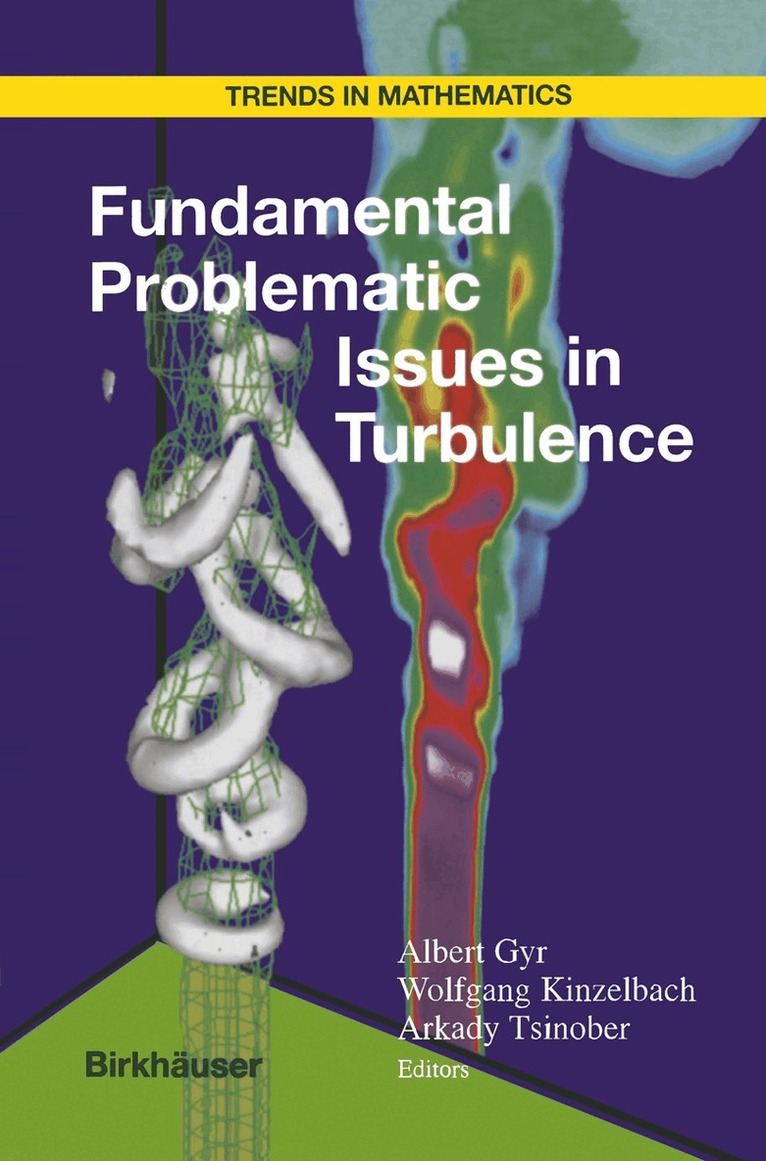
The Second Monte Verita Colloquium Fundamental Problematic Issues in Turbu lence was held in Monte Verita, Switzerland, on March 23-27, 1998. The main goal of the Colloquium was to bring together in the relaxed atmo sphere of Monte Verita a group of leading scientists (consisting of representatives of different generations) and to discuss informally and free of the influence of funding agencies and/or other "politics" of nonscientific nature the basic issues of turbulence. The intention was to put major emphasis on the exposition of the problematic aspects and discussion(s) - not mere reporting of results, i. e. not hav ing just one more meeting. For this purpose it was originally thought to leave all the afternoons free of formal presentations at all. However, this intention became unrealistic due to a number of reasons, and, in the first place, due to strong pres sure from various parts of the scientific community and non-scientific constraints to broaden the scope and to increase the number of participants as compared to the First Colloquium held in 1991. This resulted in a considerable reduction of time for discussions. Nevertheless, the remaining time for discussions was much larger than usually allocated at scientific conferences. On the scientific side the main idea was to bring together scientists work ing in turbulence from different fields, such as mathematics, physics, engineering and others. In this respect the Colloquium was definitely very successful and re sulted in a number of interesting interactions and contacts.
Structure of Turbulence and Drag Reduction
IUTAM Symposium Zurich, Switzerland July 25–28, 1989
Häftad, Engelska, 2012
536 kr
Skickas inom 10-15 vardagar
In 1976 a similar titled IUTAM Symposium (Structure of Turbulence and Drag Reduction) was held in Washington . However, the progress made during the last thirteen years as weil as the much promising current research desired a second one this year. In Washington drag reduction by additives and by direct manipulation of the walls (compliant walls and heated surfaces) were discussed. In the meantime it became evident that drag reduction also occurs when turbulence is influenced by geometrical means, e.g. by influencing the pressure distribution by the shape of the body (airfoils) or by the introduction of streamwise perturbances on a body (riblets). In the recent years turbulence research has seen increasing attention being focused on the investigation of coherent structures, mainly in Newtonian fluids. We all know that these structures are a significant feature of turbulent flows, playing an important role in the energy balance in such flows. However their place in turbulence theories as weil as the factors influencing their development are still poorly understood. Consequently, the investigation of phenomena in which the properties of coherent structures are alte red provides a promising means of improving our understanding of turbulent flows in general.
1 578 kr
Skickas inom 10-15 vardagar
The Second Monte Verita Colloquium Fundamental Problematic Issues in Turbu lence was held in Monte Verita, Switzerland, on March 23-27, 1998. The main goal of the Colloquium was to bring together in the relaxed atmo sphere of Monte Verita a group of leading scientists (consisting of representatives of different generations) and to discuss informally and free of the influence of funding agencies and/or other "politics" of nonscientific nature the basic issues of turbulence. The intention was to put major emphasis on the exposition of the problematic aspects and discussion(s) - not mere reporting of results, i. e. not hav ing just one more meeting. For this purpose it was originally thought to leave all the afternoons free of formal presentations at all. However, this intention became unrealistic due to a number of reasons, and, in the first place, due to strong pres sure from various parts of the scientific community and non-scientific constraints to broaden the scope and to increase the number of participants as compared to the First Colloquium held in 1991. This resulted in a considerable reduction of time for discussions. Nevertheless, the remaining time for discussions was much larger than usually allocated at scientific conferences. On the scientific side the main idea was to bring together scientists work ing in turbulence from different fields, such as mathematics, physics, engineering and others. In this respect the Colloquium was definitely very successful and re sulted in a number of interesting interactions and contacts.
1 578 kr
Skickas inom 10-15 vardagar
A major part of this sediment transport representation closely follows the progress made in understanding the interactions between a turbulent flow and transportable solid particles. Introducing new aspects found in the research of turbulent flows, this book updates the theory of sediment transport, e. g. , using new representations for flow separations, and coherent structures thought to be relevant and confronts the problem that existent theories do not relate directly the relevant quantities involved in the physical processes. A review of the complex matter suggests that a closer cooperation between engineers and physicists would benefit the problem and our concept tries to acknowledge this fact. Having this in mind the book was organized in four parts. The engineer who is interested in predicting sediment transport will find the classical as well as statistical approaches in the first part (Chaps. 1–4). The second part (Chaps. 5–8) critically reviews the most problematic issues like rheology, turbulence, topological aspects of flow separations, vortical dynamics, and scaling parameters. This part is mainly addressed to the physicist interested in the geophysical aspects of river dynamics but will also support the engineers in their decision making process, when constructing a simulation scheme. The third part (Chaps. 9–11) presents the sediment transport using micromechanical principles, using new results from turbulence research and introducing flow separation as the main self-organization mechanism observed in the formation of bedforms.