Alessia Sammarra - Böcker
Visar alla böcker från författaren Alessia Sammarra. Handla med fri frakt och snabb leverans.
3 produkter
3 produkter
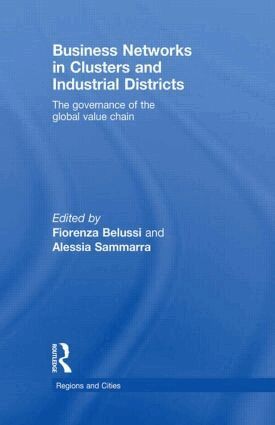
Business Networks in Clusters and Industrial Districts
The Governance of the Global Value Chain
Inbunden, Engelska, 2009
2 634 kr
Skickas inom 10-15 vardagar
During the 1980s the Marshallian concept of industrial district (ID) became widely popular due to the resurgence of interest in the reasons that make the agglomeration of specialised industries a territorial phenomenon worth being analysed. The analysis of clusters and IDs has often been limited, considering only the local dimension of the created business networks. The external links of these systems have been systematically under-evaluated. This book offers a deep insight into the evolution of these systems and the internal-external mechanism of knowledge circulation and learning. This means that the access to external knowledge (information or R&D cooperative research) or to productive networks (global supply chains) is studied in order to describe how external knowledge is absorbed and how local clusters or districts become global systems. It provides a unified approach; showing that existing capabilities expand when locally embedded knowledge is combined with accessible external knowledge. In this view, external knowledge linkages reduce the danger of cognitive ‘lock-in’ and ‘over-embeddedness’, which may become important obstacles to local learning and innovation when technological trajectories and global economic conditions change. A selection of international experts
Business Networks in Clusters and Industrial Districts
The Governance of the Global Value Chain
Häftad, Engelska, 2012
691 kr
Skickas inom 10-15 vardagar
During the 1980s the Marshallian concept of industrial district (ID) became widely popular due to the resurgence of interest in the reasons that make the agglomeration of specialised industries a territorial phenomenon worth being analysed. The analysis of clusters and IDs has often been limited, considering only the local dimension of the created business networks. The external links of these systems have been systematically under-evaluated. This book offers a deep insight into the evolution of these systems and the internal-external mechanism of knowledge circulation and learning. This means that the access to external knowledge (information or R&D cooperative research) or to productive networks (global supply chains) is studied in order to describe how external knowledge is absorbed and how local clusters or districts become global systems. It provides a unified approach; showing that existing capabilities expand when locally embedded knowledge is combined with accessible external knowledge. In this view, external knowledge linkages reduce the danger of cognitive ‘lock-in’ and ‘over-embeddedness’, which may become important obstacles to local learning and innovation when technological trajectories and global economic conditions change. A selection of international experts
Del 17 - Advanced Series in Management
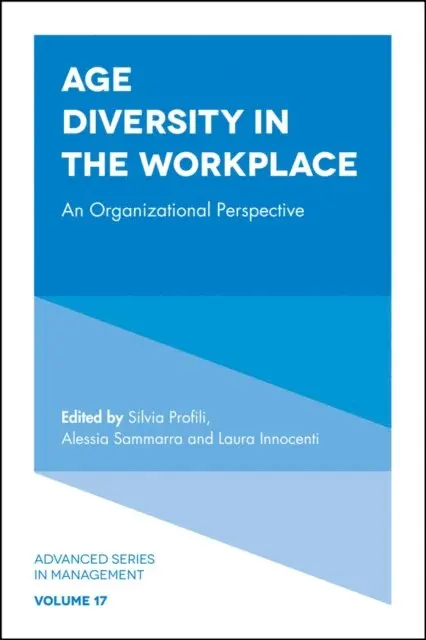
Age Diversity in the Workplace
An Organizational Perspective
Inbunden, Engelska, 2017
1 131 kr
Skickas inom 7-10 vardagar
Organisations, as well as individuals and societies, continue to struggle with the complexity associated with unprecedenteddemographic changes. Workforce ageing and increasing age diversity are not transient phenomena, and their implications are compounded by the combination of several global trends like workers' increased mobility and migration, as well as increasing gender and ethnic differences. This demographic pressure compels organisations to question conventional ways of management thinking, doing and being in order to capitalize on the benefits of an age-diverse workforce.This volume bridges theoretical and empirical approaches in order to illuminate the challenges of valuing employees at any point in their professional lives, from youth to retirement. Embracing perspectives that span from the individual to the organisational levels of analysis, the book explores the two distinct but intertwined phenomena of workforce ageing and increasing workforce age diversity.The volume is divided into two parts. Contributions in the first section raise questions about the meanings of age and age diversity, as well as how and when age matters in organisations. The second part of the book examines the role andcontribution of HR practices in forging an age-inclusive workplace.