Fiorenza Belussi – författare
648 kr
Skickas inom 10-15 vardagar
629 kr
Skickas inom 10-15 vardagar
2 714 kr
Skickas inom 10-15 vardagar
705 kr
Skickas inom 10-15 vardagar
2 215 kr
Skickas inom 10-15 vardagar
2 286 kr
Skickas inom 10-15 vardagar
422 kr
Läs direkt efter köp
Pulished in 2000, a selection of contributions presented in 1998 at the conference of Udine entitled, "The Development of Industrial Districts in Italy". The theoretical aim of the book is to explain the dynamic mechanism of the growth of Italian "industrial districts" shifting attention from "Marshallian industrial districts", where focus is not just on the decentralization of production among small-batch firms. Determinant factors explaining growth seem related to the ways in which firms explore the markets, learn tacit knowledge, network with subcontractors and make incremental innovations. In substance, the work offers a cognitive approach to the issue of industrial districts.
422 kr
Läs direkt efter köp
Pulished in 2000, a selection of contributions presented in 1998 at the conference of Udine entitled, "The Development of Industrial Districts in Italy". The theoretical aim of the book is to explain the dynamic mechanism of the growth of Italian "industrial districts" shifting attention from "Marshallian industrial districts", where focus is not just on the decentralization of production among small-batch firms. Determinant factors explaining growth seem related to the ways in which firms explore the markets, learn tacit knowledge, network with subcontractors and make incremental innovations. In substance, the work offers a cognitive approach to the issue of industrial districts.
753 kr
Läs direkt efter köp
During the 1980s the Marshallian concept of industrial district (ID) became widely popular due to the resurgence of interest in the reasons that make the agglomeration of specialised industries a territorial phenomenon worth being analysed. The analysis of clusters and IDs has often been limited, considering only the local dimension of the created business networks. The external links of these systems have been systematically under-evaluated.
This book offers a deep insight into the evolution of these systems and the internal-external mechanism of knowledge circulation and learning. This means that the access to external knowledge (information or R&D cooperative research) or to productive networks (global supply chains) is studied in order to describe how external knowledge is absorbed and how local clusters or districts become global systems. It provides a unified approach; showing that existing capabilities expand when locally embedded knowledge is combined with accessible external knowledge. In this view, external knowledge linkages reduce the danger of cognitive ‘lock-in’ and ‘over-embeddedness’, which may become important obstacles to local learning and innovation when technological trajectories and global economic conditions change. A selection of international experts
746 kr
Läs direkt efter köp
During the 1980s the Marshallian concept of industrial district (ID) became widely popular due to the resurgence of interest in the reasons that make the agglomeration of specialised industries a territorial phenomenon worth being analysed. The analysis of clusters and IDs has often been limited, considering only the local dimension of the created business networks. The external links of these systems have been systematically under-evaluated.
This book offers a deep insight into the evolution of these systems and the internal-external mechanism of knowledge circulation and learning. This means that the access to external knowledge (information or R&D cooperative research) or to productive networks (global supply chains) is studied in order to describe how external knowledge is absorbed and how local clusters or districts become global systems. It provides a unified approach; showing that existing capabilities expand when locally embedded knowledge is combined with accessible external knowledge. In this view, external knowledge linkages reduce the danger of cognitive ‘lock-in’ and ‘over-embeddedness’, which may become important obstacles to local learning and innovation when technological trajectories and global economic conditions change. A selection of international experts
852 kr
Läs direkt efter köp
The aim of the Managing Networks of Creativity is to improve our understanding of creativity and the management of creativity, as discussed in the fields of management (including strategic management, organization science, organizational behaviour, and entrepreneurship), economics, sociology, regional studies, and political science.
While research on creativity has made several important contributions to the theoretical literature, little attention has been paid to the development and testing of formal theoretical models, especially in those cases where creativity is the result not so much of individual behaviour than the outcome of collective efforts, connecting individuals in organizations, social networks, projects, geographic clusters, and so forth. The proposed volume includes studies, both conceptual and empirical, which, as a whole, "deconstruct" the concept of creativity and the management of creativity by identifying specific situations, contexts, firms, clusters, and districts in which creative processes evolve. The reader is provided with in-depth discussions of theoretical issues and a range of descriptive cases and survey data that the authors use to explore or test concepts and models. Overall, the volume aims to integrate current debates concerning the role of creativity (and innovation) in economic and social development.
860 kr
Läs direkt efter köp
The aim of the Managing Networks of Creativity is to improve our understanding of creativity and the management of creativity, as discussed in the fields of management (including strategic management, organization science, organizational behaviour, and entrepreneurship), economics, sociology, regional studies, and political science.
While research on creativity has made several important contributions to the theoretical literature, little attention has been paid to the development and testing of formal theoretical models, especially in those cases where creativity is the result not so much of individual behaviour than the outcome of collective efforts, connecting individuals in organizations, social networks, projects, geographic clusters, and so forth. The proposed volume includes studies, both conceptual and empirical, which, as a whole, "deconstruct" the concept of creativity and the management of creativity by identifying specific situations, contexts, firms, clusters, and districts in which creative processes evolve. The reader is provided with in-depth discussions of theoretical issues and a range of descriptive cases and survey data that the authors use to explore or test concepts and models. Overall, the volume aims to integrate current debates concerning the role of creativity (and innovation) in economic and social development.
2 359 kr
Skickas inom 10-15 vardagar
1 736 kr
Skickas inom 10-15 vardagar
367 kr
Skickas inom 10-15 vardagar
2 286 kr
Skickas inom 10-15 vardagar
947 kr
Skickas inom 10-15 vardagar
734 kr
Skickas inom 10-15 vardagar
730 kr
Läs direkt efter köp
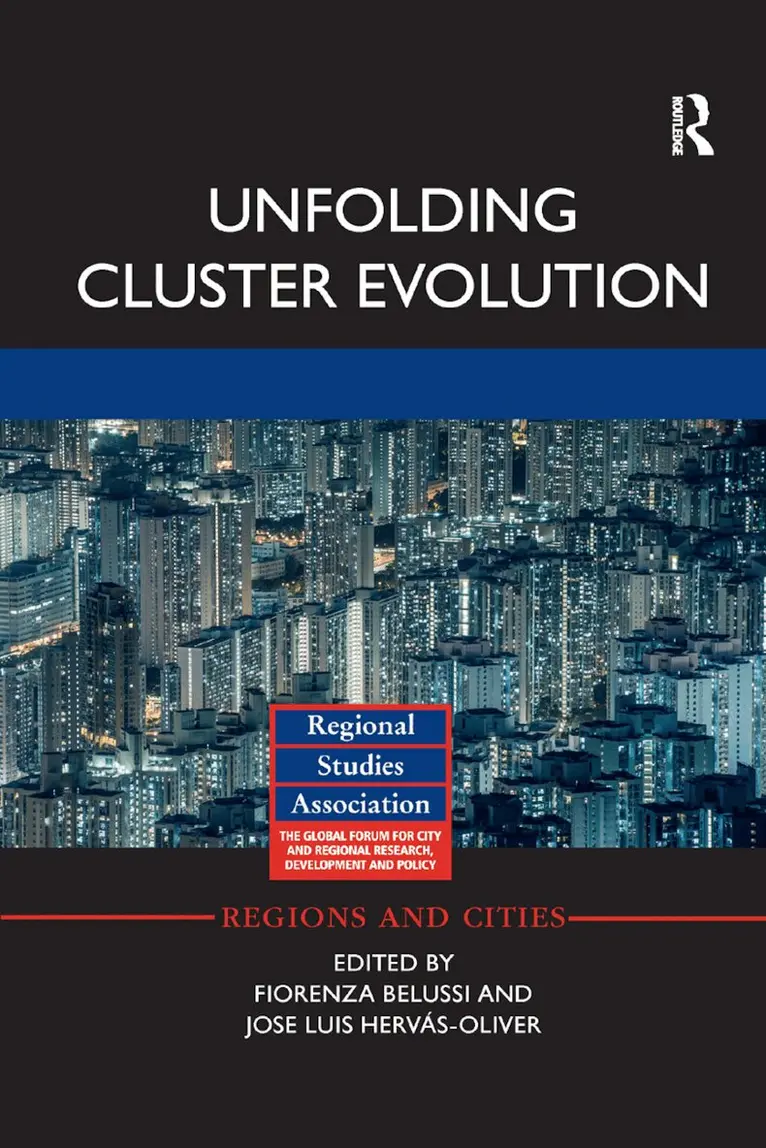
Various theories have been put forward as to why business and industry develops in clusters and despite good work being carried out on path dependence and dynamics, this is still very much an emerging topic in the social sciences. To date, no overarching theoretical framework has been developed to show how clusters evolve.
Unfolding Cluster Evolution aims to address this gap by presenting theoretical and empirical research on the geography of innovation. This contributed volume seeks to shed light on the understanding of clusters and its dynamic evolution. The book provides evidence to suggest that traditional perspectives from evolutionary economic geography need to be wedded to management thinking in order to reach this point. Bringing together thinking from a range of disciplines and countries across Europe, this book explores a wide range of topics from the capability approach, to network dynamics, to multinational corporations, to firm entry and exit and social capital.
This book will be of interest to policy makers and students of urban studies, economic geography, and planning and development.
730 kr
Läs direkt efter köp
Various theories have been put forward as to why business and industry develops in clusters and despite good work being carried out on path dependence and dynamics, this is still very much an emerging topic in the social sciences. To date, no overarching theoretical framework has been developed to show how clusters evolve.
Unfolding Cluster Evolution aims to address this gap by presenting theoretical and empirical research on the geography of innovation. This contributed volume seeks to shed light on the understanding of clusters and its dynamic evolution. The book provides evidence to suggest that traditional perspectives from evolutionary economic geography need to be wedded to management thinking in order to reach this point. Bringing together thinking from a range of disciplines and countries across Europe, this book explores a wide range of topics from the capability approach, to network dynamics, to multinational corporations, to firm entry and exit and social capital.
This book will be of interest to policy makers and students of urban studies, economic geography, and planning and development.
752 kr
Läs direkt efter köp
Recent years have seen a growth in strategic alliances, mergers and acquisitions and collaborative networks involving knowledge-intensive and hi-tech industries. However, there have been relatively few studies looking at this form of collaboration as a strategy to drive firms’ innovative performances. This book specifically focuses on the role of strategic alliances, M&A and innovation networks, providing insights on if and how they contribute to boosting firms’ innovation performances.
The book has a double purpose. Firstly, it investigates at an industry level the role played by the alliance, M&As and networks in high-tech environments such as biotechnology, pharmaceutical, software and nanotechnology in creating, transforming and reshaping the dynamics inside and between industries. Secondly, it explores the impact at the firm level of factors such as cognitive distance, management capabilities, and relational and social capabilities, on firms’ global innovation capacity, measured as innovation quantity, innovation quality and innovation novelty. The book will be of interest to scholars working on the economics of innovation, innovation management studies, strategic management, regional science and evolutionary economics, among other areas.
752 kr
Läs direkt efter köp
Recent years have seen a growth in strategic alliances, mergers and acquisitions and collaborative networks involving knowledge-intensive and hi-tech industries. However, there have been relatively few studies looking at this form of collaboration as a strategy to drive firms’ innovative performances. This book specifically focuses on the role of strategic alliances, M&A and innovation networks, providing insights on if and how they contribute to boosting firms’ innovation performances.
The book has a double purpose. Firstly, it investigates at an industry level the role played by the alliance, M&As and networks in high-tech environments such as biotechnology, pharmaceutical, software and nanotechnology in creating, transforming and reshaping the dynamics inside and between industries. Secondly, it explores the impact at the firm level of factors such as cognitive distance, management capabilities, and relational and social capabilities, on firms’ global innovation capacity, measured as innovation quantity, innovation quality and innovation novelty. The book will be of interest to scholars working on the economics of innovation, innovation management studies, strategic management, regional science and evolutionary economics, among other areas.
1 071 kr
Läs direkt efter köp
Creativity is the emergence of something novel and appropriate, from a person, a group, a society. A creative idea or product must be novel. Yet, novelty is not enough (a novel idea may be ridiculous or nonsensical). In addition to novelty, to be creative an idea or product must also attain some level of social recognition. The individualist approaches to creativity overestimate the role of the individual and of his/her abilities (the myth of the genius). On the contrary, the socio-cultural approach emphasizes the role played by contexts in the creation process: societies, cultures and historical periods. Accordingly, the individual is seen as a member of many overlapping social groups, each of them has its own network, with a specific structure and organization, which influences the creation of networks of—potentially creative—ideas. Each individual is also a member of a culture, which gives him/her the categories used to understand the world. Finally, each individual is representative of a specific historical period. From a managerial perspective it is important to deepen the knowledge of the contexts, both spatial and cognitive, which favor ‘‘situated creativity’’ in the realm of the cultural industries. This special book offers both theoretical and empirical contributions in an attempt to build such knowledge.
1 071 kr
Läs direkt efter köp
Creativity is the emergence of something novel and appropriate, from a person, a group, a society. A creative idea or product must be novel. Yet, novelty is not enough (a novel idea may be ridiculous or nonsensical). In addition to novelty, to be creative an idea or product must also attain some level of social recognition. The individualist approaches to creativity overestimate the role of the individual and of his/her abilities (the myth of the genius). On the contrary, the socio-cultural approach emphasizes the role played by contexts in the creation process: societies, cultures and historical periods. Accordingly, the individual is seen as a member of many overlapping social groups, each of them has its own network, with a specific structure and organization, which influences the creation of networks of—potentially creative—ideas. Each individual is also a member of a culture, which gives him/her the categories used to understand the world. Finally, each individual is representative of a specific historical period. From a managerial perspective it is important to deepen the knowledge of the contexts, both spatial and cognitive, which favor ‘‘situated creativity’’ in the realm of the cultural industries. This special book offers both theoretical and empirical contributions in an attempt to build such knowledge.
2 221 kr
Skickas inom 10-15 vardagar
2 221 kr
Skickas inom 10-15 vardagar
2 822 kr
Läs direkt efter köp
1 619 kr
Skickas inom 10-15 vardagar
1 619 kr
Skickas inom 10-15 vardagar
2 036 kr
Läs direkt efter köp
This contributed volume studies and explains the effect of agglomeration on a firm’s innovation and performance. It presents new cases as well as new topics within the agglomeration phenomenon, exploring also their role under the Great Recession. Beyond the analysis of regions or clusters, this volume focuses on firms within agglomerations and captures this phenomenon from different perspectives, contexts and diverse literatures. Specifically, it looks at the question under what circumstances exert generate benefits on firms’ performance, and how those gains are generated and distributed, usually asymmetrically, across agglomerated firms. In this context, the book addresses topics such as networks, collocation, labor mobility, firm’s strategies, innovation, competitiveness and collective actions across a diverse set of literatures, including economic geography, business economics, management, social networks, industrial districts, international business, sociology or industry dynamics.