Jose Luis Hervás-Oliver - Böcker
Visar alla böcker från författaren Jose Luis Hervás-Oliver. Handla med fri frakt och snabb leverans.
7 produkter
7 produkter
616 kr
Skickas inom 10-15 vardagar
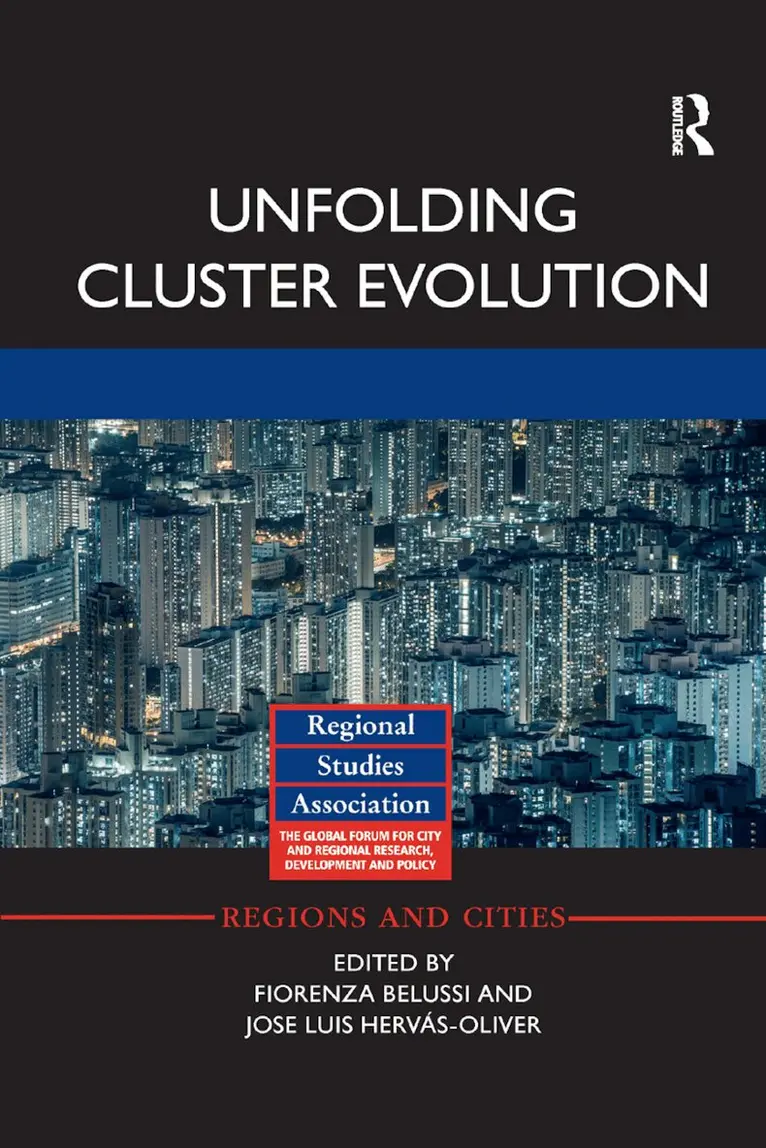
Various theories have been put forward as to why business and industry develops in clusters and despite good work being carried out on path dependence and dynamics, this is still very much an emerging topic in the social sciences. To date, no overarching theoretical framework has been developed to show how clusters evolve.Unfolding Cluster Evolution aims to address this gap by presenting theoretical and empirical research on the geography of innovation. This contributed volume seeks to shed light on the understanding of clusters and its dynamic evolution. The book provides evidence to suggest that traditional perspectives from evolutionary economic geography need to be wedded to management thinking in order to reach this point. Bringing together thinking from a range of disciplines and countries across Europe, this book explores a wide range of topics from the capability approach, to network dynamics, to multinational corporations, to firm entry and exit and social capital.This book will be of interest to policy makers and students of urban studies, economic geography, and planning and development.
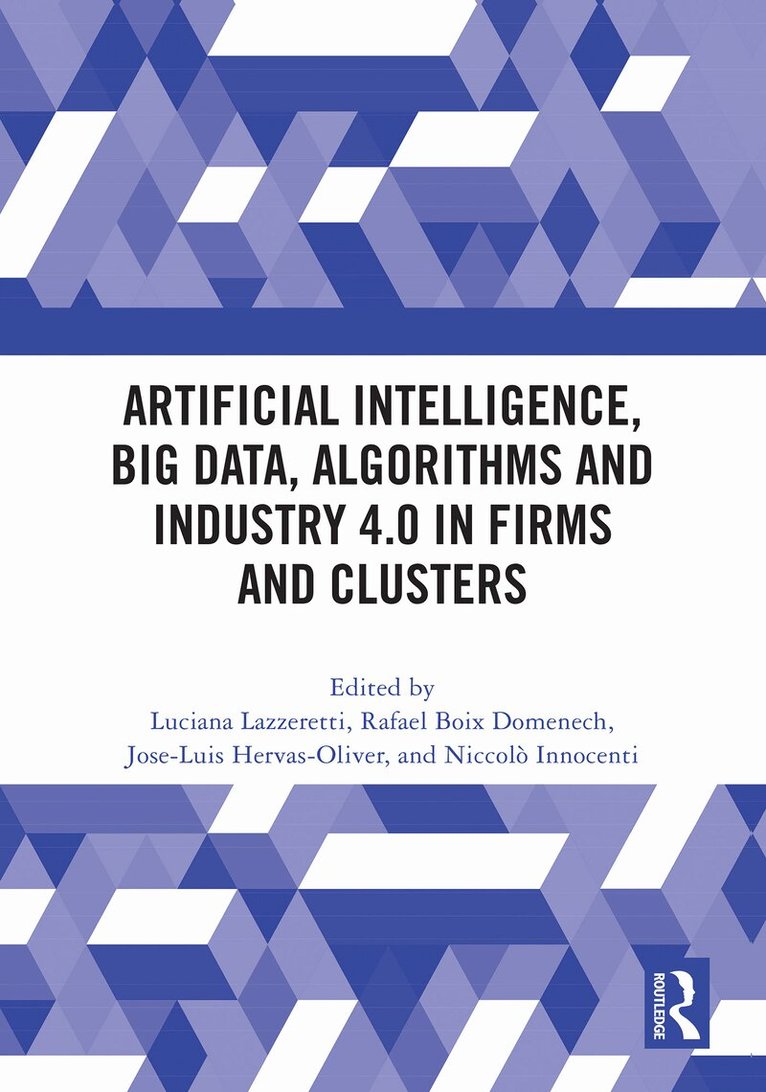
Artificial Intelligence, Big Data, Algorithms and Industry 4.0 in Firms and Clusters
Inbunden, Engelska, 2024
2 171 kr
Skickas inom 10-15 vardagar
This volume offers a wide-ranging discussion on the interrelations among AI, algorithms, big data, and Industry 4.0 to understand the importance of these new paradigms for the development of firms, districts, clusters, cities, regions, and innovation.Drawing on theoretical, empirical, and qualitative studies and using local perspectives, the chapters in this book explore theoretical aspects of AI and its evolution in social sciences, focusing on industry 4.0, smart cities, big data, and other related topics. They examine the role of industrial robots in employment, productivity, and knowledge absorption in industrial districts. They also discuss innovation in the context of local production systems, AI ecosystems, and the growth and potential of the Metaverse. Taken together, the book offers insights to help understand the new dynamics generated by the advent of these technologies and how they may affect regions, cities, clusters, industries, and organizations, and identifies avenues for future research in the development of new trajectories for clusters and firms.This book will be a key resource for scholars and advanced students in the fields of economics, geography, architecture, planning, and management as well as for interdisciplinary researchers who want to learn more about the development of new technologies, the relevance of AI, Big Data and I4.0 for firms and in relation to their adoption in clusters. This book was originally published as a special issue of European Planning Studies.
2 306 kr
Skickas inom 10-15 vardagar
Various theories have been put forward as to why business and industry develops in clusters and despite good work being carried out on path dependence and dynamics, this is still very much an emerging topic in the social sciences. To date, no overarching theoretical framework has been developed to show how clusters evolve.Unfolding Cluster Evolution aims to address this gap by presenting theoretical and empirical research on the geography of innovation. This contributed volume seeks to shed light on the understanding of clusters and its dynamic evolution. The book provides evidence to suggest that traditional perspectives from evolutionary economic geography need to be wedded to management thinking in order to reach this point. Bringing together thinking from a range of disciplines and countries across Europe, this book explores a wide range of topics from the capability approach, to network dynamics, to multinational corporations, to firm entry and exit and social capital.This book will be of interest to policy makers and students of urban studies, economic geography, and planning and development.
1 593 kr
Skickas inom 10-15 vardagar
This contributed volume studies and explains the effect of agglomeration on a firm’s innovation and performance. It presents new cases as well as new topics within the agglomeration phenomenon, exploring also their role under the Great Recession. Beyond the analysis of regions or clusters, this volume focuses on firms within agglomerations and captures this phenomenon from different perspectives, contexts and diverse literatures. Specifically, it looks at the question under what circumstances exert generate benefits on firms’ performance, and how those gains are generated and distributed, usually asymmetrically, across agglomerated firms. In this context, the book addresses topics such as networks, collocation, labor mobility, firm’s strategies, innovation, competitiveness and collective actions across a diverse set of literatures, including economic geography, business economics, management, social networks, industrial districts, international business, sociology or industry dynamics.
Management Innovation
Antecedents, Complementarities and Performance Consequences
Inbunden, Engelska, 2014
1 096 kr
Skickas inom 10-15 vardagar
Under a framework in which technology and organizational innovation are markedly separated, this book advances knowledge on the topic by exploring the antecedents of a firm’s adoption of organizational innovation and its performance consequences. The concept of organizational innovation encompasses the introduction of new administrative organizational and managerial activities, although currently it is accepted that these terms overlap. There are two different kinds of organizational innovation, usually inter-related: structural innovations(organizational arrangement and the division of labour within it)and managerial innovations(the way a firm organizes its activities or its personnel). Based on papers from the Organizational Innovation and its Background, Consequences and Technological Complementarities Performance Conference, this volume contributes to the organizational and innovation literature by providing insights on the antecedents of the adoption of management innovation; exploring the complementary roles of management and technological innovation; addressing the performance consequences of management innovation adoption with and without technological innovation; and discusses management innovation using the resource-based view, thus enriching that theoretical approach.
Management Innovation
Antecedents, Complementarities and Performance Consequences
Häftad, Engelska, 2016
1 096 kr
Skickas inom 10-15 vardagar
Under a framework in which technology and organizational innovation are markedly separated, this book advances knowledge on the topic by exploring the antecedents of a firm’s adoption of organizational innovation and its performance consequences. The concept of organizational innovation encompasses the introduction of new administrative organizational and managerial activities, although currently it is accepted that these terms overlap. There are two different kinds of organizational innovation, usually inter-related: structural innovations(organizational arrangement and the division of labour within it)and managerial innovations(the way a firm organizes its activities or its personnel). Based on papers from the Organizational Innovation and its Background, Consequences and Technological Complementarities Performance Conference, this volume contributes to the organizational and innovation literature by providing insights on the antecedents of the adoption of management innovation; exploring the complementary roles of management and technological innovation; addressing the performance consequences of management innovation adoption with and without technological innovation; and discusses management innovation using the resource-based view, thus enriching that theoretical approach.
1 593 kr
Skickas inom 10-15 vardagar
This contributed volume studies and explains the effect of agglomeration on a firm’s innovation and performance. It presents new cases as well as new topics within the agglomeration phenomenon, exploring also their role under the Great Recession. Beyond the analysis of regions or clusters, this volume focuses on firms within agglomerations and captures this phenomenon from different perspectives, contexts and diverse literatures. Specifically, it looks at the question under what circumstances exert generate benefits on firms’ performance, and how those gains are generated and distributed, usually asymmetrically, across agglomerated firms. In this context, the book addresses topics such as networks, collocation, labor mobility, firm’s strategies, innovation, competitiveness and collective actions across a diverse set of literatures, including economic geography, business economics, management, social networks, industrial districts, international business, sociology or industry dynamics.