Alex Singleton – författare
96 kr
Skickas inom 5-8 vardagar
202 kr
Läs direkt efter köp
"PR can do more for your money than any other marketing tool. But very few people understand how to use it. Alex does because he has been at the receiving end. So will you if you read this remarkably practical book." —Drayton Bird, author, Commonsense Direct and Digital Marketing
"The lessons contained within The PR Masterclass should be plastered over the walls of organisations seeking to utilise the media effectively for their campaigns. This book is a must-have reference point." —Ryan Bourne, CityAM columnist and Head of Economic Research, Centre for Policy Studies
"This is an important book about public relations and how the media is changing. Singleton is a straight-talking journalist-turned-practitioner who pulls no punches. He calls on the industry to grow up and adopt the rigour of a professional discipline. It''s a call to action that I wholly heartedly support. You should read The PR Masterclass if you''re new to public relations or work in the profession and want to continue doing so." —Stephen Waddington, European director, Ketchum, and 2014 President of the Chartered Institute of Public Relations (CIPR)
"Provides all you need to know about securing press coverage." —Fraser Seitel, O''Dwyer''s PR magazine
"Every page is packed with insight and practical advice." —Steve Harrison, co-founder, Harrison Troughton Wunderman
"Written in a no-nonsense style, every chapter contains a mine of information about the subject. What''s more, it''s clear that Alex knows the business inside out. This is the kind of book you need to have close at hand. Do what it says, and you''ll be miles ahead with your PR." —James Hammond, brand consultant
"Alex Singleton''s book on public relations strategy is an excellent practical guide to the real world of PR." —Ray Hiebert, Editor, Public Relations Review
202 kr
Läs direkt efter köp
"PR can do more for your money than any other marketing tool. But very few people understand how to use it. Alex does because he has been at the receiving end. So will you if you read this remarkably practical book." —Drayton Bird, author, Commonsense Direct and Digital Marketing
"The lessons contained within The PR Masterclass should be plastered over the walls of organisations seeking to utilise the media effectively for their campaigns. This book is a must-have reference point." —Ryan Bourne, CityAM columnist and Head of Economic Research, Centre for Policy Studies
"This is an important book about public relations and how the media is changing. Singleton is a straight-talking journalist-turned-practitioner who pulls no punches. He calls on the industry to grow up and adopt the rigour of a professional discipline. It''s a call to action that I wholly heartedly support. You should read The PR Masterclass if you''re new to public relations or work in the profession and want to continue doing so." —Stephen Waddington, European director, Ketchum, and 2014 President of the Chartered Institute of Public Relations (CIPR)
"Provides all you need to know about securing press coverage." —Fraser Seitel, O''Dwyer''s PR magazine
"Every page is packed with insight and practical advice." —Steve Harrison, co-founder, Harrison Troughton Wunderman
"Written in a no-nonsense style, every chapter contains a mine of information about the subject. What''s more, it''s clear that Alex knows the business inside out. This is the kind of book you need to have close at hand. Do what it says, and you''ll be miles ahead with your PR." —James Hammond, brand consultant
"Alex Singleton''s book on public relations strategy is an excellent practical guide to the real world of PR." —Ray Hiebert, Editor, Public Relations Review
173 kr
Skickas inom 5-8 vardagar
792 kr
Läs direkt efter köp
Geocomputation is the use of software and computing power to solve complex spatial problems. It is gaining increasing importance in the era of the ‘big data’ revolution, of ‘smart cities’, of crowdsourced data, and of associated applications for viewing and managing data geographically - like Google Maps. This student focused book:
Provides a selection of practical examples of geocomputational techniques and ‘hot topics’ written by world leading practitioners. Integrates supporting materials in each chapter, such as code and data, enabling readers to work through the examples themselves.Chapters provide highly applied and practical discussions of:
Visualisation and exploratory spatial data analysis Space time modelling Spatial algorithms Spatial regression and statistics Enabling interactions through the use of neogeographyAll chapters are uniform in design and each includes an introduction, case studies, conclusions - drawing together the generalities of the introduction and specific findings from the case study application – and guidance for further reading. This accessible text has been specifically designed for those readers who are new to Geocomputation as an area of research, showing how complex real-world problems can be solved through the integration of technology, data, and geocomputational methods. This is the applied primer for Geocomputation in the social sciences.
2 483 kr
Skickas inom 10-15 vardagar
3 157 kr
Läs direkt efter köp
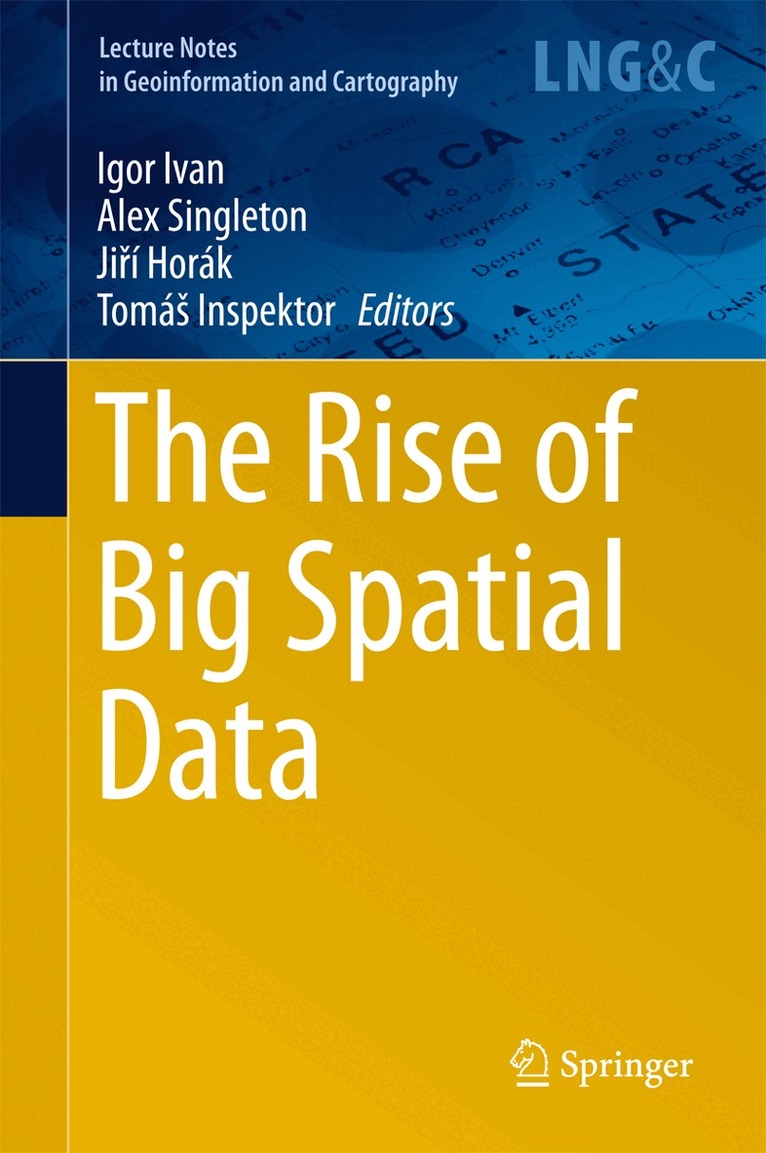
This edited volume gathers the proceedings of the Symposium GIS Ostrava 2016, the Rise of Big Spatial Data, held at the Technical University of Ostrava, Czech Republic, March 16–18, 2016. Combining theoretical papers and applications by authors from around the globe, it summarises the latest research findings in the area of big spatial data and key problems related to its utilisation.
Welcome to dawn of the big data era: though it’s in sight, it isn’t quite here yet. Big spatial data is characterised by three main features: volume beyond the limit of usual geo-processing, velocity higher than that available using conventional processes, and variety, combining more diverse geodata sources than usual. The popular term denotes a situation in which one or more of these key properties reaches a point at which traditional methods for geodata collection, storage, processing, control, analysis, modelling, validation and visualisation fail to provide effective solutions.
>Entering the era of big spatial data calls for finding solutions that address all “small data” issues that soon create “big data” troubles. Resilience for big spatial data means solving the heterogeneity of spatial data sources (in topics, purpose, completeness, guarantee, licensing, coverage etc.), large volumes (from gigabytes to terabytes and more), undue complexity of geo-applications and systems (i.e. combination of standalone applications with web services, mobile platforms and sensor networks), neglected automation of geodata preparation (i.e. harmonisation, fusion), insufficient control of geodata collection and distribution processes (i.e. scarcity and poor quality of metadata and metadata systems), limited analytical tool capacity (i.e. domination of traditional causal-driven analysis), low visual system performance, inefficient knowledge-discovery techniques (for transformation of vast amounts of information into tiny and essential outputs) and much more. These trends are accelerating as sensors become more ubiquitous around the world.
2 483 kr
Skickas inom 10-15 vardagar