Alex Woloch - Böcker
Visar alla böcker från författaren Alex Woloch. Handla med fri frakt och snabb leverans.
3 produkter
3 produkter
522 kr
Skickas inom 5-8 vardagar
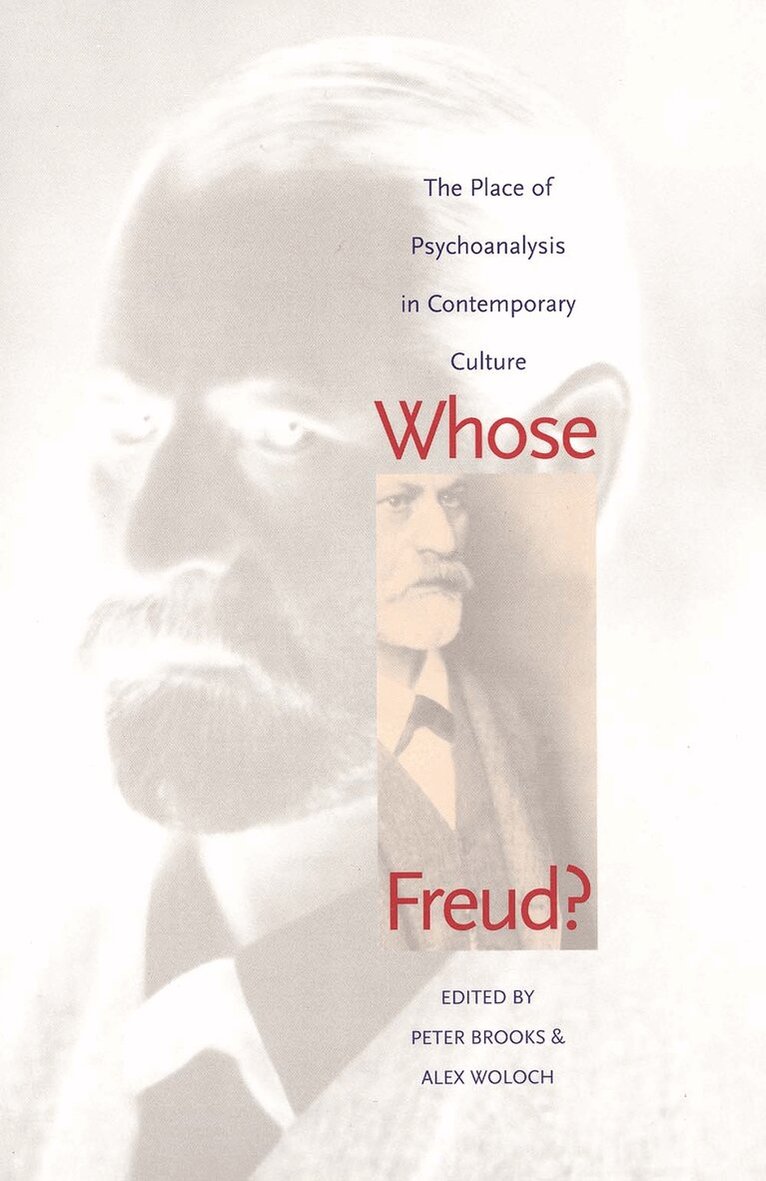
One hundred years after the publication of The Interpretation of Dreams, Freud remains the most frequently cited author of our culture—and one of the most controversial. To some he is the presiding genius of modernity, to others the author of its symptomatic illnesses. The current position of psychoanalysis is very much at issue. Is it still valid as a theory of the mind? Have its therapeutic applications been rendered obsolete by drugs? Why does it still figure in debates about sexual identity, despite its rejection by many feminists? How does it contribute to cultural analysis? This book offers a new assessment of the status of psychoanalysis as a discipline and a discourse in contemporary culture. It brings together an exceptional group of theorists and practitioners, such partisans and critics of Freud as Frederic Crews, Judith Butler, Leo Bersani, Juliet Mitchell, Robert Jay Lifton, Richard Wollheim, Jonathan Lear, and others. These contributors, who are active in literature, philosophy, film, history, cultural studies, neuroscience, psychotherapy, and other disciplines, debate how psychoanalysis has enriched—and been enriched by—these fields.
591 kr
Skickas inom 10-15 vardagar
There have been many studies of George Orwell’s life and work, but nothing quite like this book by Alex Woloch—an exuberant, revisionary account of Orwell’s writing.“Good prose is like a window-pane,” Orwell famously avers. But what kind of literary criticism is possible, face-to-face with Orwell’s plain-style prose? Too often this style has been either dismissed by a seemingly more savvy critical theory, or held up as a reprimand against the enterprise of theory. In a series of unusually close and intensive readings—focused on the unstable event of writing itself—Woloch recovers the radical and experimental energies of Orwell’s prose. Against accounts that would quickly naturalize Orwell’s truthfulness or reduce his window-pane prose to bad faith, Woloch’s study bears down on a propulsive irony and formal restlessness that have always been intertwined with Orwell’s plain-style. Such restlessness, far from diluting Orwell’s democratic and socialist politics, is at its aesthetic and conceptual core.The first half of Or Orwell ranges across his nonfiction prose, including new readings of “A Hanging,” The Road to Wigan Pier, and Inside the Whale. The second half develops an extended analysis of a single writing project: Orwell’s eighty “As I Please” newspaper columns, written for the Socialist weekly Tribune. Moving through multiple forms and genres, testing the limits of each, Orwell emerges in Woloch’s fine-grained account as a boldly unconventional writer and a central figure in twentieth-century literature and political thought.
One vs. the Many
Minor Characters and the Space of the Protagonist in the Novel
Häftad, Engelska, 2003
939 kr
Skickas inom 3-6 vardagar
Does a novel focus on one life or many? Alex Woloch uses this simple question to develop a powerful new theory of the realist novel, based on how narratives distribute limited attention among a crowded field of characters. His argument has important implications for both literary studies and narrative theory. Characterization has long been a troubled and neglected problem within literary theory. Through close readings of such novels as Pride and Prejudice, Great Expectations, and Le Pere Goriot, Woloch demonstrates that the representation of any character takes place within a shifting field of narrative attention and obscurity. Each individual--whether the central figure or a radically subordinated one--emerges as a character only through his or her distinct and contingent space within the narrative as a whole. The "character-space," as Woloch defines it, marks the dramatic interaction between an implied person and his or her delimited position within a narrative structure.The organization of, and clashes between, many character-spaces within a single narrative totality is essential to the novel's very achievement and concerns, striking at issues central to narrative poetics, the aesthetics of realism, and the dynamics of literary representation. Woloch's discussion of character-space allows for a different history of the novel and a new definition of characterization itself. By making the implied person indispensable to our understanding of literary form, this book offers a forward-looking avenue for contemporary narrative theory.