Alexander Otgaar - Böcker
Visar alla böcker från författaren Alexander Otgaar. Handla med fri frakt och snabb leverans.
8 produkter
8 produkter
2 171 kr
Skickas inom 10-15 vardagar
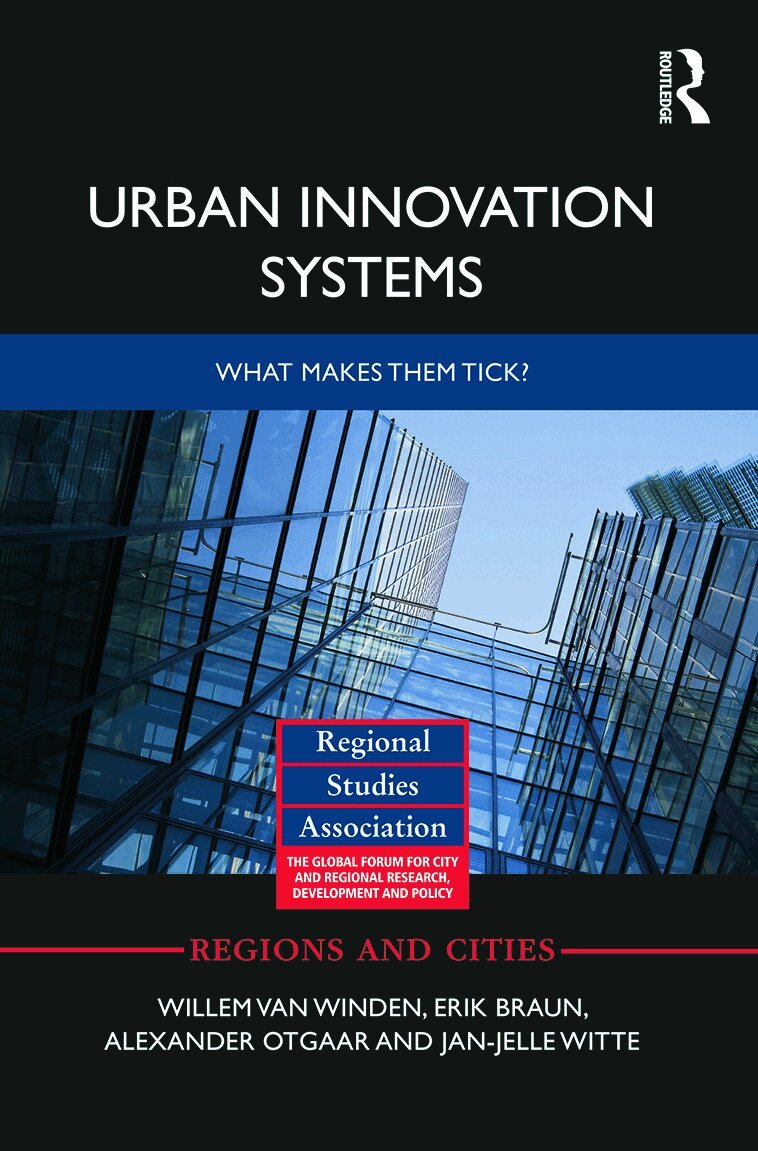
Why are some regions and cities so good at attracting talented people, creating high-level knowledge, and producing exciting new ideas and innovations? What are the ingredients of success? Can innovative cities be created and stimulated, or do they just flourish by mere chance? This book analyses the development and management of innovation systems in cities, in order to provide a better understanding of what makes such systems perform.The book opens by developing a conceptual model that combines insights from urban economics with economic geography, urban governance and place marketing. This highlights the relevance of path dependence, different types of proximity (and the role of clusters, networks and platforms), institutional conditions, place attractiveness and place identity in the evolution of local innovation systems. The authors then draw on this conceptual framework to structure empirical case studies in three cities with a relatively high innovation performance: Eindhoven (the Netherlands), Stockholm (Sweden) and Suzhou (China). Through these case studies they provide a detailed analysis of how successful innovation systems evolve and what makes them tick.Unique to this book is the linking of analysis to concrete policy and management responses. The book ends with a discussion on six themes in the development of successful urban innovation systems: firm-capabilities and leader firms, higher education and research, attractive environment, place branding, institutional environment and entrepreneurship. Each theme is examined fully, drawing lessons from the case studies, and from recent insights and other cases discussed in the literature.This title will be of interest to students, researchers and policymakers involved in regional innovation systems, knowledge locations and cluster development.
2 171 kr
Skickas inom 10-15 vardagar
This insightful book analyzes the development of cross-border and cross-sector partnerships in a number of European cities and regions. Including, amongst others, Copenhagen, Budapest, Helsinki, Munich and Catalonia, these case studies shed light on the factors determining the success or failure of the coalition-forming process. Over the course of the nine case studies, the following questions are addressed: - What forms of metropolitan and/or regional partnerships can be found? -
751 kr
Skickas inom 10-15 vardagar
This book explores the conditions needed to make public and private investments in healthy cities most effective. The authors argue that three conditions are essential for such investments: citizen empowerment, corporate responsibility and a coordinated improvement of urban health conditions. Using an integrated approach to health in line with the Healthy Cities philosophy of the World Health Organization, case studies in Helsinki, Liverpool, London, Udine and Vancouver are not only used to demonstrate the relevance of these conditions, but also to show how actors in these cities are trying to meet these conditions.
751 kr
Skickas inom 10-15 vardagar
This insightful book analyzes the development of cross-border and cross-sector partnerships in a number of European cities and regions. Including, amongst others, Copenhagen, Budapest, Helsinki, Munich and Catalonia, these case studies shed light on the factors determining the success or failure of the coalition-forming process. Over the course of the nine case studies, the following questions are addressed: - What forms of metropolitan and/or regional partnerships can be found? -
670 kr
Skickas inom 10-15 vardagar
Why are some regions and cities so good at attracting talented people, creating high-level knowledge, and producing exciting new ideas and innovations? What are the ingredients of success? Can innovative cities be created and stimulated, or do they just flourish by mere chance? This book analyses the development and management of innovation systems in cities, in order to provide a better understanding of what makes such systems perform.The book opens by developing a conceptual model that combines insights from urban economics with economic geography, urban governance and place marketing. This highlights the relevance of path dependence, different types of proximity (and the role of clusters, networks and platforms), institutional conditions, place attractiveness and place identity in the evolution of local innovation systems. The authors then draw on this conceptual framework to structure empirical case studies in three cities with a relatively high innovation performance: Eindhoven (the Netherlands), Stockholm (Sweden) and Suzhou (China). Through these case studies they provide a detailed analysis of how successful innovation systems evolve and what makes them tick.Unique to this book is the linking of analysis to concrete policy and management responses. The book ends with a discussion on six themes in the development of successful urban innovation systems: firm-capabilities and leader firms, higher education and research, attractive environment, place branding, institutional environment and entrepreneurship. Each theme is examined fully, drawing lessons from the case studies, and from recent insights and other cases discussed in the literature.This title will be of interest to students, researchers and policymakers involved in regional innovation systems, knowledge locations and cluster development.
494 kr
Skickas inom 10-15 vardagar
This title was first published in 2003. While in the past, corporate community involvement was mainly considered a form of philanthropy, nowadays the argument is gaining credit that corporate community involvement is not only a matter of ethics, but also of self-interest. As companies recognize their interest in the welfare of the city, they may become inclined to invest in some way in that city's welfare. Assuming that the interests of public and private stakeholders tend to converge as companies become aware of their interest in an attractive environment, then corporate community involvement may bring along a new type of public-private partnership, as an instrument of urban regeneration. Bringing together comparative case studies from Amsterdam, Chicago, Leeds, London, Munich, New York, Seattle, St. Louis and The Hague, this considers the potential implications of corporate community involvement for the sustainable development of cities and the creation of cross-sector partnerships. It analyses the involvement of companies in urban challenges in the fields of education, employment, safety, affordable housing and the living environment. It also looks at the efforts made to establish strategic partnership between "enlightened" corporations and public authorities. The book reveals that "pro-active" firms attach much value to investments in their "urban environment" as part of their corporate strategy. But it also shows that cities do not yet take full advantage of these arising opportunities.
City and Enterprise
Corporate Community Involvement in European and US Cities
Inbunden, Engelska, 2017
1 143 kr
Skickas inom 10-15 vardagar
This title was first published in 2003. While in the past, corporate community involvement was mainly considered a form of philanthropy, nowadays the argument is gaining credit that corporate community involvement is not only a matter of ethics, but also of self-interest. As companies recognize their interest in the welfare of the city, they may become inclined to invest in some way in that city's welfare. Assuming that the interests of public and private stakeholders tend to converge as companies become aware of their interest in an attractive environment, then corporate community involvement may bring along a new type of public-private partnership, as an instrument of urban regeneration. Bringing together comparative case studies from Amsterdam, Chicago, Leeds, London, Munich, New York, Seattle, St. Louis and The Hague, this considers the potential implications of corporate community involvement for the sustainable development of cities and the creation of cross-sector partnerships. It analyses the involvement of companies in urban challenges in the fields of education, employment, safety, affordable housing and the living environment. It also looks at the efforts made to establish strategic partnership between "enlightened" corporations and public authorities. The book reveals that "pro-active" firms attach much value to investments in their "urban environment" as part of their corporate strategy. But it also shows that cities do not yet take full advantage of these arising opportunities.
2 171 kr
Skickas inom 10-15 vardagar
This book explores the conditions needed to make public and private investments in healthy cities most effective. The authors argue that three conditions are essential for such investments: citizen empowerment, corporate responsibility and a coordinated improvement of urban health conditions. Using an integrated approach to health in line with the Healthy Cities philosophy of the World Health Organization, case studies in Helsinki, Liverpool, London, Udine and Vancouver are not only used to demonstrate the relevance of these conditions, but also to show how actors in these cities are trying to meet these conditions.