Amit K. Roy-Chowdhury - Böcker
Visar alla böcker från författaren Amit K. Roy-Chowdhury. Handla med fri frakt och snabb leverans.
7 produkter
7 produkter
1 578 kr
Skickas inom 10-15 vardagar
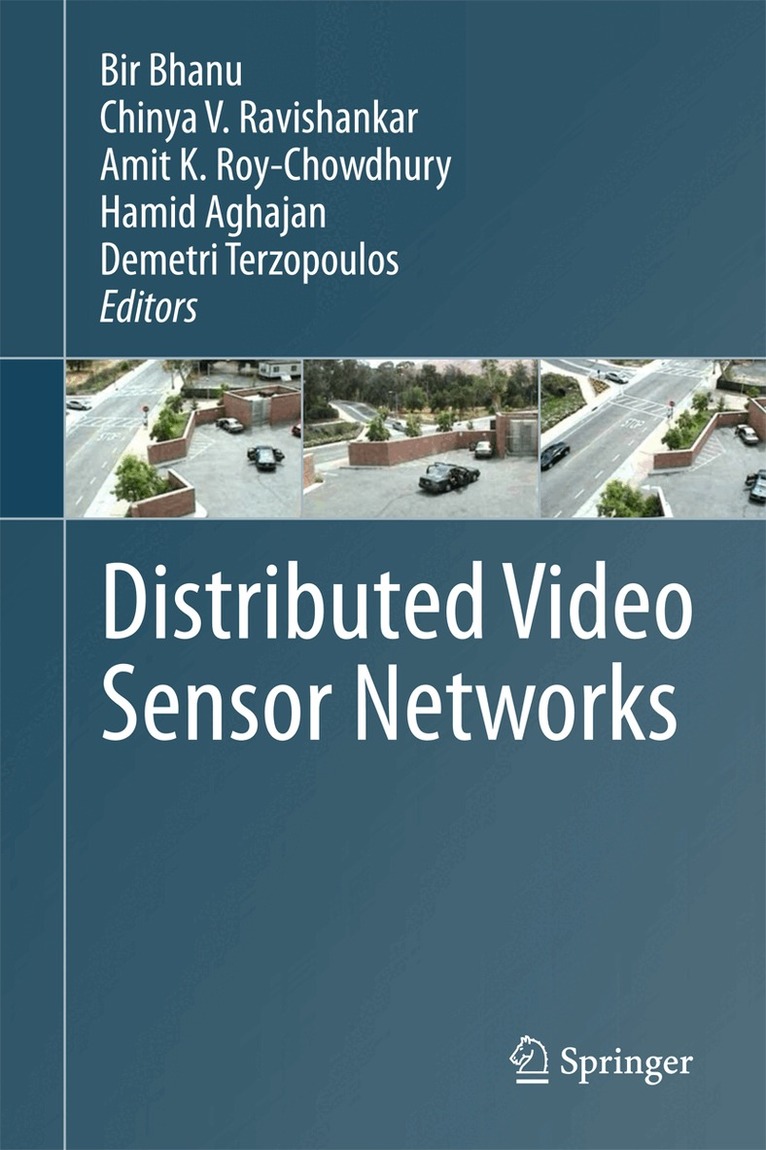
Large-scale video networks are of increasing importance in a wide range of applications. However, the development of automated techniques for aggregating and interpreting information from multiple video streams in real-life scenarios is a challenging area of research.Collecting the work of leading researchers from a broad range of disciplines, this timely text/reference offers an in-depth survey of the state of the art in distributed camera networks. The book addresses a broad spectrum of critical issues in this highly interdisciplinary field: current challenges and future directions; video processing and video understanding; simulation, graphics, cognition and video networks; wireless video sensor networks, communications and control; embedded cameras and real-time video analysis; applications of distributed video networks; and educational opportunities and curriculum-development.Topics and features: presents an overview of research in areas of motion analysis, invariants, multiple cameras for detection, object tracking and recognition, and activities in video networks; provides real-world applications of distributed video networks, including force protection, wide area activities, port security, and recognition in night-time environments; describes the challenges in graphics and simulation, covering virtual vision, network security, human activities, cognitive architecture, and displays; examines issues of multimedia networks, registration, control of cameras (in simulations and real networks), localization and bounds on tracking; discusses system aspects of video networks, with chapters on providing testbed environments, data collection on activities, new integrated sensors for airborne sensors, face recognition, and building sentient spaces; investigates educational opportunities and curriculum development from the perspective of computer science and electrical engineering.This unique text will be of great interest to researchers and graduate students of computer vision and pattern recognition, computer graphics and simulation, image processing and embedded systems, and communications, networks and controls. The large number of example applications will also appeal to application engineers.
2 692 kr
Skickas inom 10-15 vardagar
Over the last thirty years, the subject of nonlinear integrable systems has grown into a full-fledged research topic. In the last decade, Lie algebraic methods have grown in importance to various fields of theoretical research and worked to establish close relations between apparently unrelated systems.The various ideas associated with Lie algebra and Lie groups can be used to form a particularly elegant approach to the properties of nonlinear systems. In this volume, the author exposes the basic techniques of using Lie algebraic concepts to explore the domain of nonlinear integrable systems. His emphasis is not on developing a rigorous mathematical basis, but on using Lie algebraic methods as an effective tool.The book begins by establishing a practical basis in Lie algebra, including discussions of structure Lie, loop, and Virasor groups, quantum tori and Kac-Moody algebras, and gradation. It then offers a detailed discussion of prolongation structure and its representation theory, the orbit approach-for both finite and infinite dimension Lie algebra. The author also presents the modern approach to symmetries of integrable systems, including important new ideas in symmetry analysis, such as gauge transformations, and the "soldering" approach. He then moves to Hamiltonian structure, where he presents the Drinfeld-Sokolov approach, the Lie algebraic approach, Kupershmidt's approach, Hamiltonian reductions and the Gelfand Dikii formula. He concludes his treatment of Lie algebraic methods with a discussion of the classical r-matrix, its use, and its relations to double Lie algebra and the KP equation.
1 578 kr
Skickas inom 10-15 vardagar
Large-scale video networks are of increasing importance in a wide range of applications. However, the development of automated techniques for aggregating and interpreting information from multiple video streams in real-life scenarios is a challenging area of research.Collecting the work of leading researchers from a broad range of disciplines, this timely text/reference offers an in-depth survey of the state of the art in distributed camera networks. The book addresses a broad spectrum of critical issues in this highly interdisciplinary field: current challenges and future directions; video processing and video understanding; simulation, graphics, cognition and video networks; wireless video sensor networks, communications and control; embedded cameras and real-time video analysis; applications of distributed video networks; and educational opportunities and curriculum-development.Topics and features: presents an overview of research in areas of motion analysis, invariants, multiple cameras for detection, object tracking and recognition, and activities in video networks; provides real-world applications of distributed video networks, including force protection, wide area activities, port security, and recognition in night-time environments; describes the challenges in graphics and simulation, covering virtual vision, network security, human activities, cognitive architecture, and displays; examines issues of multimedia networks, registration, control of cameras (in simulations and real networks), localization and bounds on tracking; discusses system aspects of video networks, with chapters on providing testbed environments, data collection on activities, new integrated sensors for airborne sensors, face recognition, and building sentient spaces; investigates educational opportunities and curriculum development from the perspective of computer science and electrical engineering.This unique text will be of great interest to researchers and graduate students of computer vision and pattern recognition, computer graphics and simulation, image processing and embedded systems, and communications, networks and controls. The large number of example applications will also appeal to application engineers.
2 289 kr
Skickas inom 10-15 vardagar
Over the last thirty years, the subject of nonlinear integrable systems has grown into a full-fledged research topic. In the last decade, Lie algebraic methods have grown in importance to various fields of theoretical research and worked to establish close relations between apparently unrelated systems.The various ideas associated with Lie algebra and Lie groups can be used to form a particularly elegant approach to the properties of nonlinear systems. In this volume, the author exposes the basic techniques of using Lie algebraic concepts to explore the domain of nonlinear integrable systems. His emphasis is not on developing a rigorous mathematical basis, but on using Lie algebraic methods as an effective tool.The book begins by establishing a practical basis in Lie algebra, including discussions of structure Lie, loop, and Virasor groups, quantum tori and Kac-Moody algebras, and gradation. It then offers a detailed discussion of prolongation structure and its representation theory, the orbit approach-for both finite and infinite dimension Lie algebra. The author also presents the modern approach to symmetries of integrable systems, including important new ideas in symmetry analysis, such as gauge transformations, and the "soldering" approach. He then moves to Hamiltonian structure, where he presents the Drinfeld-Sokolov approach, the Lie algebraic approach, Kupershmidt's approach, Hamiltonian reductions and the Gelfand Dikii formula. He concludes his treatment of Lie algebraic methods with a discussion of the classical r-matrix, its use, and its relations to double Lie algebra and the KP equation.
366 kr
Skickas inom 10-15 vardagar
As networks of video cameras are installed in many applications like security and surveillance, environmental monitoring, disaster response, and assisted living facilities, among others, image understanding in camera networks is becoming an important area of research and technology development.
312 kr
Skickas inom 10-15 vardagar
Person re-identification is the problem of associating observations of targets in different non-overlapping cameras. Most of the existing learning-based methods have resulted in improved performance on standard re-identification benchmarks, but at the cost of time-consuming and tediously labeled data. Motivated by this, learning person re-identification models with limited to no supervision has drawn a great deal of attention in recent years.In this book, we provide an overview of some of the literature in person re-identification, and then move on to focus on some specific problems in the context of person re-identification with limited supervision in multi-camera environments. We expect this to lead to interesting problems for researchers to consider in the future, beyond the conventional fully supervised setup that has been the framework for a lot of work in person re-identification.Chapter 1 starts with an overview of the problems in person re-identification and the major research directions. We provide an overview of the prior works that align most closely with the limited supervision theme of this book. Chapter 2 demonstrates how global camera network constraints in the form of consistency can be utilized for improving the accuracy of camera pair-wise person re-identification models and also selecting a minimal subset of image pairs for labeling without compromising accuracy. Chapter 3 presents two methods that hold the potential for developing highly scalable systems for video person re-identification with limited supervision. In the one-shot setting where only one tracklet per identity is labeled, the objective is to utilize this small labeled set along with a larger unlabeled set of tracklets to obtain a re-identification model. Another setting is completely unsupervised without requiring any identity labels. The temporal consistency in the videos allows us to infer about matching objects across the cameras with higher confidence, even withlimited to no supervision. Chapter 4 investigates person re-identification in dynamic camera networks. Specifically, we consider a novel problem that has received very little attention in the community but is critically important for many applications where a new camera is added to an existing group observing a set of targets. We propose two possible solutions for on-boarding new camera(s) dynamically to an existing network using transfer learning with limited additional supervision. Finally, Chapter 5 concludes the book by highlighting the major directions for future research.
303 kr
Skickas inom 10-15 vardagar
The recognition of humans and their activities from video sequences is currently a very active area of research because of its applications in video surveillance, design of realistic entertainment systems, multimedia communications, and medical diagnosis.