Amy Roth McDuffie – författare
Visar alla böcker från författaren Amy Roth McDuffie. Handla med fri frakt och snabb leverans.
4 produkter
4 produkter
Häftad, Engelska, 2016
618 kr
Skickas inom 5-8 vardagar
Employing Mathematical Modeling to Engage Students at All LevelsMathematical modeling plays an increasingly important role both in real-life applications—in engineering, business, the social sciences, climate study, advanced design, and more—and within mathematics education itself. This 2016 volume of Annual Perspectives in Mathematics Education (APME) focuses on this key topic from a wide variety of perspectives and distinguishes it from modeling mathematics. The book’s 25 chapters are grouped into seven sections:Understanding Models and ModelingUsing Models to Represent MathematicsTeaching and Learning about Mathematical ModelingMathematical Modeling as a Vehicle for STEM LearningDesigning Modeling-Oriented Tasks and CurriculaAssessing Mathematical ModelingSupporting Teachers’ Learning about Mathematical ModelingWritten by leading mathematics educators, mathematicians, and researchers, the chapters in this volume include reflections on the meaning and practice of modeling, case studies, research observations, and proven strategies for implementation in the classroom and in teacher education. With its thorough consideration of this essential subject, this year’s volume of APME supports educators at all levels as they incorporate modeling in their instructional practice to improve the learning of mathematics and its applications for all students.
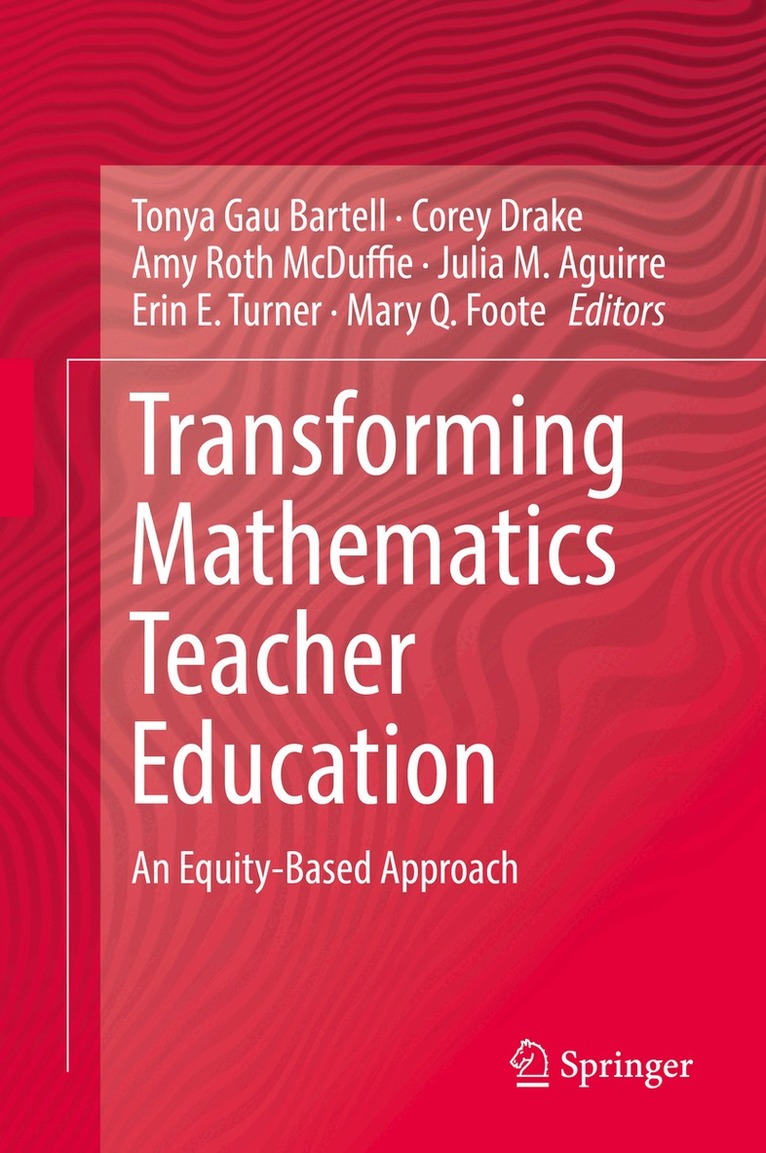
Inbunden, Engelska, 2019
1 403 kr
Skickas inom 10-15 vardagar
This book builds on the Teachers Empowered to Advance Change in Mathematics (TEACH Math) project, which was an initiative that sought to develop a new generation of preK-8 mathematics teachers to connect mathematics, children’s mathematical thinking, and community and family knowledge in mathematics instruction – or what we have come to call children’s multiple mathematical knowledge bases in mathematics instruction, with an explicit focus on equity. Much of the work involved in the TEACH Math project included the development of three instructional modules for preK-8 mathematics methods courses to support the project’s goals. These activities were used and refined over eight semesters, and in Fall 2014 shared at a dissemination conference with other mathematics teacher educators from a variety of universities across the United States. Chapter contributions represent diverse program and geographical contexts and teach prospective and practicing teachers from a variety of socioeconomic and ethnic backgrounds, in particular providing accounts of supports, challenges, and tensions in implementing equity-based mathematics teacher education. The chapters supply rich evidence and illustrative examples of how other mathematics teacher educators and professional developers might make the modules work for their unique practices, courses, workshops, and prospective teachers/teachers. It promises to be an important resource for offering guidance and examples to those working with prospective teachers of mathematics who want to create positive, culturally responsive, and equity-based mathematics experiences for our nation’s youth.
E-bok
Engelska, 20191 223 kr
Läs direkt efter köp
This book builds on the Teachers Empowered to Advance Change in Mathematics (TEACH Math) project, which was an initiative that sought to develop a new generation of preK-8 mathematics teachers to connect mathematics, children’s mathematical thinking, and community and family knowledge in mathematics instruction – or what we have come to call children’s multiple mathematical knowledge bases in mathematics instruction, with an explicit focus on equity. Much of the work involved in the TEACH Math project included the development of three instructional modules for preK-8 mathematics methods courses to support the project’s goals. These activities were used and refined over eight semesters, and in Fall 2014 shared at a dissemination conference with other mathematics teacher educators from a variety of universities across the United States. Chapter contributions represent diverse program and geographical contexts and teach prospective and practicing teachers from a variety of socioeconomic and ethnic backgrounds, in particular providing accounts of supports, challenges, and tensions in implementing equity-based mathematics teacher education. The chapters supply rich evidence and illustrative examples of how other mathematics teacher educators and professional developers might make the modules work for their unique practices, courses, workshops, and prospective teachers/teachers. It promises to be an important resource for offering guidance and examples to those working with prospective teachers of mathematics who want to create positive, culturally responsive, and equity-based mathematics experiences for our nation’s youth.
Häftad, Engelska, 2020
973 kr
Skickas inom 10-15 vardagar
This book builds on the Teachers Empowered to Advance Change in Mathematics (TEACH Math) project, which was an initiative that sought to develop a new generation of preK-8 mathematics teachers to connect mathematics, children’s mathematical thinking, and community and family knowledge in mathematics instruction – or what we have come to call children’s multiple mathematical knowledge bases in mathematics instruction, with an explicit focus on equity. Much of the work involved in the TEACH Math project included the development of three instructional modules for preK-8 mathematics methods courses to support the project’s goals. These activities were used and refined over eight semesters, and in Fall 2014 shared at a dissemination conference with other mathematics teacher educators from a variety of universities across the United States. Chapter contributions represent diverse program and geographical contexts and teach prospective and practicing teachers from a variety of socioeconomic and ethnic backgrounds, in particular providing accounts of supports, challenges, and tensions in implementing equity-based mathematics teacher education. The chapters supply rich evidence and illustrative examples of how other mathematics teacher educators and professional developers might make the modules work for their unique practices, courses, workshops, and prospective teachers/teachers. It promises to be an important resource for offering guidance and examples to those working with prospective teachers of mathematics who want to create positive, culturally responsive, and equity-based mathematics experiences for our nation’s youth.