Anand Balu Nellippallil - Böcker
Visar alla böcker från författaren Anand Balu Nellippallil. Handla med fri frakt och snabb leverans.
4 produkter
4 produkter
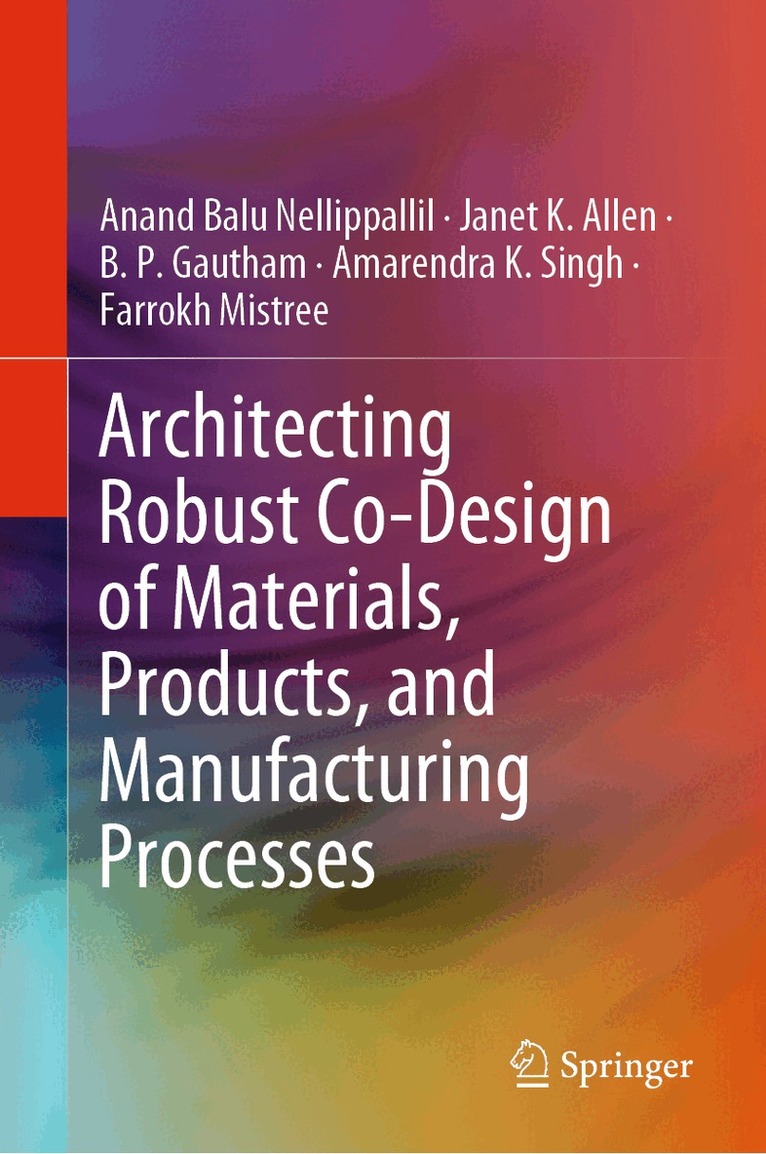
Architecting Robust Co-Design of Materials, Products, and Manufacturing Processes
Inbunden, Engelska, 2020
1 578 kr
Skickas inom 10-15 vardagar
This book explores systems-based, co-design, introducing a “Decision-Based, Co-Design” (DBCD) approach for the co-design of materials, products, and processes. In recent years there have been significant advances in modeling and simulation of material behavior, from the smallest atomic scale to the macro scale.
Architecting Robust Co-Design of Materials, Products, and Manufacturing Processes
Häftad, Engelska, 2021
1 578 kr
Skickas inom 10-15 vardagar
This book explores systems-based, co-design, introducing a “Decision-Based, Co-Design” (DBCD) approach for the co-design of materials, products, and processes. In recent years there have been significant advances in modeling and simulation of material behavior, from the smallest atomic scale to the macro scale.
1 787 kr
Skickas inom 10-15 vardagar
"Design Engineering for Industry 4.0 (DE4.0) represents the 'human-cyber-physical view of the systems realization ecosystem “that is necessary to accommodate the drivers of Industry 4.0 (IoX) and provide an open ecosystem for the realization of complex systems. Seamless integration of digital threads and digital twins throughout the product design, the development and fulfillment lifecycle; the ability to accommodate diverse and rapidly changing technologies; and the mechanisms to facilitate the creation of new opportunities for the design of products, processes, services, and systems are some of the desired characteristics of DE4.0."Jiao, R., Commuri, S. Panchal, J., Milisavljevic-Syed, J, Allen, J.K., Mistree, F. and Schaefer, D., "Design Engineering in the Age of Industry 4.0," ASME Journal of Mechanical Design, 143(7), 070801, 25 pages.In keeping with the Design Engineering 4.0 construct the authors describe architecting a computer platform to support human designers make decisions associated with the realization of complex engineered systems. The platform is designed to facilitate end-to-end digital integration, customization and personalization, agile collaboration networks, open innovation, co-creation and crowdsourcing, product servitization and anything-as-a-service.Recognizing that simulation models are abstractions of reality the authors opt for a satisficing strategy instead of an optimization strategy. They include fundamentals and then describe tools for architecting a knowledge-based platforms for decision support. Challenges associated with developing a computational platform for decision support for the realization of complex engineered systems in the context of Design Engineering 4.0 are identified. Constructs for formulating design decisions (e.g., selection, compromise, and coupled decisions), knowledge modelling schemes (e.g., ontologies and modular templates), diagrams for designing decision workflows (e.g., the PEI-X diagram), and some analytical methods for robust design under uncertainty are presented. The authors describe integrating the knowledge-based platform to architect a cloud-based platform for decision support promoting co-design and cloud-based design communication essential for mass collaboration and open innovation for Design Engineering 4.0.This book is a valuable resource for researchers, design engineers, and others working on pushing the boundary of digitized manufacturing to include Design Engineering 4.0 principles in designing products, processes, and services.
1 787 kr
Skickas inom 10-15 vardagar
"Design Engineering for Industry 4.0 (DE4.0) represents the 'human-cyber-physical view of the systems realization ecosystem “that is necessary to accommodate the drivers of Industry 4.0 (IoX) and provide an open ecosystem for the realization of complex systems. Seamless integration of digital threads and digital twins throughout the product design, the development and fulfillment lifecycle; the ability to accommodate diverse and rapidly changing technologies; and the mechanisms to facilitate the creation of new opportunities for the design of products, processes, services, and systems are some of the desired characteristics of DE4.0."Jiao, R., Commuri, S. Panchal, J., Milisavljevic-Syed, J, Allen, J.K., Mistree, F. and Schaefer, D., "Design Engineering in the Age of Industry 4.0," ASME Journal of Mechanical Design, 143(7), 070801, 25 pages.In keeping with the Design Engineering 4.0 construct the authors describe architecting a computer platform to support human designers make decisions associated with the realization of complex engineered systems. The platform is designed to facilitate end-to-end digital integration, customization and personalization, agile collaboration networks, open innovation, co-creation and crowdsourcing, product servitization and anything-as-a-service.Recognizing that simulation models are abstractions of reality the authors opt for a satisficing strategy instead of an optimization strategy. They include fundamentals and then describe tools for architecting a knowledge-based platforms for decision support. Challenges associated with developing a computational platform for decision support for the realization of complex engineered systems in the context of Design Engineering 4.0 are identified. Constructs for formulating design decisions (e.g., selection, compromise, and coupled decisions), knowledge modelling schemes (e.g., ontologies and modular templates), diagrams for designing decision workflows (e.g., the PEI-X diagram), and some analytical methods for robust design under uncertainty are presented. The authors describe integrating the knowledge-based platform to architect a cloud-based platform for decision support promoting co-design and cloud-based design communication essential for mass collaboration and open innovation for Design Engineering 4.0.This book is a valuable resource for researchers, design engineers, and others working on pushing the boundary of digitized manufacturing to include Design Engineering 4.0 principles in designing products, processes, and services.