Janet K. Allen - Böcker
Visar alla böcker från författaren Janet K. Allen. Handla med fri frakt och snabb leverans.
8 produkter
8 produkter
698 kr
Skickas inom 10-15 vardagar
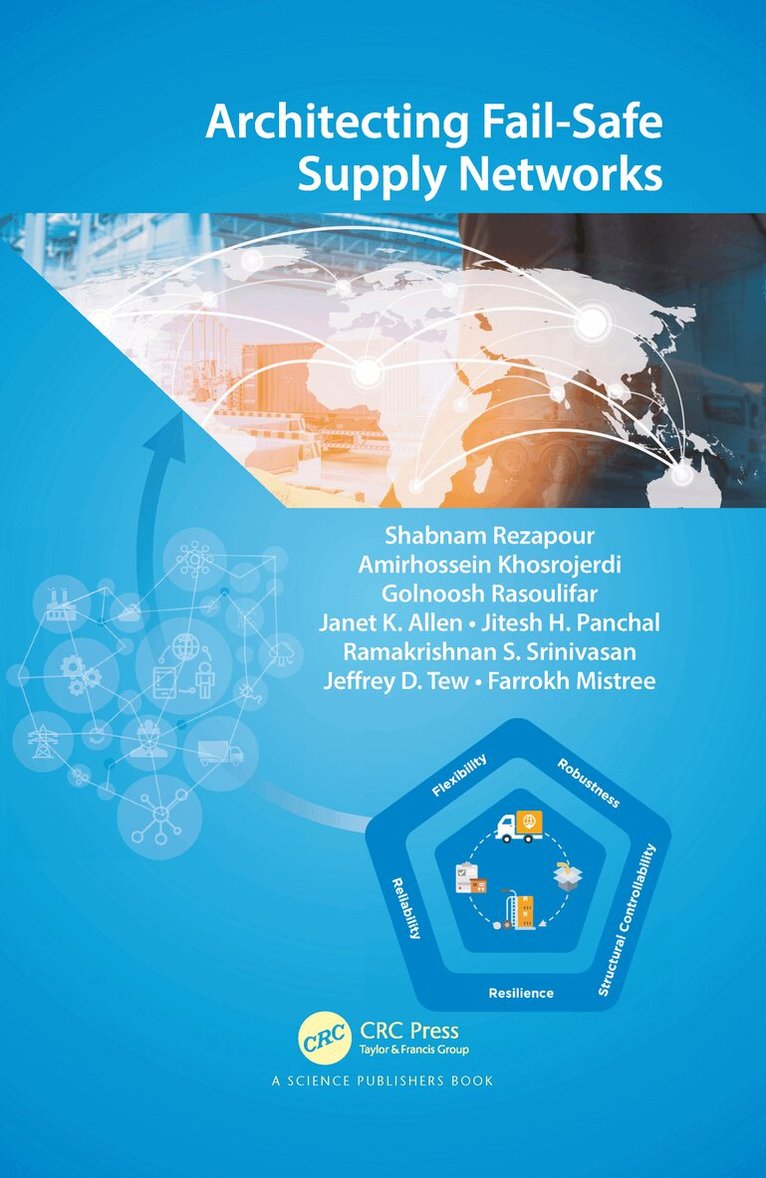
A fail-safe supply network is designed to mitigate the impact of variations and disruptions on people and corporations. This is achieved by (1) developing a network structure to mitigate the impact of disruptions that distort the network structure and (2) planning flow through the network to neutralize the effects of variations. In this monograph, we propose a framework, develop mathematical models and provide examples of fail-safe supply network design. We show that, contrary to current thinking as embodied in the supply network literature, disruption management decisions made at the strategic network design level are not independent from variation management decisions made at the operational level. Accordingly, we suggest that it is beneficial to manage disruptions and variations concurrently in supply networks. This is achieved by architecting fail-safe supply networks, which are characterized by the following elements: reliability, robustness, flexibility, structural controllability, and resilience. Organizations can use the framework presented in this monograph to manage variations and disruptions. Managers can select the best operational management strategies for their supply networks considering variations in supply and demand, and identify the best network restoration strategies including facility fortification, backup inventory, flexible production capacity, flexible inventory, and transportation route reconfiguration. The framework is generalizable to other complex engineered networks.
2 692 kr
Skickas inom 10-15 vardagar
A fail-safe supply network is designed to mitigate the impact of variations and disruptions on people and corporations. This is achieved by (1) developing a network structure to mitigate the impact of disruptions that distort the network structure and (2) planning flow through the network to neutralize the effects of variations. In this monograph, we propose a framework, develop mathematical models and provide examples of fail-safe supply network design. We show that, contrary to current thinking as embodied in the supply network literature, disruption management decisions made at the strategic network design level are not independent from variation management decisions made at the operational level. Accordingly, we suggest that it is beneficial to manage disruptions and variations concurrently in supply networks. This is achieved by architecting fail-safe supply networks, which are characterized by the following elements: reliability, robustness, flexibility, structural controllability, and resilience. Organizations can use the framework presented in this monograph to manage variations and disruptions. Managers can select the best operational management strategies for their supply networks considering variations in supply and demand, and identify the best network restoration strategies including facility fortification, backup inventory, flexible production capacity, flexible inventory, and transportation route reconfiguration. The framework is generalizable to other complex engineered networks.
Architecting Networked Engineered Systems
Manufacturing Systems Design for Industry 4.0
Inbunden, Engelska, 2020
1 892 kr
Skickas inom 10-15 vardagar
In this monograph, the authors demonstrate how the integration of adaptability, operability, and re-configurability in the design of complex systems is indispensable for the further digitization of engineering systems in smart manufacturing.
Architecting Robust Co-Design of Materials, Products, and Manufacturing Processes
Inbunden, Engelska, 2020
1 578 kr
Skickas inom 10-15 vardagar
This book explores systems-based, co-design, introducing a “Decision-Based, Co-Design” (DBCD) approach for the co-design of materials, products, and processes. In recent years there have been significant advances in modeling and simulation of material behavior, from the smallest atomic scale to the macro scale.
Architecting Robust Co-Design of Materials, Products, and Manufacturing Processes
Häftad, Engelska, 2021
1 578 kr
Skickas inom 10-15 vardagar
This book explores systems-based, co-design, introducing a “Decision-Based, Co-Design” (DBCD) approach for the co-design of materials, products, and processes. In recent years there have been significant advances in modeling and simulation of material behavior, from the smallest atomic scale to the macro scale.
1 787 kr
Skickas inom 10-15 vardagar
"Design Engineering for Industry 4.0 (DE4.0) represents the 'human-cyber-physical view of the systems realization ecosystem “that is necessary to accommodate the drivers of Industry 4.0 (IoX) and provide an open ecosystem for the realization of complex systems. Seamless integration of digital threads and digital twins throughout the product design, the development and fulfillment lifecycle; the ability to accommodate diverse and rapidly changing technologies; and the mechanisms to facilitate the creation of new opportunities for the design of products, processes, services, and systems are some of the desired characteristics of DE4.0."Jiao, R., Commuri, S. Panchal, J., Milisavljevic-Syed, J, Allen, J.K., Mistree, F. and Schaefer, D., "Design Engineering in the Age of Industry 4.0," ASME Journal of Mechanical Design, 143(7), 070801, 25 pages.In keeping with the Design Engineering 4.0 construct the authors describe architecting a computer platform to support human designers make decisions associated with the realization of complex engineered systems. The platform is designed to facilitate end-to-end digital integration, customization and personalization, agile collaboration networks, open innovation, co-creation and crowdsourcing, product servitization and anything-as-a-service.Recognizing that simulation models are abstractions of reality the authors opt for a satisficing strategy instead of an optimization strategy. They include fundamentals and then describe tools for architecting a knowledge-based platforms for decision support. Challenges associated with developing a computational platform for decision support for the realization of complex engineered systems in the context of Design Engineering 4.0 are identified. Constructs for formulating design decisions (e.g., selection, compromise, and coupled decisions), knowledge modelling schemes (e.g., ontologies and modular templates), diagrams for designing decision workflows (e.g., the PEI-X diagram), and some analytical methods for robust design under uncertainty are presented. The authors describe integrating the knowledge-based platform to architect a cloud-based platform for decision support promoting co-design and cloud-based design communication essential for mass collaboration and open innovation for Design Engineering 4.0.This book is a valuable resource for researchers, design engineers, and others working on pushing the boundary of digitized manufacturing to include Design Engineering 4.0 principles in designing products, processes, and services.
1 787 kr
Skickas inom 10-15 vardagar
"Design Engineering for Industry 4.0 (DE4.0) represents the 'human-cyber-physical view of the systems realization ecosystem “that is necessary to accommodate the drivers of Industry 4.0 (IoX) and provide an open ecosystem for the realization of complex systems. Seamless integration of digital threads and digital twins throughout the product design, the development and fulfillment lifecycle; the ability to accommodate diverse and rapidly changing technologies; and the mechanisms to facilitate the creation of new opportunities for the design of products, processes, services, and systems are some of the desired characteristics of DE4.0."Jiao, R., Commuri, S. Panchal, J., Milisavljevic-Syed, J, Allen, J.K., Mistree, F. and Schaefer, D., "Design Engineering in the Age of Industry 4.0," ASME Journal of Mechanical Design, 143(7), 070801, 25 pages.In keeping with the Design Engineering 4.0 construct the authors describe architecting a computer platform to support human designers make decisions associated with the realization of complex engineered systems. The platform is designed to facilitate end-to-end digital integration, customization and personalization, agile collaboration networks, open innovation, co-creation and crowdsourcing, product servitization and anything-as-a-service.Recognizing that simulation models are abstractions of reality the authors opt for a satisficing strategy instead of an optimization strategy. They include fundamentals and then describe tools for architecting a knowledge-based platforms for decision support. Challenges associated with developing a computational platform for decision support for the realization of complex engineered systems in the context of Design Engineering 4.0 are identified. Constructs for formulating design decisions (e.g., selection, compromise, and coupled decisions), knowledge modelling schemes (e.g., ontologies and modular templates), diagrams for designing decision workflows (e.g., the PEI-X diagram), and some analytical methods for robust design under uncertainty are presented. The authors describe integrating the knowledge-based platform to architect a cloud-based platform for decision support promoting co-design and cloud-based design communication essential for mass collaboration and open innovation for Design Engineering 4.0.This book is a valuable resource for researchers, design engineers, and others working on pushing the boundary of digitized manufacturing to include Design Engineering 4.0 principles in designing products, processes, and services.
1 578 kr
Skickas inom 10-15 vardagar
In this book, the authors describe how designers evolve their designs through the Design Evolution Cycle. It identifies challenges associated with designing complex systems, such as dealing with multiple conflicting goals, evolving design preferences, nonlinear and nonconvex constraints and goals, continuous and discrete variables, coupled decisions, sub-models with different levels of fidelity, and emergent properties.The book empowers designers to make robust, informed, and iteratively improved decisions in designing complex systems