Anastasius Gavras - Böcker
Visar alla böcker från författaren Anastasius Gavras. Handla med fri frakt och snabb leverans.
6 produkter
6 produkter
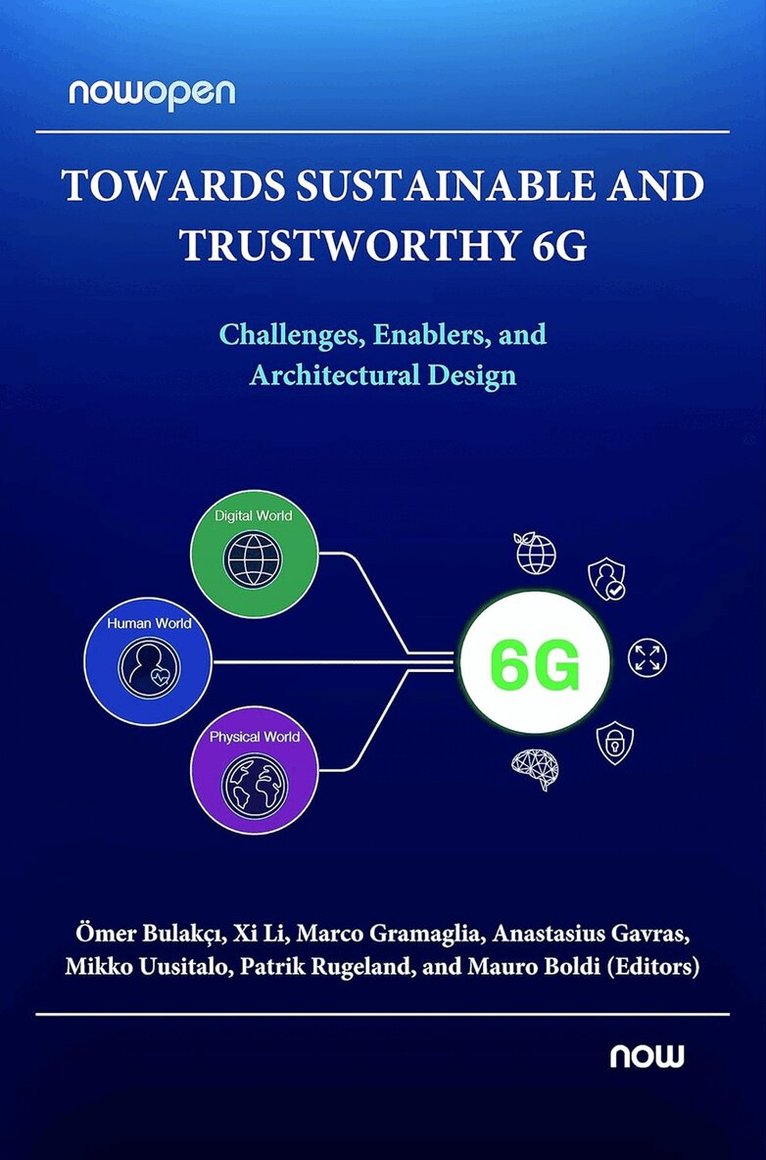
Towards Sustainable and Trustworthy 6G
Challenges, Enablers, and Architectural Design
Inbunden, Engelska, 2023
1 259 kr
Skickas inom 7-10 vardagar
The ebook edition of this title is Open Access and freely available to read online.While the 5th Generation (5G) system is being widely deployed across the globe, the research and consensus building for the 6th generation (6G) are already well underway with high expectations toward the merger of digital, physical and human worlds. The main goal of this book is to introduce the upcoming 6G technologies and outline the foreseen challenges, enablers, and architectural design trends that will be instrumental in realizing a Sustainable and Trustworthy 6G system in the coming years.The envisioned 6G system promises to offer a more advanced and comprehensive user experience not only by achieving higher speeds, larger capacity, and lower latency, but also much more improved reliability, greater energy efficiency, and an enhanced security framework while natively integrating intelligence end-to-end (E2E). Achieving these goals will require innovative technological solutions and a holistic system design that considers the needs of various stakeholders and future 6G use cases.Capitalizing on the 5G Public-Private-Partnership (5G PPP) Phase 3 projects and the join efforts between the Architecture Working Group and the flagship Hexa-X project, this book delves into the critical challenges and enablers of the 6G system, including new network architectures and novel enhancements as well as the role of regulators, network operators, industry players, application developers, and end-users. Accordingly, this book provides a comprehensive overview of the current research activities on 6G and sets a solid cornerstone towards a more connected, intelligent, and sustainable world.
1 069 kr
Skickas inom 10-15 vardagar
Healthcare and well-being have captured the attention of established software companies, start-ups, and investors. Software is starting to play a central role for addressing the problems of the aging society and the escalating cost of healthcare services. Enablers of such digital health are a growing number of sensors for sensing the human body and communication infrastructure for remote meetings, data sharing, and messaging. The challenge that lies in front of us is how to effectively make use of these capabilities, for example to empower patients and to free the scarce resources of medical personnel.Requirements engineering is the process by which the capabilities of a software product are aligned with stakeholder needs and a shared understanding between the stakeholders and development team established. This book provides guide for what to look for and do when inquiring and specifying software that targets healthcare and well-being, helping readers avoid the pitfalls of the highly regulated and sensible healthcare domain are and how they can be overcome.This book brings together the knowledge of 22 researchers, engineers, lawyers, and CEOs that have experience in the development of digital health solutions. It represents a unique line-up of best practices and recommendations of how to engineer requirements for digital health. In particular the book presents:· The area of digital health, e-health, and m-health· Best practice for requirements engineering based on evidence from a large number of projects· Practical step-by-step guidelines, examples, and lessons-learned for working with laws, regulations, ethical issues, interoperability, user experience, security, and privacy· How to put these many concerns together for engineering the requirements of a digital health solution and for scaling a digital health productFor anybody who intends to develop software for digital health, this book is an introduction and reference with a wealth of actionable insights. For students interested in understanding how to apply software to healthcare, the text introduces key topics and guides further studies with references to important literature.
999 kr
Skickas inom 10-15 vardagar
Healthcare and well-being have captured the attention of established software companies, start-ups, and investors. Software is starting to play a central role for addressing the problems of the aging society and the escalating cost of healthcare services. Enablers of such digital health are a growing number of sensors for sensing the human body and communication infrastructure for remote meetings, data sharing, and messaging. The challenge that lies in front of us is how to effectively make use of these capabilities, for example to empower patients and to free the scarce resources of medical personnel.Requirements engineering is the process by which the capabilities of a software product are aligned with stakeholder needs and a shared understanding between the stakeholders and development team established. This book provides guide for what to look for and do when inquiring and specifying software that targets healthcare and well-being, helping readers avoid the pitfalls of the highly regulated and sensible healthcare domain are and how they can be overcome.This book brings together the knowledge of 22 researchers, engineers, lawyers, and CEOs that have experience in the development of digital health solutions. It represents a unique line-up of best practices and recommendations of how to engineer requirements for digital health. In particular the book presents:· The area of digital health, e-health, and m-health· Best practice for requirements engineering based on evidence from a large number of projects· Practical step-by-step guidelines, examples, and lessons-learned for working with laws, regulations, ethical issues, interoperability, user experience, security, and privacy· How to put these many concerns together for engineering the requirements of a digital health solution and for scaling a digital health productFor anybody who intends to develop software for digital health, this book is an introduction and reference with a wealth of actionable insights. For students interested in understanding how to apply software to healthcare, the text introduces key topics and guides further studies with references to important literature.
Future Internet
Future Internet Assembly 2011: Achievements and Technological Promises
Häftad, Engelska, 2011
538 kr
Skickas inom 10-15 vardagar
Irrespective of whether we use economic or societal metrics, the Internet is one of the most important technical infrastructures in existence today. It will be a catalyst for much of our innovation and prosperity in the future. A competitive Europe will require Internet connectivity and services beyond the capabilities offered by current technologies. Future Internet research is therefore a must. This book is published in full compliance with the Open Access publishing initiative; it is based on the research carried out within the Future Internet Assembly (FIA). It contains a sample of representative results from the recent FIA meetings spanning a broad range of topics, all being of crucial importance for the future Internet. The book includes 32 contributions and has been structured into the following sections, each of which is preceded by a short introduction:Foundations: architectural issues; socio-economic issues; security and trust; and experiments and experimental design. Future Internet Areas: networks, services, and content; and applications.
538 kr
Skickas inom 10-15 vardagar
Irrespective of whether we use economic or societal metrics, the Internet is one of the most important technical infrastructures in existence today. It will serve as a catalyst for much of our innovation and prosperity in the future. A competitive Europe will require Internet connectivity and services beyond the capabilities offered by current technologies. Future Internet research is therefore a must.The Future Internet Assembly (FIA) is a successful and unique bi-annual conference that brings together participants of over 150 projects from several distinct but interrelated areas in the EU Framework Programme 7. The 20 full papers included in this volume were selected from 40 submissions, and are preceded by a vision paper describing the FIA Roadmap. The papers have been organized into topical sections on the foundations of Future Internet, the applications of Future Internet, Smart Cities, and Future Internet infrastructures.
Future Internet
Future Internet Assembly 2013: Validated Results and New Horizons
Häftad, Engelska, 2013
554 kr
Skickas inom 10-15 vardagar
Co-editors of the volume are: Federico Álvarez, Alessandro Bassi, Michele Bezzi, Laurent Ciavaglia, Frances Cleary, Petros Daras, Hermann De Meer, Panagiotis Demestichas, John Domingue, Theo G. Kanter, Stamatis Karnouskos, Srdjan Krčo, Laurent Lefevre, Jasper Lentjes, Man-Sze Li, Paul Malone, Antonio Manzalini, Volkmar Lotz, Henning Müller, Karsten Oberle, Noel E. O'Connor, Nick Papanikolaou, Dana Petcu, Rahim Rahmani, Danny Raz, Gaël Richards, Elio Salvadori, Susana Sargento, Hans Schaffers, Joan Serrat, Burkhard Stiller, Antonio F. Skarmeta, Kurt Tutschku, Theodore ZahariadisThe Internet is the most vital scientific, technical, economic and societal set of infrastructures in existenceand in operation today serving 2.5 billion users. Continuing its developments would secure much of the upcoming innovation and prosperity and it would underpin the sustainable growth in economic values and volumes needed in the future. Future Internet infrastructures research is therefore a must. The Future Internet Assembly (FIA) is a successful conference that brings together participants of over 150 research projects from several distinct yet interrelated areas in the European Union Framework Programme 7 (FP7). The research projects are grouped as follows: the network of the future as infrastructure connecting and orchestrating the future Internet of people, computers, devices, content, clouds and things; cloud computing, Internet of Services and advanced software engineering; the public-private partnership projects on Future Internet; Future Internet Research and Experimentation (FIRE). The 26 full papers included in this volume were selected from 45 submissions. Theyare organized in topical sections named: software driven networks, virtualization, programmability and autonomic management; computing and networking clouds; internet of things; and enabling technologies and economic incentives.