AndrA(c) Blais – författare
Visar alla böcker från författaren AndrA(c) Blais. Handla med fri frakt och snabb leverans.
6 produkter
6 produkter
E-bok
PDF, Engelska, 2013416 kr
Läs direkt efter köp
Outcomes of legislative elections are typically reported in terms of party support: how many votes and seats were obtained by each party? But in fact voters are faced with three choices which must be folded into one. They must decide which party they prefer, but in so doing they must take account of the policies advocated by these parties and the leaders who will eventually have to enact them.This simple fact raises question about the relative weight of these considerations, and espeically the importance granted to the leaders. This issue has been largely neglected in the vast literature on voting behaviour.The dominant traditions in the study of voting behaviour focus on political parties and party identification; and on political issues and ideology, respectively.This volume uses election surveys over the past 50 years to systematically assesses the impact of political leaders on voting decisions in nine democracies (Australia, Britain, Canada, Germany, the Netherlands, Norway, Spain, Sweden, and the United States). It analyses issues such as the changes in political communication (particularly the rise of televized politics), and the relative importance accorded to political leaders in different types of political systems. It demonstrates how electoralsystems and other political institutions have a discernible effect on the importance voters accord to actual political leaders. Contrary to popular wisdom, Political Leaders and Democratic Elections shows how unimportant the characteristics of political leaders, parties, and indeed the votersthemselves actually are on voting patterns. The volume shows that voters tend to let themselves be guided by the leaders they like rather than being pushed away from those they dislike.Comparative Politics is a series for students, teachers, and researchers of political science that deals with contemporary government and politics. Global in scope, books in the series are characterised by a stress on comparative analysis and strong methodological rigour. The series is published in association with the European Consortium for Political Research. For more information visit: www.ecprnet.eu. The Comparative Politics series is edited by Professor David M. Farrell,School of Politics and International Relations, University College Dublin, Kenneth Carty, Professor of Political Science, University of British Columbia, and Professor Dirk Berg-Schlosser, Institute of Political Science, Philipps University, Marburg.
E-bok
PDF, Engelska, 20111 323 kr
Läs direkt efter köp
Three unprecedented large-scale democratic experiments have recently taken place. Citizen assemblies on electoral reform were conducted in British Columbia, the Netherlands, and Ontario. Groups of randomly selected ordinary citizens were asked to independently design the next electoral system. In each case, the participants spent almost an entire year learning about electoral systems, consulting the public, deliberating, debating, and ultimately deciding whatspecific institution should be adopted.When Citizens Decide uses these unique cases to examine claims about citizens'' capacity for democratic deliberation and active engagement in policy-making. It offers empirical insight into numerous debates and provides answers to a series of key questions: 1) Are ordinary citizens able to decide about a complex issue? Are their decisions reasonable? 2) Who takes part in such proceedings? Are they dominated by people dissatisfied by the status quo? 3) Do some citizens play a moreprominent role than others? Are decisions driven by the most vocal or most informed members? 4) Did the participants decide by themselves? Were they influenced by staff, political parties, interest groups, or the public hearings? 5) Does participation in a deliberative process foster citizenship? Did participantsbecome more trusting, tolerant, open-minded, civic-minded, interested in politics, and active in politics? 6) How do the other political actors react? Can the electorate accept policy proposals made by a group of ordinary citizens?The analyses rely upon various types of evidence about both the inner workings of the assemblies and the reactions toward them outside: multi-wave panel surveys of assembly members, content analysis of newspaper coverage, and public opinion survey data. The lessons drawn from this research are relevant to those interested in political participation, public opinion, deliberation, public policy, and democracy.Comparative Politics is a series for students, teachers, and researchers of political science that deals with contemporary government and politics. Global in scope, books in the series are characterised by a stress on comparative analysis and strong methodological rigour. The series is published in association with the European Consortium for Political Research. For more information visit: www.essex.ac.uk/ecpr. The Comparative Politics Series is edited by ProfessorDavid M. Farrell, School of Politics and International Relations, University College Dublin, Kenneth Carty, Professor of Political Science, University of British Columbia, and Professor Dirk Berg-Schlosser, Institute of Political Science, Philipps University, Marburg.
E-bok
PDF, Engelska, 20121 288 kr
Läs direkt efter köp
Politics at the Centre is a comparative study of the rules, norms and behaviour surrounding political party leadership. The primary analysis includes 25 parties in Australia, Canada, Ireland, New Zealand, and the United Kingdom from 1965 onwards. The topics covered include methods of leadership selection and removal and the nature of leadership politics. The themes of the book include intra party democracy, with an emphasis on the relative roles of theparliamentary and extra parliamentary groups, and the causes of organizational reform within parties.Particular attention is paid to change over time and to differences among parties with explanations offered for both. Considerable attention is paid to the trend of expanding the leadership selectorate including consideration of why many parties are adopting this reform while others resist it. Data, collected from more than 200 leadership elections, are analyzed to consider issues such as the competitiveness of leadership contests, the types of individuals who win the contests and thelongevity of leaders. The influence of different methods of selection and removal on these issues is also examined.Much of the analysis is based on in-country interviews conducted with active politicians, former and current party leaders, political journalists and officials of the extra parliamentary parties. Extensive use is also made of a comprehensive review of party documents related to leadership selection. Many real-life examples from all five countries are used to illustrate the central concepts and themes.A separate chapter considers the applicability of the findings from the Westminster systems to parties in other parliamentary and presidential systems. The concluding chapter makes a normative argument for a particular version of leadership selection and removal.Comparative Politics is a series for students, teachers, and researchers of political science that deals with contemporary government and politics. Global in scope, books in the series are characterised by a stress on comparative analysis and strong methodological rigour. The series is published in association with the European Consortium for Political Research. For more information visit: www.essex.ac.uk/ecpr. The Comparative Politics Series is edited by Professor David M. Farrell,School of Politics and International Relations, University College Dublin, Kenneth Carty, Professor of Political Science, University of British Columbia, and Professor Dirk Berg-Schlosser, Institute of Political Science, Philipps University, Marburg.
E-bok
PDF, Engelska, 2017945 kr
Läs direkt efter köp
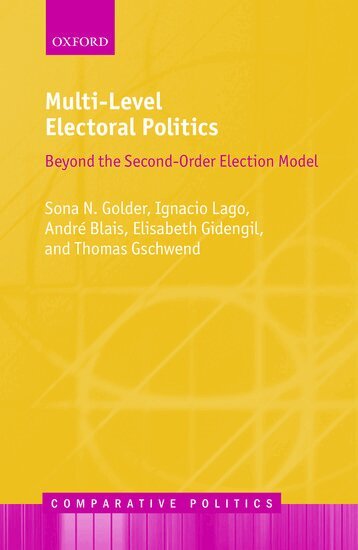
National-level elections receive more attention from scholars and the media than elections at other levels, even though in many European countries the importance of both regional and European levels of government has grown in recent years. The growing importance of multiple electoral arenas suggests that scholars should be cautious about examining single levels in isolation. Taking the multilevel structure of electoral politics seriously requires a re-examination ofhow the incentives created by electoral institutions affect the behaviour of voters and party elites.The standard approach to analysing multilevel elections is the second-order election (SOE) model, in which national elections are considered to be first-order elections while other elections are second order. However, this model does not provide micro mechanisms that determine how elections in one arena affect those in another, or explain variations in individual voting behaviour.The objective of this book is to explain how party and voter behaviour in a given election is affected by the existence of multiple electoral arenas. It provides original qualitative and quantitative data to examine European, national, and subnational elections in France, Germany, and Spain from 2011-2015. The volume examines party mobilization efforts across multiple electoral arenas, as well as decisions by individual voters with respect to turnout, strategic voting, and accountability. Thisbook provides the first systematic analysis of multilevel electoral politics at three different levels across multiple countries.Comparative Politics is a series for researchers, teachers, and students of political science that deals with contemporary government and politics. Global in scope, books in the series are characterised by a stress on comparative analysis and strong methodological rigour. The series is published in association with the European Consortium for Political Research. For more information visit: www.ecprnet.eu.The series is edited by Emilie van Haute, Professor of Political Science, Université libre de Bruxelles; Ferdinand Müller-Rommel, Director of the Center for the Study of Democracy, Leuphana University; and Susan Scarrow, Chair of the Department of Political Science, University of Houston.
E-bok
Engelska, 2017945 kr
Läs direkt efter köp
National-level elections receive more attention from scholars and the media than elections at other levels, even though in many European countries the importance of both regional and European levels of government has grown in recent years. The growing importance of multiple electoral arenas suggests that scholars should be cautious about examining single levels in isolation. Taking the multilevel structure of electoral politics seriously requires a re-examination ofhow the incentives created by electoral institutions affect the behaviour of voters and party elites.The standard approach to analysing multilevel elections is the second-order election (SOE) model, in which national elections are considered to be first-order elections while other elections are second order. However, this model does not provide micro mechanisms that determine how elections in one arena affect those in another, or explain variations in individual voting behaviour.The objective of this book is to explain how party and voter behaviour in a given election is affected by the existence of multiple electoral arenas. It provides original qualitative and quantitative data to examine European, national, and subnational elections in France, Germany, and Spain from 2011-2015. The volume examines party mobilization efforts across multiple electoral arenas, as well as decisions by individual voters with respect to turnout, strategic voting, and accountability. Thisbook provides the first systematic analysis of multilevel electoral politics at three different levels across multiple countries.Comparative Politics is a series for researchers, teachers, and students of political science that deals with contemporary government and politics. Global in scope, books in the series are characterised by a stress on comparative analysis and strong methodological rigour. The series is published in association with the European Consortium for Political Research. For more information visit: www.ecprnet.eu.The series is edited by Emilie van Haute, Professor of Political Science, Université libre de Bruxelles; Ferdinand Müller-Rommel, Director of the Center for the Study of Democracy, Leuphana University; and Susan Scarrow, Chair of the Department of Political Science, University of Houston.
Inbunden, Engelska, 2017
1 633 kr
Skickas inom 3-6 vardagar
National-level elections receive more attention from scholars and the media than elections at other levels, even though in many European countries the importance of both regional and European levels of government has grown in recent years. The growing importance of multiple electoral arenas suggests that scholars should be cautious about examining single levels in isolation. Taking the multilevel structure of electoral politics seriously requires a re-examination of how the incentives created by electoral institutions affect the behaviour of voters and party elites. The standard approach to analysing multilevel elections is the second-order election (SOE) model, in which national elections are considered to be first-order elections while other elections are second order. However, this model does not provide micro mechanisms that determine how elections in one arena affect those in another, or explain variations in individual voting behaviour. The objective of this book is to explain how party and voter behaviour in a given election is affected by the existence of multiple electoral arenas. It provides original qualitative and quantitative data to examine European, national, and subnational elections in France, Germany, and Spain from 2011-2015. The volume examines party mobilization efforts across multiple electoral arenas, as well as decisions by individual voters with respect to turnout, strategic voting, and accountability. This book provides the first systematic analysis of multilevel electoral politics at three different levels across multiple countries.Comparative Politics is a series for researchers, teachers, and students of political science that deals with contemporary government and politics. Global in scope, books in the series are characterised by a stress on comparative analysis and strong methodological rigour. The series is published in association with the European Consortium for Political Research. For more information visit: www.ecprnet.eu. The series is edited by Emilie van Haute, Professor of Political Science, Université libre de Bruxelles; Ferdinand Müller-Rommel, Director of the Center for the Study of Democracy, Leuphana University; and Susan Scarrow, Chair of the Department of Political Science, University of Houston.