András Kiséry - Böcker
Visar alla böcker från författaren András Kiséry. Handla med fri frakt och snabb leverans.
4 produkter
4 produkter
1 684 kr
Skickas inom 7-10 vardagar
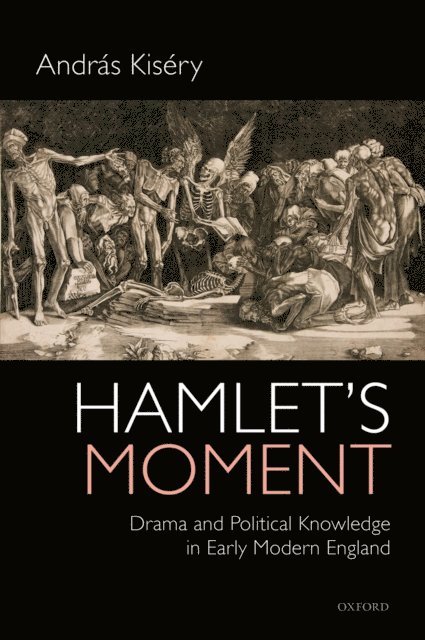
Hamlet's Moment identifies a turning point in the history of English drama and early modern political culture: the moment when the business of politics became a matter of dramatic representation. Drama turned from open, military conflict to diplomacy and court policy, from the public contestation of power to the technologies of government. Tragedies of state turned into tragedies of state servants, inviting the public to consider politics as a profession and to imagine what it meant to have a political career.By staging intelligence derived from diplomatic sources, and by inflecting the action and discourse of their plays with a Machiavellian style of political analysis, playwrights such as Shakespeare, Jonson, Chapman, Marston transformed political knowledge into a more broadly useful type of cultural capital, something even people without political agency could deploy in conversation and use in claiming social distinction. In Hamlet's moment, the public stage created the political competence that enabled the rise of the modern public sphere.The first half of the book offers a new analysis of Shakespeare's Hamlet through the lens of its use of political knowledge, while the second half broadens the scope of discussion by exploring the plays of Shakespeare's contemporaries.
499 kr
Skickas inom 7-10 vardagar
Hamlet's Moment identifies a turning point in the history of English drama and early modern political culture: the moment when the business of politics became a matter of dramatic representation. Drama turned from open, military conflict to diplomacy and court policy, from the public contestation of power to the technologies of government. Tragedies of state turned into tragedies of state servants, inviting the public to consider politics as a profession-to imagine what it meant to have a political career. By staging intelligence derived from diplomatic sources, and by inflecting the action and discourse of their plays with a Machiavellian style of political analysis, playwrights such as Shakespeare, Jonson, Chapman, and Marston transformed political knowledge into a more broadly useful type of cultural capital, something even people without political agency could deploy in conversation and use in claiming social distinction. In Hamlet's moment, the public stage created the political competence that enabled the rise of the modern public sphere.
1 299 kr
Skickas inom 5-8 vardagar
How do the formal properties of early modern texts, together with the materials that envelop and shape them, relate to the cultural, political, and social world of their production? Formal matters: Reading the materials of English Renaissance literature answers this question by linking formalist analysis with the insights of book history. It thus represents the new English Renaissance literary historiography tying literary composition to the materials and material practices of writing. The book combines studies of familiar and lesser known texts, from the poems and plays of Shakespeare to jests and printed commonplace books. Its ten studies make important, original contributions to research on the genres of early modern literature, focusing on the involvement of literary forms in the scribal and print cultures of compilation, continuation, translation, and correspondence, as well as in matters of political republicanism and popular piety, among others. Taken together, the collection’s essays exemplify how an attention to form and matter can historicise writing without abandoning a literary focus.
1 467 kr
Skickas inom 10-15 vardagar
Worlds of Hungarian Writing responds to the rapidly growing interest in Hungarian authors throughout the English-speaking world. Addressing an international audience, the essays in the collection highlight the intercultural contexts that have molded the conventions, genres and institutions of Hungarian writing from the nineteenth century to the present. They are mapping some of the ways in which a modern literature is produced by encounters with languages, cultures, and media external to its traditionally conceived boundaries. But rather than viewing intercultural exchange as an external force, the collection recognizes its enabling importance to the globalizing reception and circulation of Hungarian writing over the continuities and constraints implied by more traditional national narratives. Worlds of Hungarian Writing posits intercultural exchange as the very substance of a literary culture.Discussions of the politics of appropriation and translation, of the impact of émigré writers and critics, and of the use of world-literary models in genre-formation complement studies of the fate of western leftist critical theory in post-1989 Hungary, of the role of African-American models in contemporary Roma culture, and of the use of photography in late 20th-century prose. The volume spans a wide generic range, from the achievements of such canonical 19th-century critics and poets as József Bajza and János Arany, to neglected women authors-translators such as Theresa Pulszky, to modernist writers and critics like Antal Szerb and György Lukács, and to the contemporary novelists Péter Esterházy, Péter Nádas, and László Krasznahorkai. Each essay is an original contribution to comparative literature and to the study of this Central-European literature, but is intended to be accessible to readers unfamiliar with its traditions.