André Pineau – författare
Visar alla böcker från författaren André Pineau. Handla med fri frakt och snabb leverans.
11 produkter
11 produkter
Inbunden, Engelska, 1996
2 153 kr
Skickas inom 10-15 vardagar
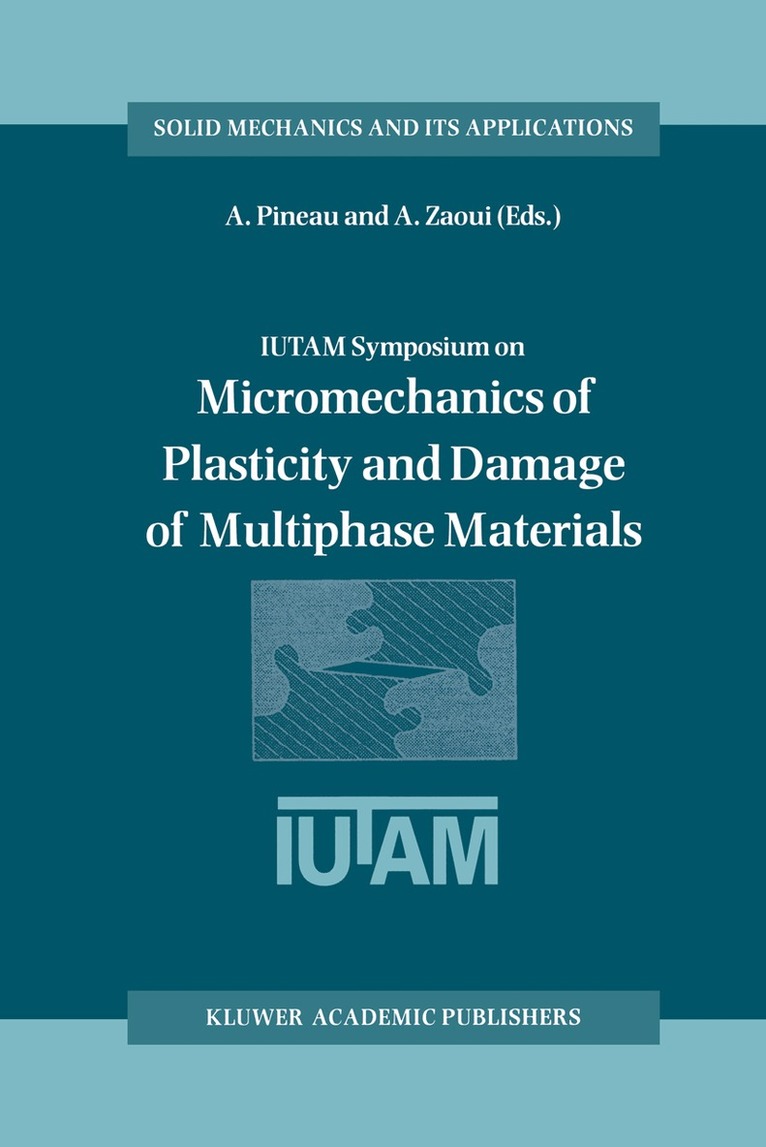
This volume contains 51 contributions presented at the IUTAM Symposium on Micromechanics of Plasticity and Damage of Multiphase Materials. The Symposium aimed at improving the prediction of the macroscopic behaviour of multiphase solid materials from their microstructure. After review and revision, the papers have been grouped together under five headings, namely: plasticity and viscoplasticity; damage; phase transformations; statistical and geometrical aspects; and cracks and interfaces. The contributions emphasized the importance of local phenomena and of the spatial phase distribution, as well as the importance of an adequate treatment of the nonlinear character of the overall response. The book is an illustration of the cross-fertilizing effects of mechanics and materials science when investigating the mechanical properties of a variety of materials: metals, ceramics, polymers and composites. It should be of interest and assistance both to academic researchers and to engineers concerned with the use of advanced materials in structural applications.
Inbunden, Engelska, 1998
1 080 kr
Skickas inom 10-15 vardagar
Designing new structural materials, extending lifetimes and guarding against fracture in service are among the preoccupations of engineers, and to deal with these they need to have command of the mechanics of material behaviour. The first volume of this two-volume work deals with elastic and elastoplastic behaviour; this second volume continues with viscoelasticity, damage, fracture (resistance to cracking) and contact mechanics. As in Volume I, the treatment starts from the active mechanisms on the microscopic scale and develops the laws of macroscopic behaviour. Chapter I deals with viscoplastic behaviour, as shown, for example, at low temperatures by the effects of oscillatory loads and at high temperatures by creep under steady load. Chapter 2 treats damage phenomena encountered in all materials - for example, metals, polymers, glasses, concretes - such as cavitation, fatigue and stress-corrosion cracking. Chapter 3 treats those concepts of fracture mechanics that are needed for the understanding of resistance to cracking and Chapter 4 completes the volume with a survey of the main concepts of contact mechanics.
Inbunden, Engelska, 2010
3 474 kr
Skickas inom 5-8 vardagar
The design of mechanical structures with improved and predictable durability cannot be achieved without a thorough understanding of the mechanisms of fatigue damage and more specifically the relationships between the microstructure of materials and their fatigue properties. Written by leading experts in the field, this book (which is complementary to Fatigue of Materials and Structures: Application to Damage and Design, also edited by Claude Bathias and André Pineau), provides an authoritative, comprehensive and unified treatment of the mechanics and micromechanisms of fatigue in metals, polymers and composites. Each chapter is devoted to one of the major classes of materials or to different types of fatigue damage, thereby providing overall coverage of the field.The book deals with crack initiation, crack growth, low-cycle fatigue, gigacycle fatigue, shorts cracks, fatigue micromechanisms and the local approach to fatigue damage, corrosion fatigue, environmental effects and variable amplitude loadings, and will be an important and much used reference for students, practicing engineers and researchers studying fracture and fatigue in numerous areas of mechanical, structural, civil, design, nuclear, and aerospace engineering as well as materials science.
Inbunden, Engelska, 2011
1 970 kr
Skickas inom 11-20 vardagar
The design of mechanical structures with improved and predictable durability cannot be achieved without a thorough understanding of the mechanisms of fatigue damage and more specifically the relationships between the microstructure of materials and their fatigue properties. Written by leading experts in the field, this book (which is complementary to Fatigue of Materials and Structures: Application to Damage and Design, also edited by Claude Bathias and André Pineau), provides an authoritative, comprehensive and unified treatment of the mechanics and micromechanisms of fatigue in metals, polymers and composites. Each chapter is devoted to one of the major classes of materials or to different types of fatigue damage, thereby providing overall coverage of the field. The book deals with crack initiation, crack growth, low-cycle fatigue, gigacycle fatigue, shorts cracks, fatigue micromechanisms and the local approach to fatigue damage, corrosion fatigue, environmental effects and variable amplitude loadings, and will be an important and much used reference for students, practicing engineers and researchers studying fracture and fatigue in numerous areas of mechanical, structural, civil, design, nuclear, and aerospace engineering as well as materials science.
Inbunden, Engelska, 2011
1 970 kr
Skickas inom 11-20 vardagar
The design of mechanical structures with predictable and improved durability cannot be achieved without a thorough understanding of the mechanisms of fatigue damage and more specifically the relationships between the microstructure of materials and their fatigue properties.Written by leading researchers in the field, this book, along with the complementary books Fatigue of Materials and Structures: Fundamentals and Application to Damage and Design (both also edited by Claude Bathias and André Pineau), provides an authoritative, comprehensive and unified treatment of the mechanics and micromechanisms of fatigue in metals, polymers and composites. Each chapter is devoted to one of the major classes of materials or to different types of fatigue damage, thereby providing overall coverage of the field. This book deals with multiaxial fatigue, thermomechanical fatigue, fretting-fatigue, influence of defects on fatigue life, cumulative damage and damage tolerance, and will be an important and much used reference for students, practicing engineers and researchers studying fracture and fatigue in numerous areas of materials science and engineering, mechanical, nuclear and aerospace engineering.
Häftad, Engelska, 2010
1 083 kr
Skickas inom 10-15 vardagar
Designing new structural materials, extending lifetimes and guarding against fracture in service are among the preoccupations of engineers, and to deal with these they need to have command of the mechanics of material behaviour. The first volume of this two-volume work deals with elastic and elastoplastic behaviour; this second volume continues with viscoelasticity, damage, fracture (resistance to cracking) and contact mechanics. As in Volume I, the treatment starts from the active mechanisms on the microscopic scale and develops the laws of macroscopic behaviour. Chapter I deals with viscoplastic behaviour, as shown, for example, at low temperatures by the effects of oscillatory loads and at high temperatures by creep under steady load. Chapter 2 treats damage phenomena encountered in all materials - for example, metals, polymers, glasses, concretes - such as cavitation, fatigue and stress-corrosion cracking. Chapter 3 treats those concepts of fracture mechanics that are needed for the understanding of resistance to cracking and Chapter 4 completes the volume with a survey of the main concepts of contact mechanics.As with Volume I, each chapter has a set of exercises, either with solutions or with indications of how to attack the problem; and there are many explanatory diagrams and other illustrations.
Inbunden, Engelska, 2012
2 373 kr
Skickas inom 10-15 vardagar
Advances in technology are demanding ever-increasing mastery over the materials being used: the challenge is to gain a better understanding of their behaviour, and more particularly of the relations between their microstructure and their macroscopic properties. This work, of which this is the first volume, aims to provide the means by which this challenge may be met. Starting from the mechanics of deformation, it develops the laws governing macroscopic behaviour – expressed as the constitutive equations – always taking account of the physical phenomena which underlie rheological behaviour. The most recent developments are presented, in particular those concerningheterogeneous materials such as metallic alloys, polymers and composites. Each chapter is devoted to one of the major classes of material behaviour. As the subtitles indicate, Volume 1 deals with micro- and macroscopic constitutive behaviour and Volume 2 with damage and fracture mechanics. A third volume will be devoted to exercises and their full solutions complementing the content of these two first volumes. Most of the chapters end with a set of exercises, to many of which either the full solution or hints on how to obtain this are given; each volume is profusely illustrated with explanatory diagrams and with electron-microscope photographs. This book, now in its second edition, has been rigorously re-written, updated and modernised for a new generation. The authors improved the existing material, in particular in modifying the organisation, and added new up-to-date content. Understanding the subject matter requires a good knowledge of solid mechanics and materialsscience; the main elements of these fields are given in a set of annexes at theend of the first volume. The authors also thought it interesting for the readers to give as footnotes some information about the many scientists whose names are attached to theories and formulae and whose memories must be celebrated. Whilst the present book, as well as Volume 2, is addressed primarily to graduate students, part of it can be used in undergraduate courses; and it is hoped that practising engineers and scientists will find the information it conveys useful. It is the authors’ hope also that English-speaking readers will want to learn about the aspects of Frenchculture, and more particularly of the French school of micromechanics of materials, which this treatment undoubtedly displays.
Inbunden, Engelska, 2012
1 620 kr
Skickas inom 10-15 vardagar
Chapter III is devoted to brittle fracture, chapter IV to ductile fracture and chapter V to the brittle-ductile transition. Chapter VII is devoted to hydrogen embrittlement and to environment assisted cracking, chapter VIII to creep damage.
Häftad, Engelska, 2014
2 373 kr
Skickas inom 10-15 vardagar
Advances in technology are demanding ever-increasing mastery over the materials being used: the challenge is to gain a better understanding of their behaviour, and more particularly of the relations between their microstructure and their macroscopic properties. This work, of which this is the first volume, aims to provide the means by which this challenge may be met. Starting from the mechanics of deformation, it develops the laws governing macroscopic behaviour – expressed as the constitutive equations – always taking account of the physical phenomena which underlie rheological behaviour. The most recent developments are presented, in particular those concerningheterogeneous materials such as metallic alloys, polymers and composites. Each chapter is devoted to one of the major classes of material behaviour. As the subtitles indicate, Volume 1 deals with micro- and macroscopic constitutive behaviour and Volume 2 with damage and fracture mechanics. A third volume will be devoted to exercises and their full solutions complementing the content of these two first volumes. Most of the chapters end with a set of exercises, to many of which either the full solution or hints on how to obtain this are given; each volume is profusely illustrated with explanatory diagrams and with electron-microscope photographs. This book, now in its second edition, has been rigorously re-written, updated and modernised for a new generation. The authors improved the existing material, in particular in modifying the organisation, and added new up-to-date content. Understanding the subject matter requires a good knowledge of solid mechanics and materialsscience; the main elements of these fields are given in a set of annexes at theend of the first volume. The authors also thought it interesting for the readers to give as footnotes some information about the many scientists whose names are attached to theories and formulae and whose memories must be celebrated. Whilst the present book, as well as Volume 2, is addressed primarily to graduate students, part of it can be used in undergraduate courses; and it is hoped that practising engineers and scientists will find the information it conveys useful. It is the authors’ hope also that English-speaking readers will want to learn about the aspects of Frenchculture, and more particularly of the French school of micromechanics of materials, which this treatment undoubtedly displays.
Häftad, Engelska, 2011
2 158 kr
Skickas inom 10-15 vardagar
The IUT AM Symposium on "Micromechanics of Plasticity and Damage of Multiphase Materials" was held in Sevres, Paris, France, 29 August - 1 September 1995. The Symposium was attended by 83 persons from 18 countries. In addition 17 young French students attended the meeting. During the 4 day meeting, a total of 55 papers were presented, including 24 papers in the poster sessions. The meeting was divided into 7 oral and 3 poster sessions. The 7 oral sessions were the following: - Plasticity and Viscoplasticity I and II; - Phase transformations; - Damage I and II; - Statistical and geometrical aspects; - Cracks and interfaces. Each poster session was introduced by a Rapporteur, as follows: - Session I (Plasticity and Viscoplasticity): G. Cailletaud; - Session 2 (Damage): D. Franc;:ois; - Session 3 (Phase transformation; statistical and geometrical aspects): D. Jeulin. The main purpose of the Symposium was the discussion of the state of the art in the development of micromechanical models used to predict the macroscopic mechanical behaviour of mUltiphase solid materials. These materials consist of at least two chemically different phases, present either initially or formed during plastic deformation, when a strain-induced phase transformation takes place. One session was devoted to the latter case. Continuously strengthened composite materials, containing long fibers, were out of the scope of the Symposium.
Häftad, Engelska, 2015
1 620 kr
Skickas inom 10-15 vardagar
Designing new structural materials, extending lifetimes and guarding against fracture in service are among the preoccupations of engineers, and to deal with these they need to have command of the mechanics of material behaviour. This ought to reflect in the training of students. In this respect, the first volume of this work deals with elastic, elastoplastic, elastoviscoplastic and viscoelastic behaviours; this second volume continues with fracture mechanics and damage, and with contact mechanics, friction and wear. As in Volume I, the treatment links the active mechanisms on the microscopic scale and the laws of macroscopic behaviour. Chapter I is an introduction to the various damage phenomena. Chapter II gives the essential of fracture mechanics. Chapter III is devoted to brittle fracture, chapter IV to ductile fracture and chapter V to the brittle-ductile transition. Chapter VI is a survey of fatigue damage. Chapter VII is devoted to hydrogen embrittlement and to environment assisted cracking, chapter VIII to creep damage. Chapter IX gives results of contact mechanics and a description of friction and wear mechanisms. Finally, chapter X treats damage in non metallic materials: ceramics, glass, concrete, polymers, wood and composites. The volume includes many explanatory diagrams and illustrations. A third volume will include exercises allowing deeper understanding of the subjects treated in the first two volumes.