Andrea Pinotti – författare
Visar alla böcker från författaren Andrea Pinotti. Handla med fri frakt och snabb leverans.
6 produkter
6 produkter
654 kr
Skickas inom 10-15 vardagar
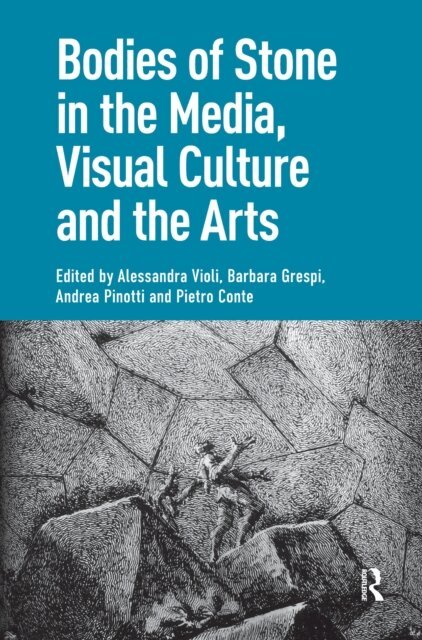
If mediatization has surprisingly revealed the secret life of inert matter and the ‘face of things’, the flipside of this has been the petrification of living organisms, an invasion of stone bodies in a state of suspended animation. Within a contemporary imaginary pervaded by new forms of animism, the paradigm of death looms large in many areas of artistic experimentation, pushing the modern body towards mineral modes of being which revive ancient myths of flesh-made-stone and the issue of the monument. Scholars in media, visual culture and the arts propose studies of bodies of stone, from actors simulating statues to the transmutation of the filmic body into a fossil; from the real treatment of the cadaver as a mineral living object to the rediscovery of materials such as wax; from the quest for a ‘thermal’ equivalence between stone and flesh to the transformation of the biomedical body into a living monument.
262 kr
Skickas inom 5-8 vardagar
1 909 kr
Skickas inom 10-15 vardagar
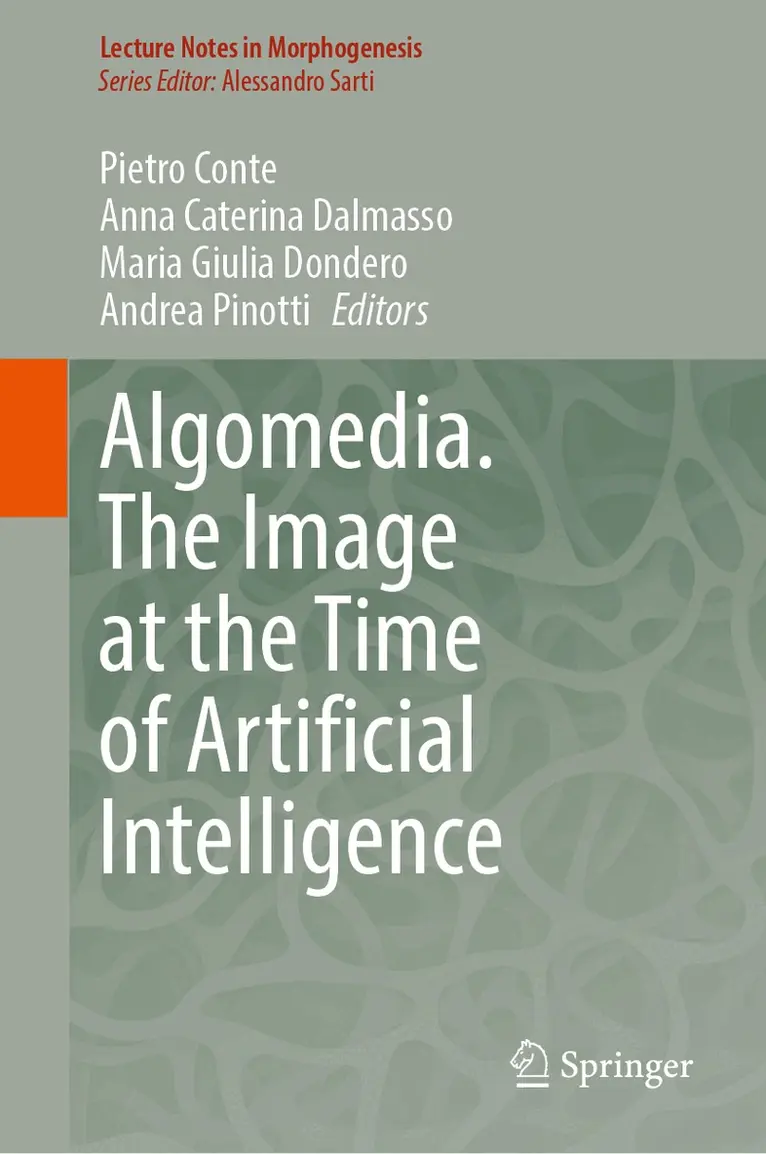
Contemporary media ecosystems are deeply entangled with algorithms, which play an increasingly pervasive role in shaping our environment and mediating our perception of reality. This book aims to provide a critical map of a rapidly evolving mediascape in which humans, machines, and data negotiate forms of agency, cultural imaginaries, and scopic regimes.In particular, the volume addresses the multiple challenges posed by algorithmic media within the domain of visual culture, and identifies a paradigmatic shift: in the age of artificial intelligence, images are no longer merely captured or represented—they are synthesized, inferred, and predicted by probabilistic models. As active agents shaping creativity and meaning-making, AI systems carry far-reaching epistemological, aesthetic, and political implications. They open new possibilities for content accessibility and participatory engagement, yet they also encode existing asymmetries. Trained on massive datasets, machine learning models often reproduce structural biases, amplify cultural and social exclusions, and perpetuate inequalities. At the same time, algorithmic systems are being subverted and reappropriated by artists and curators, transforming them into sites of resistance and experimentation for imagining alternative futures.Bringing together perspectives from computer science, semiotics, philosophy, critical theory, aesthetics, art theory, visual culture, and film and media studies, this book sets out an interdisciplinary exploration to make key concepts—such as algorithm, latent space, neural networks, generative models, and NFTs—accessible to a humanities audience, while providing a set of critical tools to interrogate both the ruptures and continuities that define this ongoing transformation.The contributions span a wide array of topics: from machine vision and facial recognition to social robots; from computational art analysis to generative AI, distributed authorship, and curatorial practices; from biometric surveillance and predictive modeling to the politics of datasets and decolonial critique; from virtual and augmented reality to posthuman imagery, digital afterlives, and AI-mediated memory.Compelling us to revisit foundational categories in media studies, this book offers an analytical framework to open a debate that is not merely about “technology’s impact” but about how algorithms have become the media themselves: veritable algomedia.
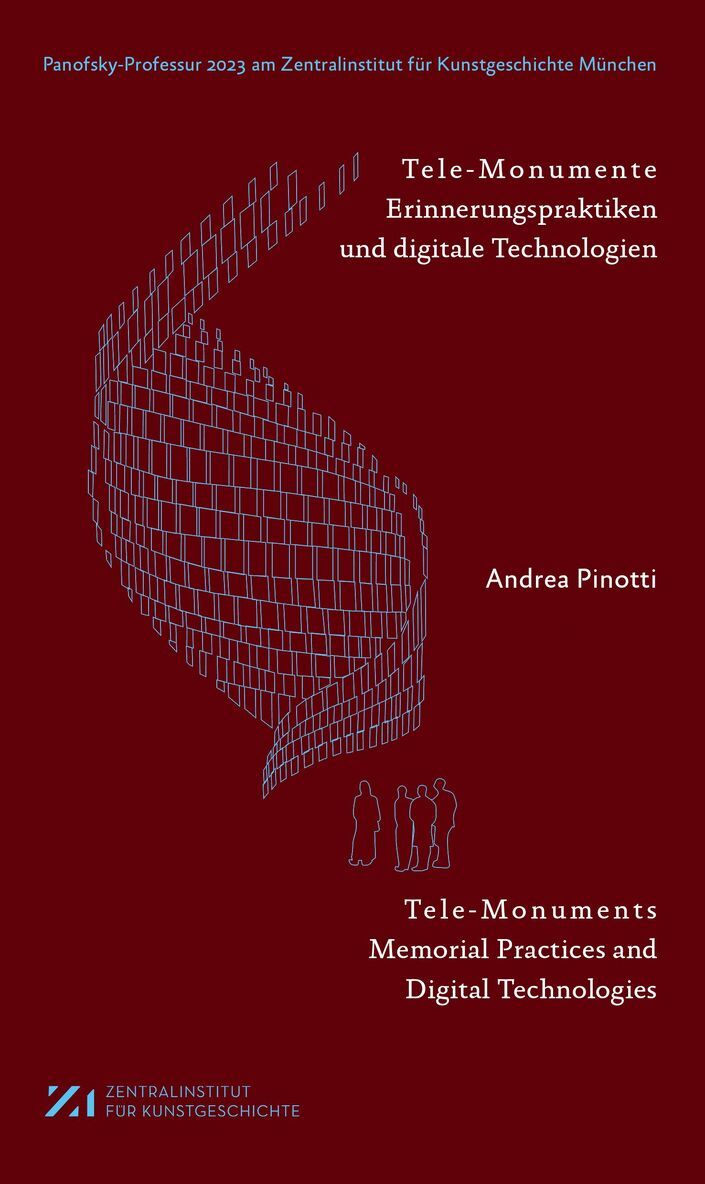
Tele-Monumente - Tele-Monuments
Erinnerungspraktiken und digitale Technologien - Memorial Practices and Digital Technologies
Häftad, Tyska, 2026
245 kr
Kommande
When we think of monuments, we usually refer to objects made of stone or bronze that embody the social memory of a nation or community and make it tangible in material objects. New digital technologies – virtual reality, augmented reality and artificial intelligence – lend commemorative practices an unexpected materiality and novel potential.This book offers a critical comparative overview of the various types of digital monuments and considers them as strategies of telepresence, from aesthetic as well as ethical and socio-political perspectives. Several paradigmatic case studies are analysed to show how the experience of externalised memory is being profoundly transformed in the age of algorithmic media.Innovative critical approach comparing digital technologies (VR, AR, AI) as commemorative strategiesTele-commemoration is contextualised within the human dialectics near/farAnalysis of how social memory is reshaped in the age of algorithmic media
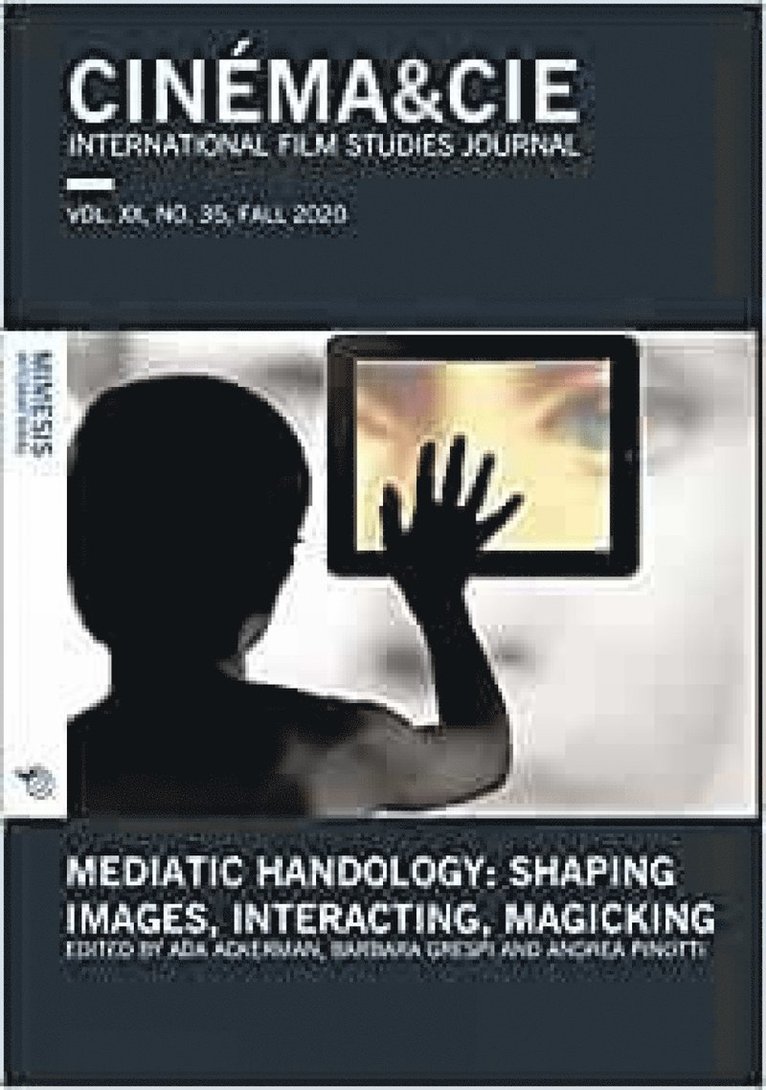
Mediatic Handology. Shaping Images, Interacting, Magicking
VOL. XX, no. 35, FALL 2020
Häftad, Engelska, 2022
174 kr
Skickas
Digital culture, taken etymologically, means a culture of the fingers (from the Latin digitus). Although our contemporary times are still envisioned through the lens of an over-reigning visual paradigm, our media practice has become mainly bodily, since the role of hands has proven ever more decisive and as gestures have increasingly been constructed as tools for thinking and conceptualization. This issue presents crucial case studies in film and visual culture, ranging from classic to experimental cinema, from science visualization to esoteric culture. In every field, filmed hands come to be extraordinary operators of visibility: they depict imaginary worlds which do not rely upon eye perception, they make visible the intimacy of the human being, they give shape to the spectator’s gaze and, in a more concrete fashion, to the image itself through gestures of care and restoration of the filmstrip as well as by anchoring vision through data visualization processes. A hypnotic and a powerful motif, hands represent the corporeal grounds of the cinematic medium and the indelible crystallization of the human in technique.
1 987 kr
Skickas inom 10-15 vardagar
In this book scholars in media, visual culture and the arts propose studies of bodies of stone.