Andrea Prencipe – författare
Visar alla böcker från författaren Andrea Prencipe. Handla med fri frakt och snabb leverans.
10 produkter
Business of Systems Integration
2nd edn
Av Michael Hobday, Andrew Davies m. fl.
E-bok, 2003
772 kr
Lägg i varukorg
Over the past decade or so, systems integration has become a key factor in the operations, strategy and competitive advantage of major corporations in a wide variety of sectors (e.g. computing, automotive, telecommunications, military systems and aerospace). Systems integration is a strategic task …
Business of Systems Integration
2nd edn
Av Michael Hobday, Andrew Davies m. fl.
E-bok, 2005
688 kr
Lägg i varukorg
Over the past decade or so, systems integration has become a key factor in the operations, strategy and competitive advantage of major corporations in a wide variety of sectors (e.g. computing, automotive, telecommunications, military systems and aerospace). Systems integration is a strategic task …
The Business of Systems Integration
1st edn
Av Andrea Prencipe, Andrew Davies m. fl.
Inbunden, 2003
4310 kr
Lägg i varukorg
Over the past decade or so, systems integration has become a key factor in the operations, strategy and competitive advantage of major corporations in a wide variety of sectors (e.g. computing, automotive, telecommunications, military systems and aerospace). Systems integration is a strategic task …
The Business of Systems Integration
2nd edn
Av Andrea Prencipe, Andrew Davies m. fl.
Häftad, 2005
1412 kr
Lägg i varukorg
Over the past decade or so, systems integration has become a key factor in the operations, strategy and competitive advantage of major corporations in a wide variety of sectors (e.g. computing, automotive, telecommunications, military systems and aerospace). Systems integration is a strategic task …
Digital Business Ecosystem
Av Angelo Corallo, Giuseppina Passiante m. fl.
Inbunden, 2007
1983 kr
Lägg i varukorg
By bringing together elements of a radical new approach to the firm based on a biological metaphor of the ecosystem, this unique book extends the limits of existing theories traditionally used to investigate business networks. The book illustrates that like a biological system, a business ecosystem …
Exploring Innovation in a Digital World
Cultural and Organizational Challenges
Av Federica Ceci, Andrea Prencipe m. fl.
Häftad, 2021
1699 kr
Lägg i varukorg
Innovation is occurring at a rapid pace in digital work and demands increasing attention from academic scholars. In line with this demand, this book aims to provide an overview of recent advances in studies of innovation and technology in the digital space. The book addresses the cultural elements …
Exploring Innovation in a Digital World
Cultural and Organizational Challenges
Av Paolo Spagnoletti, Andrea Prencipe m. fl.
E-bok, 2021
2174 kr
Lägg i varukorg
Innovation is occurring at a rapid pace in digital work and demands increasing attention from academic scholars. In line with this demand, this book aims to provide an overview of recent advances in studies of innovation and technology in the digital space. The book addresses the cultural elements …
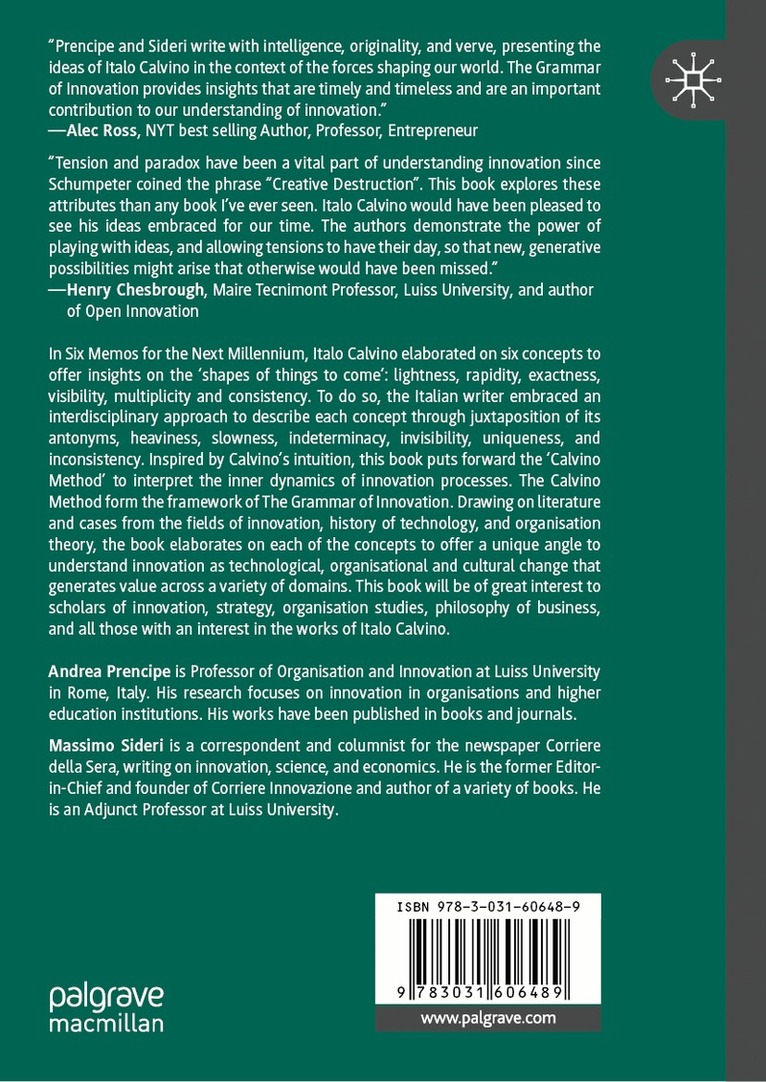
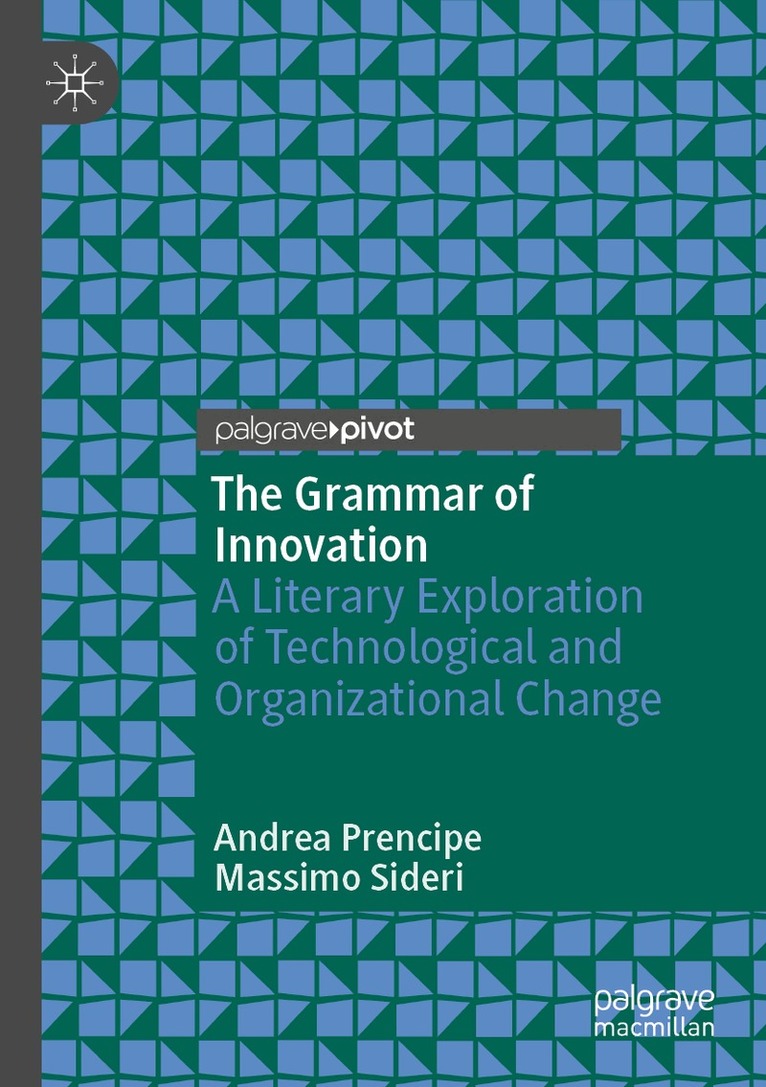
Grammar of Innovation
A Literary Exploration of Technological and Organizational Change
Av Andrea Prencipe, Massimo Sideri
Inbunden, 2024
547 kr
Lägg i varukorg
In Six Memos for the Next Millennium, Italo Calvino elaborated on six concepts or memos to offer insights on the ‘shapes of things to come’, which were lightness, rapidity, exactness, visibility, multiplicity and consistency. To do so, the Italian writer embraced an interdisciplinary approach to …
Grammar of Innovation
A Literary Exploration of Technological and Organizational Change
Av Massimo Sideri, Andrea Prencipe
E-bok, 2024
699 kr
Lägg i varukorg
In Six Memos for the Next Millennium , Italo Calvino elaborated on six concepts or memos to offer insights on the ‘shapes of things to come’, which were lightness, rapidity, exactness, visibility, multiplicity and consistency. To do so, the Italian writer embraced an interdisciplinary approach to …
Grammar of Innovation
A Literary Exploration of Technological and Organizational Change
Av Andrea Prencipe, Massimo Sideri
Häftad, 2025
547 kr
Lägg i varukorg
In Six Memos for the Next Millennium, Italo Calvino elaborated on six concepts or memos to offer insights on the ‘shapes of things to come’, which were lightness, rapidity, exactness, visibility, multiplicity and consistency. To do so, the Italian writer embraced an interdisciplinary approach to …