Andreas Burger – författare
Visar alla böcker från författaren Andreas Burger. Handla med fri frakt och snabb leverans.
7 produkter
7 produkter
E-bok
PDF, Engelska, 2012193 kr
Läs direkt efter köp
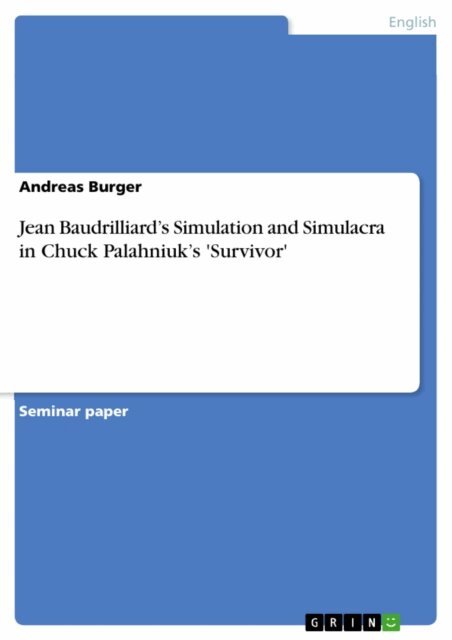
Seminar paper from the year 2011 in the subject American Studies - Literature, grade: 1,0, University of Wurzburg (Neuphilologisches Institut), course: Masters of Transgressive Fiction: Ellis, Palahniuk and McCarthy, language: English, abstract: In Ferdinand de Saussure's terms a sign always consists of a signifier, arbitrarily connected to a signified. Jean Baudrillard used Saussure's structuralistic ideas as a base for his concepts of simulation and simulacra, artificial signs that have lost their connection to a real signified. This idea is a central pillar of his postmodern theory of sign systems and their relation to the real. It is a complex and revolutionary theory discussed by some as unscientific and overly generalized (Kellner, 1). Even if this were the case it can be used in interpreting contemporary postmodern literature such as Chuck Palahniuk's works. Survivor, Palahniuk s second novel, is peppered with appearances of simulacra and the concepts of simulation and hyperreality. And Palahniuk himself gives a direct hint which shows that he knows about Baudrillard s ideas. On page 88 of Survivor Tender Branson states: The signifier outlasts the signified, the symbol the symbolized. (Palahniuk, 88)In this term paper I will give an overview of where and how Palahniuk uses Baudrillard s concepts of simulation and simulacra in Survivor and how the reader could interpret these concepts and appearances in the context of his critique of consumer society. Beforehand I will summarize Baudrillard s main concepts which are related to Survivor.
Del 29 - Eco-Efficiency in Industry and Science
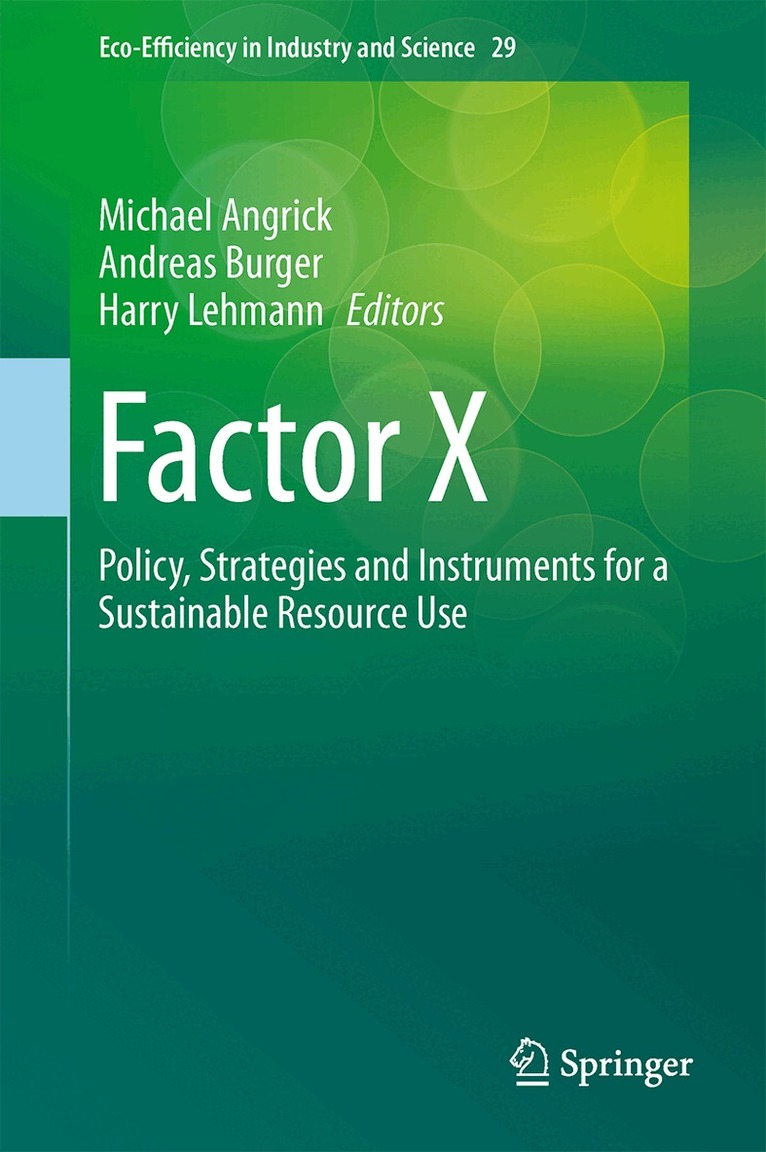
Factor X
Policy, Strategies and Instruments for a Sustainable Resource Use
Inbunden, Engelska, 2013
1 079 kr
Skickas inom 10-15 vardagar
The editors of Factor X explore and analyze this trajectory, predicting scarcities of non-renewable materials such as metals, limited availability of ecological capacities and shortages arising from geographic concentrations of materials. They argue that what is needed is a radical change in the ways we use nature’s resources to produce goods and services and generate well-being. The goal of saving our ecosystem demands a prompt and decisive reduction of man-induced material flows. Before 2050, they assert, we must achieve a significant decrease in consumption of resources, in the line with the idea of a factor 10 reduction target. EU-wide and country specific targets must be set, and enforced using strict, accurate measurement of consumption of materials. Their arguments are drawn from empirical evidence and observations, as well as theoretical considerations based on economic modeling and on natural science.
E-bok
PDF, Engelska, 20131 459 kr
Läs direkt efter köp
The editors of Factor X explore and analyze this trajectory, predicting scarcities of non-renewable materials such as metals, limited availability of ecological capacities and shortages arising from geographic concentrations of materials. They argue that what is needed is a radical change in the ways we use nature’s resources to produce goods and services and generate well-being. The goal of saving our ecosystem demands a prompt and decisive reduction of man-induced material flows. Before 2050, they assert, we must achieve a significant decrease in consumption of resources, in the line with the idea of a factor 10 reduction target. EU-wide and country specific targets must be set, and enforced using strict, accurate measurement of consumption of materials. Their arguments are drawn from empirical evidence and observations, as well as theoretical considerations based on economic modeling and on natural science.
Del 30 - Eco-Efficiency in Industry and Science
Factor X
Re-source - Designing the Recycling Society
Inbunden, Engelska, 2013
1 079 kr
Skickas inom 10-15 vardagar
Factor X: Re-source—Designing the Recycling Society explores the role of recycling in efforts to achieve the sustainable world envisioned in the Federal Environment Ministry’s Resource Efficiency Programme, known as ProgRess. The chapters build a roadmap to a Recycling Society in which the decoupling of resource consumption and economic growth is accomplished.
E-bok
PDF, Engelska, 20131 303 kr
Läs direkt efter köp
Factor X: Re-source—Designing the Recycling Society explores the role of recycling in efforts to achieve the sustainable world envisioned in the Federal Environment Ministry’s Resource Efficiency Programme, known as ProgRess. The chapters build a roadmap to a Recycling Society in which the decoupling of resource consumption and economic growth is accomplished.
Del 30 - Eco-Efficiency in Industry and Science
Factor X
Re-source - Designing the Recycling Society
Häftad, Engelska, 2015
1 079 kr
Skickas inom 10-15 vardagar
Factor X: Re-source—Designing the Recycling Society explores the role of recycling in efforts to achieve the sustainable world envisioned in the Federal Environment Ministry’s Resource Efficiency Programme, known as ProgRess. The chapters build a roadmap to a Recycling Society in which the decoupling of resource consumption and economic growth is accomplished.
Del 29 - Eco-Efficiency in Industry and Science
Factor X
Policy, Strategies and Instruments for a Sustainable Resource Use
Häftad, Engelska, 2016
1 079 kr
Skickas inom 10-15 vardagar
The editors of Factor X explore and analyze this trajectory, predicting scarcities of non-renewable materials such as metals, limited availability of ecological capacities and shortages arising from geographic concentrations of materials. They argue that what is needed is a radical change in the ways we use nature’s resources to produce goods and services and generate well-being. The goal of saving our ecosystem demands a prompt and decisive reduction of man-induced material flows. Before 2050, they assert, we must achieve a significant decrease in consumption of resources, in the line with the idea of a factor 10 reduction target. EU-wide and country specific targets must be set, and enforced using strict, accurate measurement of consumption of materials. Their arguments are drawn from empirical evidence and observations, as well as theoretical considerations based on economic modeling and on natural science.