Andrew T. Williams – författare
Visar alla böcker från författaren Andrew T. Williams. Handla med fri frakt och snabb leverans.
2 produkter
2 produkter
E-bok
Engelska, 20111 415 kr
Läs direkt efter köp
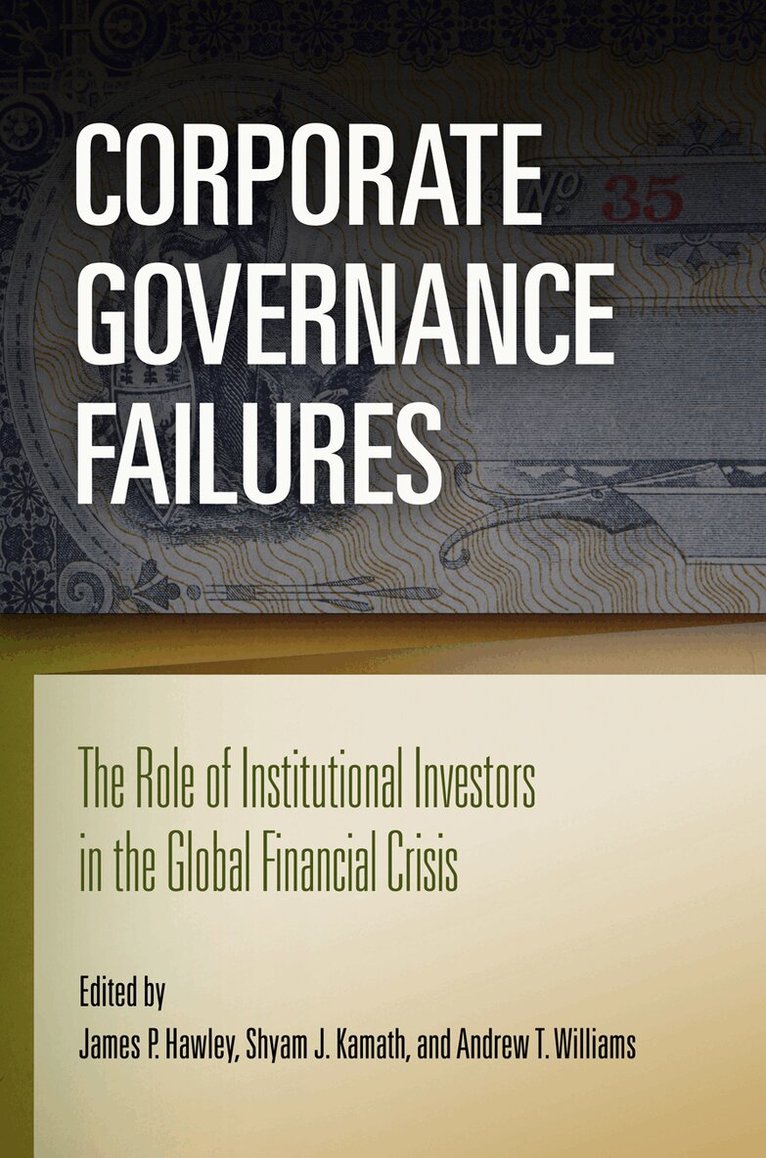
Corporate governance, the internal policies and leadership that guide the actions of corporations, played a major part in the recent global financial crisis. While much blame has been targeted at compensation arrangements that rewarded extreme risk-taking but did not punish failure, the performance of large, supposedly sophisticated institutional investors in this crisis has gone for the most part unexamined. Shareholding organizations, such as pension funds and mutual funds, hold considerable sway over the financial industry from Wall Street to the City of London. Corporate Governance Failures: The Role of Institutional Investors in the Global Financial Crisis exposes the misdeeds and lapses of these institutional investors leading up to the recent economic meltdown.In this collection of original essays, edited by pioneers in the field of fiduciary capitalism, top legal and financial practitioners and researchers discuss detrimental actions and inaction of institutional investors. Corporate Governance Failures reveals how these organizations exposed themselves and their clientele to extremely complex financial instruments, such as credit default swaps, through investments in hedge and private equity funds as well as more traditional equity investments in large financial institutions. The book's contributors critique fund executives for tolerating the "pursuit of alpha" culture that led managers to pursue risky financial strategies in hopes of outperforming the market. The volume also points out how and why institutional investors failed to effectively monitor such volatile investments, ignoring relatively well-established corporate governance principles and best practices.Along with detailed investigations of institutional investor missteps, Corporate Governance Failures offers nuanced and realistic proposals to mitigate future financial pitfalls. This volume provides fresh perspectives on ways institutional investors can best act as gatekeepers and promote responsible investment.
Inbunden, Engelska, 2000
918 kr
Skickas inom 10-15 vardagar
At the beginning of the twenty-first century, the structure of corporate ownership is undergoing major change. The Rise of Fiduciary Capitalism chronicles the rise of fiduciary institutions-primarily public and private pension funds-which now own almost 50 percent of the equity of American corporations. In turn, approximately 50 percent of Americans either own stock individually or, more typically, have an ownership or retirement interest in these fiduciary institutions.James P. Hawley and Andrew T. Williams argue that, because of their extensive diversification of ownership, fiduciary institutions have become "universal owners" with a significant stake in a broad cross-section of the largest publicly traded firms in the economy. Forced to evaluate portfolio-wide effects of individual firm actions, these institutions have a quasipublic policy interest in the long-term health and wellbeing of the whole society. As universal owners, fiduciary institutions are in a unique position to develop and pursue policies of virtuous efficiency, minimizing negative externalities and encouraging positive outcomes by the firms in their portfolios. In this way, they have the potential to make the firms in which they own stock more responsive to the needs of the Americans to whom they are responsible and thereby make those firms more democratic.The Rise of Fiduciary Capitalism investigates the nature of property and ownership in the modern corporate setting, the effects of the decline of traditional, personally held property in equity form, and the governance implications of the developing new form of corporate ownership.