Andy Hamilton – författare
208 kr
Skickas
160 kr
Skickas
100 kr
Läs direkt efter köp
504 kr
Läs direkt efter köp
1 561 kr
Skickas inom 5-8 vardagar
661 kr
Skickas inom 7-10 vardagar
504 kr
Läs direkt efter köp
2 058 kr
Skickas inom 10-15 vardagar
485 kr
Skickas inom 10-15 vardagar
774 kr
Läs direkt efter köp
Philosophers have discussed art – or artistic practices such as poetry – since ancient times. But systems of art and entertainment appeared only in the modern era – in the West, during the 18th and 19th centuries. And philosophers have largely neglected the concept of entertainment. In this book Andy Hamilton explores art and entertainment from a philosophical standpoint. He argues, against modernist theory, that art and entertainment are not opposites, but form a loosely connected conceptual system. Against postmodernism, however, he insists on their vital differences.
Hamilton begins by questioning the received modernist view, examining artist-entertainers including Jane Austen, Charles Dickens, Louis Armstrong and Billie Holiday. Entertainment, he argues, is by nature audience-centred – but so is art, in a different way. Thus while art should pass the test of time, entertainment must pass the test of its own time – it has to entertain at the time it is produced. Art and entertainment are inter-dependent concepts, and must be understood together with other aesthetic concepts including criticism, genius, canons and design. These concepts form the subject of later chapters of this book, where Hamilton develops a meritocratic position that is neither elitist nor populist. He also addresses the contemporary charge of cultural appropriation, and qualifies it.
An innovative feature of the book is the inclusion of dialogues with artists, critics and academics that help to recast or reformulate the debate. Art and Entertainment: A Philosophical Exploration is essential reading for those working in art and aesthetics, and will also be of interest to those in related disciplines such as cultural studies, music and film studies, with an interest in entertainment.
774 kr
Läs direkt efter köp
Philosophers have discussed art – or artistic practices such as poetry – since ancient times. But systems of art and entertainment appeared only in the modern era – in the West, during the 18th and 19th centuries. And philosophers have largely neglected the concept of entertainment. In this book Andy Hamilton explores art and entertainment from a philosophical standpoint. He argues, against modernist theory, that art and entertainment are not opposites, but form a loosely connected conceptual system. Against postmodernism, however, he insists on their vital differences.
Hamilton begins by questioning the received modernist view, examining artist-entertainers including Jane Austen, Charles Dickens, Louis Armstrong and Billie Holiday. Entertainment, he argues, is by nature audience-centred – but so is art, in a different way. Thus while art should pass the test of time, entertainment must pass the test of its own time – it has to entertain at the time it is produced. Art and entertainment are inter-dependent concepts, and must be understood together with other aesthetic concepts including criticism, genius, canons and design. These concepts form the subject of later chapters of this book, where Hamilton develops a meritocratic position that is neither elitist nor populist. He also addresses the contemporary charge of cultural appropriation, and qualifies it.
An innovative feature of the book is the inclusion of dialogues with artists, critics and academics that help to recast or reformulate the debate. Art and Entertainment: A Philosophical Exploration is essential reading for those working in art and aesthetics, and will also be of interest to those in related disciplines such as cultural studies, music and film studies, with an interest in entertainment.
346 kr
Skickas inom 3-6 vardagar
381 kr
Skickas inom 5-8 vardagar
511 kr
Läs direkt efter köp
“Meticulously researched, detailed and documented, this long awaited overview justly establishes Konitz as one of the most consistently brilliant, adventurous and original improvisers in the jazz tradition—a genius as rare as Bird himself.”
—John Zorn
“Hamilton’s work may well mark the inception of a format new to writing on Western music, one which avoids both the self-aggrandizing of autobiography and the stylized subjectification of biography.”
—The Wire
“An extraordinary approach to a biography, with the man himself speaking for extended sessions. The main vibration I felt from Lee’s words was total honesty, almost to a fault. Konitz shows himself to be an acute observer of the scene, full of wisdom and deep musical insights, relevant to any historical period regardless of style. The asides by noted musicians are beautifully woven throughout the pages. I couldn’t put the book down—it is the definition of a living history.”
—David Liebman
The preeminent altoist associated with the “cool” school of jazz, Lee Konitz was one of the few saxophonists of his generation to forge a unique sound independent of the influence of Charlie Parker. In the late 1940s, Konitz began his career with the Claude Thornhill band, during which time he came into contact with Miles Davis, with whom he would later work on the legendary Birth of the Cool sessions. Konitz is perhaps best known through his association with Lennie Tristano, under whose influence much of his sound evolved, and for his work with Stan Kenton and Warne Marsh. His recordings have ranged from cool bop to experimental improvisation and have appeared on such labels as Prestige, Atlantic, Verve, and Polydor.
Crafted out of numerous interviews between the author and his subject, the book offers a unique look at the story of Lee Konitz’s life and music, detailing Konitz’s own insights into his musical education and his experiences with such figures as Miles Davis, Stan Kenton, Warne Marsh, Lennie Tristano, Charles Mingus, Bud Powell, and Bill Evans.
Andy Hamilton is a jazz pianist and contributor to major jazz and contemporary music magazines. He teaches philosophy, and the history and aesthetics of jazz, at Durham University in the United Kingdom. He is also the author of the book Aesthetics and Music (Continuum 2007).
Joe Lovano is a Grammy Award–winning tenor saxophonist. His most recent album is Streams of Expression.
1 942 kr
Skickas inom 10-15 vardagar
601 kr
Skickas inom 10-15 vardagar
543 kr
Skickas inom 10-15 vardagar
712 kr
Läs direkt efter köp
2 786 kr
Skickas inom 10-15 vardagar
686 kr
Skickas inom 10-15 vardagar
538 kr
Läs direkt efter köp
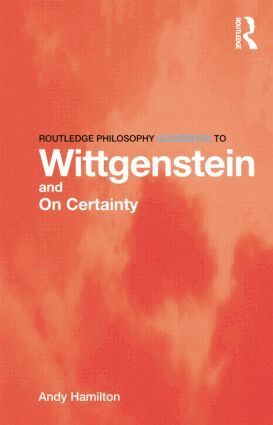
Ludwig Wittgenstein is arguably the most important philosopher of the twentieth century. In On Certainty he discusses central issues in epistemology, including the nature of knowledge and scepticism. The Routledge Philosophy Guidebook to Wittgenstein and On Certainty introduces and assesses:
Wittgenstein''s career and the background to his later philosophy the central ideas and text of On Certainty, including its responses to G.E. Moore and discussion of fundamental issues in the theory of knowledge Wittgenstein''s continuing importance in contemporary philosophy.
This GuideBook is essential reading for all students of Wittgenstein, and for those studying epistemology and philosophy of language. On Certainty, Wittgenstein''s final work, addresses a category of "world-picture" propositions discovered by G.E. Moore. These challenge Wittgenstein''s enduring commitment to a well-defined category of empirical propositions, and help to generate a critique of scepticism. Developing Wittgenstein''s view that scepticism is self-undermining, the Guidebook offers a combative yet therapeutic interpretation that locates On Certainty between the standpoints of Kant and Hume.
538 kr
Läs direkt efter köp
Ludwig Wittgenstein is arguably the most important philosopher of the twentieth century. In On Certainty he discusses central issues in epistemology, including the nature of knowledge and scepticism. The Routledge Philosophy Guidebook to Wittgenstein and On Certainty introduces and assesses:
Wittgenstein''s career and the background to his later philosophy the central ideas and text of On Certainty, including its responses to G.E. Moore and discussion of fundamental issues in the theory of knowledge Wittgenstein''s continuing importance in contemporary philosophy.
This GuideBook is essential reading for all students of Wittgenstein, and for those studying epistemology and philosophy of language. On Certainty, Wittgenstein''s final work, addresses a category of "world-picture" propositions discovered by G.E. Moore. These challenge Wittgenstein''s enduring commitment to a well-defined category of empirical propositions, and help to generate a critique of scepticism. Developing Wittgenstein''s view that scepticism is self-undermining, the Guidebook offers a combative yet therapeutic interpretation that locates On Certainty between the standpoints of Kant and Hume.
543 kr
Skickas inom 10-15 vardagar
875 kr
Kommande
312 kr
Kommande
2 357 kr
Skickas inom 10-15 vardagar
628 kr
Läs direkt efter köp
651 kr
Läs direkt efter köp
601 kr
Skickas inom 10-15 vardagar
628 kr
Läs direkt efter köp