Anke Moerland – författare
1 649 kr
Skickas inom 5-8 vardagar
395 kr
Läs direkt efter köp
Utilising a range of sector-specific, interdisciplinary and actor-focused approaches, each contribution offers suggestions on how Europe’s capacity to foster innovation-based sustainable economic growth can be enhanced on a global scale. This comprehensive book addresses the role of IP in public–private partnerships and business transactions and further explores how IP law can uphold distributive justice in the innovation society. Chapters span a range of topics of great societal interest, including standard essential patent licensing in the Internet of Things, patent quality concerns under competition law and the role of market-driven and legislative solutions to online music licensing.
Intellectual Property as a Complex Adaptive System will be a key resource for students and scholars of IP law, innovation and economics. It will also be vital reading for practitioners, knowledge-intensive industry representatives and innovation and technology transfer specialists.
1 555 kr
Läs direkt efter köp
Intellectual Property Rights as Obstacles to Legitimate Trade helps to understand one of the underlying rationales of the TRIPS Agreement in light of some of the most pertinent IP issues. The WTO/TRIPS Agreement for the first time put IP rights in the context of trade rules, such as when does the exercise of IP rights become an unjustified burden to legitimate trade? Cases have arisen where IP rights are conferred, used, or enforced in a manner that arguably impedes trade, both in domestic and international contexts. This groundbreaking book is the first comprehensive assessment of this controversial area of trade law, shedding important new light on the underlying rationales of the TRIPS Agreement.
With contributions by both practitioners and academics working in a range of countries, this book considers thorny issues in such areas as the following:
– interpretation of ‘obstacles to legitimate trade’ in the context of GATT/ WTO jurisprudence;– separating markets by preventing parallel importation in the context of patents;– geoblocking – territorial separation of digital markets;– using trademarks to prevent competition;– geographical indications – protection of terms that are considered generic in certain domestic markets;– seizure of goods in transit;– ‘evergreening’ patents – attempts to extend the duration of patents;– rights to second-hand digital goods or content;– unjustified threats – towards appropriate standards of liability.Focusing on topical and under-researched areas of IP law, the contributors stimulate a discussion on an overarching concern that is not often addressed – how to assess whether the protection and enforcement of certain IP rights in particular situations should be classified as trade barriers. As an incisive analysis of the desirable balance between the exercise of IP rights and the demands of legitimate trade, this book will be welcomed by practitioners, lawmakers, policy advisers, and academics in both trade law and IP law.
1 555 kr
Läs direkt efter köp
Intellectual Property Rights as Obstacles to Legitimate Trade helps to understand one of the underlying rationales of the TRIPS Agreement in light of some of the most pertinent IP issues. The WTO/TRIPS Agreement for the first time put IP rights in the context of trade rules, such as when does the exercise of IP rights become an unjustified burden to legitimate trade? Cases have arisen where IP rights are conferred, used, or enforced in a manner that arguably impedes trade, both in domestic and international contexts. This groundbreaking book is the first comprehensive assessment of this controversial area of trade law, shedding important new light on the underlying rationales of the TRIPS Agreement.
With contributions by both practitioners and academics working in a range of countries, this book considers thorny issues in such areas as the following:
– interpretation of ‘obstacles to legitimate trade’ in the context of GATT/ WTO jurisprudence;– separating markets by preventing parallel importation in the context of patents;– geoblocking – territorial separation of digital markets;– using trademarks to prevent competition;– geographical indications – protection of terms that are considered generic in certain domestic markets;– seizure of goods in transit;– ‘evergreening’ patents – attempts to extend the duration of patents;– rights to second-hand digital goods or content;– unjustified threats – towards appropriate standards of liability.Focusing on topical and under-researched areas of IP law, the contributors stimulate a discussion on an overarching concern that is not often addressed – how to assess whether the protection and enforcement of certain IP rights in particular situations should be classified as trade barriers. As an incisive analysis of the desirable balance between the exercise of IP rights and the demands of legitimate trade, this book will be welcomed by practitioners, lawmakers, policy advisers, and academics in both trade law and IP law.
1 654 kr
Läs direkt efter köp
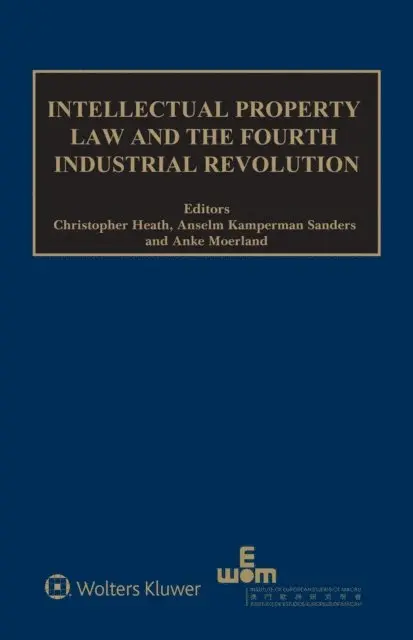
The convergence of various fields of technology is changing the fabric of society. Big data and data mining, Internet of Things, artificial intelligence and blockchains are already affecting business models and leading to a social and economic transformations that have been dubbed by the fourth industrial revolution. Focusing on the framework of intellectual property rights, the contributions to this book analyse how the technical background of this massive transformation affects intellectual property law and policy and how intellectual property is likely to change in order to serve the society.
Well-known authorities in intellectual property law offer in-depth chapters on the roles in this revolution of such concepts and actualities as the following:
power and role of data as the raw material of the revolution; artificial inventors and creators; trade marks in the dimension of avatars and fictional game characters; concept of inventive step change where the person skilled in the art is virtual; data rights versus intellectual property rights; transparency in the context of big data; interrelations of data, technology transfer and antitrust; self-executable and ‘smart’ contracts; redefining the balance among exclusive rights, development, technology transfer and contracts; and proprietary information versus the public domain.The chapters also provide complete analyses of how big data changes decision-making processes, how sustainable development requires redefinition, how technology transfer is re-emerging as technology diffusion and how the role of contracts and blockchain as instruments of monitoring and enforcement are being defined.
Offering the first in-depth legal commentary and analysis of this highly topical issue, the book approaches the fourth industrial revolution from the perspectives of technical background, society and law. Its authoritative analysis of how the data-driven economy influences innovation and technology transfer is without peer. It will be welcomed by practicing lawyers in intellectual property rights and competition law, as well as by academics, think tanks and policymakers.
1 596 kr
Läs direkt efter köp
The convergence of various fields of technology is changing the fabric of society. Big data and data mining, Internet of Things, artificial intelligence and blockchains are already affecting business models and leading to a social and economic transformations that have been dubbed by the fourth industrial revolution. Focusing on the framework of intellectual property rights, the contributions to this book analyse how the technical background of this massive transformation affects intellectual property law and policy and how intellectual property is likely to change in order to serve the society.
Well-known authorities in intellectual property law offer in-depth chapters on the roles in this revolution of such concepts and actualities as the following:
power and role of data as the raw material of the revolution; artificial inventors and creators; trade marks in the dimension of avatars and fictional game characters; concept of inventive step change where the person skilled in the art is virtual; data rights versus intellectual property rights; transparency in the context of big data; interrelations of data, technology transfer and antitrust; self-executable and ‘smart’ contracts; redefining the balance among exclusive rights, development, technology transfer and contracts; and proprietary information versus the public domain.The chapters also provide complete analyses of how big data changes decision-making processes, how sustainable development requires redefinition, how technology transfer is re-emerging as technology diffusion and how the role of contracts and blockchain as instruments of monitoring and enforcement are being defined.
Offering the first in-depth legal commentary and analysis of this highly topical issue, the book approaches the fourth industrial revolution from the perspectives of technical background, society and law. Its authoritative analysis of how the data-driven economy influences innovation and technology transfer is without peer. It will be welcomed by practicing lawyers in intellectual property rights and competition law, as well as by academics, think tanks and policymakers.