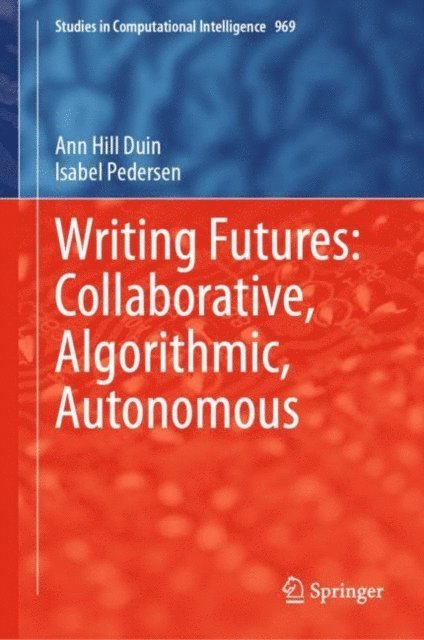
Ann Hill Duin – författare
956 kr
Skickas inom 10-15 vardagar
682 kr
Läs direkt efter köp
This book enables readers to interrogate the technical, rhetorical, theoretical, and socio-ethical challenges and opportunities involved in the development and adoption of augmentation technologies and artificial intelligence.
The core of our human experience and identity is forever affected by the rise of augmentation technologies that enhance human capability or productivity. These technologies can add cognitive, physical, sensory, and emotional enhancements to the body or environment. This book demonstrates the benefits, risks, and relevance of emerging augmentation technologies such as brain–computer interaction devices for cognitive enhancement; robots marketed to improve human social interaction; wearables that extend human senses, augment creative abilities, or overcome physical limitations; implantables that amplify intelligence or memory; and devices, AI generators, or algorithms for emotional augmentation. It allows scholars and professionals to understand the impact of these technologies, improve digital and AI literacy, and practice new methods for their design and adoption.
This book will be vital reading for students, scholars, and professionals in fields including technical communication, UX design, computer science, human factors, information technology, sociology of technology, and ethics. Artifacts and supplemental resources for research and teaching can be found at https://fabricofdigitallife.com and www.routledge.com/9781032263755.
682 kr
Läs direkt efter köp
This book enables readers to interrogate the technical, rhetorical, theoretical, and socio-ethical challenges and opportunities involved in the development and adoption of augmentation technologies and artificial intelligence.
The core of our human experience and identity is forever affected by the rise of augmentation technologies that enhance human capability or productivity. These technologies can add cognitive, physical, sensory, and emotional enhancements to the body or environment. This book demonstrates the benefits, risks, and relevance of emerging augmentation technologies such as brain–computer interaction devices for cognitive enhancement; robots marketed to improve human social interaction; wearables that extend human senses, augment creative abilities, or overcome physical limitations; implantables that amplify intelligence or memory; and devices, AI generators, or algorithms for emotional augmentation. It allows scholars and professionals to understand the impact of these technologies, improve digital and AI literacy, and practice new methods for their design and adoption.
This book will be vital reading for students, scholars, and professionals in fields including technical communication, UX design, computer science, human factors, information technology, sociology of technology, and ethics. Artifacts and supplemental resources for research and teaching can be found at https://fabricofdigitallife.com and www.routledge.com/9781032263755.
590 kr
Skickas inom 10-15 vardagar
2 227 kr
Skickas inom 10-15 vardagar
974 kr
Läs direkt efter köp
In this volume, methodological, cultural, technological, and political boundaries felt by writers are analyzed, translated, and challenged in a way that will appeal to researchers, theorists, graduate students, instructors, and managerial audiences. Instead of extracting rules from previous research, the contributors, working from multidisciplinary perspectives, describe and analyze the social and technological contexts surrounding nonacademic writing. Their essays present a formative rather than summative outlook toward future research on nonacademic writing. Collectively, these chapters articulate a unique perspective toward nonacademic writing that considers: * The centrality of emerging communications technologies in nonacademic writing research and the need for a socio-technological perspective. New technologies reshape the concept of text and significantly impact the writing process and written products in nonacademic settings. * The relationship between the academy and the workplace. A number of chapters challenge us -- sometimes from opposing perspectives -- to scrutinize our role as writing educators in preparing students for the workplace. Should we support the interests of corporate employers, or should we resist those interests? Should we enculturate students in workplace writing practices by placing them in these environments, or should we examine the tacit knowledge gained by workplace professionals and deliver this via classroom instruction? * New theory, new research agendas. Contributors from diverse fields offer new theoretical lenses or use established lenses in innovative ways, expanding the agenda for nonacademic writing research. This volume represents the vision the social landscape demands for research and pedagogy in nonacademic writing.
974 kr
Läs direkt efter köp
In this volume, methodological, cultural, technological, and political boundaries felt by writers are analyzed, translated, and challenged in a way that will appeal to researchers, theorists, graduate students, instructors, and managerial audiences. Instead of extracting rules from previous research, the contributors, working from multidisciplinary perspectives, describe and analyze the social and technological contexts surrounding nonacademic writing. Their essays present a formative rather than summative outlook toward future research on nonacademic writing. Collectively, these chapters articulate a unique perspective toward nonacademic writing that considers: * The centrality of emerging communications technologies in nonacademic writing research and the need for a socio-technological perspective. New technologies reshape the concept of text and significantly impact the writing process and written products in nonacademic settings. * The relationship between the academy and the workplace. A number of chapters challenge us -- sometimes from opposing perspectives -- to scrutinize our role as writing educators in preparing students for the workplace. Should we support the interests of corporate employers, or should we resist those interests? Should we enculturate students in workplace writing practices by placing them in these environments, or should we examine the tacit knowledge gained by workplace professionals and deliver this via classroom instruction? * New theory, new research agendas. Contributors from diverse fields offer new theoretical lenses or use established lenses in innovative ways, expanding the agenda for nonacademic writing research. This volume represents the vision the social landscape demands for research and pedagogy in nonacademic writing.
1 083 kr
Skickas inom 10-15 vardagar
1 408 kr
Läs direkt efter köp
This book is useful to understand and write alongside non-human agents, examine the impact of algorithms and AI on writing, and accommodate relationships with autonomous agents. This ground-breaking future-driven framework prepares scholars and practitioners to investigate and plan for the social, digital literacy, and civic implications arising from emerging technologies. This book prepares researchers, students, practitioners, and citizens to work with AI writers, virtual humans, and social robots. This book explores prompts to envision how fields and professions will change. The book’s unique integration with Fabric of Digital Life, a database and structured content repository for conducting social and cultural analysis of emerging technologies, provides concrete examples throughout. Readers gain imperative direction for collaborative, algorithmic, and autonomous writing futures.
1 083 kr
Skickas inom 10-15 vardagar
1 601 kr
Tillfälligt slut