Isabel Pedersen – författare
409 kr
Läs direkt efter köp
Practitioners and scholars explore ethical, social, and conceptual issues arising in relation to such devices as fitness monitors, neural implants, and a toe-controlled computer mouse.
Body-centered computing now goes beyond the “wearable” to encompass implants, bionic technology, and ingestible sensors—technologies that point to hybrid bodies and blurred boundaries between human, computer, and artificial intelligence platforms. Such technologies promise to reconfigure the relationship between bodies and their environment, enabling new kinds of physiological interfacing, embodiment, and productivity. Using the term embodied computing to describe these devices, this book offers essays by practitioners and scholars from a variety of disciplines that explore the accompanying ethical, social, and conceptual issues.
The contributors examine technologies that range from fitness monitors to neural implants to a toe-controlled mouse. They discuss topics that include the policy implications of ingestibles; the invasive potential of body area networks, which transmit data from bodily devices to the internet; cyborg experiments, linking a human brain directly to a computer; the evolution of the ankle monitor and other intrusive electronic monitoring devices; fashiontech, which offers users an aura of “cool” in exchange for their data; and the “final frontier” of technosupremacism: technologies that seek to read our minds. Taken together, the essays show the importance of considering embodied technologies in their social and political contexts rather than in isolated subjectivity or in purely quantitative terms.
Contributors
Roba Abbas, Andrew Iliadis, Gary Genosko, Suneel Jethani, Deborah Lupton, Katina Michael, M. G. Michael, Marcel O''Gorman, Maggie Orth, Isabel Pedersen, Christine Perakslis, Kevin Warwick, Elizabeth Wissinger
682 kr
Läs direkt efter köp
This book enables readers to interrogate the technical, rhetorical, theoretical, and socio-ethical challenges and opportunities involved in the development and adoption of augmentation technologies and artificial intelligence.
The core of our human experience and identity is forever affected by the rise of augmentation technologies that enhance human capability or productivity. These technologies can add cognitive, physical, sensory, and emotional enhancements to the body or environment. This book demonstrates the benefits, risks, and relevance of emerging augmentation technologies such as brain–computer interaction devices for cognitive enhancement; robots marketed to improve human social interaction; wearables that extend human senses, augment creative abilities, or overcome physical limitations; implantables that amplify intelligence or memory; and devices, AI generators, or algorithms for emotional augmentation. It allows scholars and professionals to understand the impact of these technologies, improve digital and AI literacy, and practice new methods for their design and adoption.
This book will be vital reading for students, scholars, and professionals in fields including technical communication, UX design, computer science, human factors, information technology, sociology of technology, and ethics. Artifacts and supplemental resources for research and teaching can be found at https://fabricofdigitallife.com and www.routledge.com/9781032263755.
682 kr
Läs direkt efter köp
This book enables readers to interrogate the technical, rhetorical, theoretical, and socio-ethical challenges and opportunities involved in the development and adoption of augmentation technologies and artificial intelligence.
The core of our human experience and identity is forever affected by the rise of augmentation technologies that enhance human capability or productivity. These technologies can add cognitive, physical, sensory, and emotional enhancements to the body or environment. This book demonstrates the benefits, risks, and relevance of emerging augmentation technologies such as brain–computer interaction devices for cognitive enhancement; robots marketed to improve human social interaction; wearables that extend human senses, augment creative abilities, or overcome physical limitations; implantables that amplify intelligence or memory; and devices, AI generators, or algorithms for emotional augmentation. It allows scholars and professionals to understand the impact of these technologies, improve digital and AI literacy, and practice new methods for their design and adoption.
This book will be vital reading for students, scholars, and professionals in fields including technical communication, UX design, computer science, human factors, information technology, sociology of technology, and ethics. Artifacts and supplemental resources for research and teaching can be found at https://fabricofdigitallife.com and www.routledge.com/9781032263755.
590 kr
Skickas inom 10-15 vardagar
2 227 kr
Skickas inom 10-15 vardagar
345 kr
Skickas inom 5-8 vardagar
1 083 kr
Skickas inom 10-15 vardagar
1 408 kr
Läs direkt efter köp
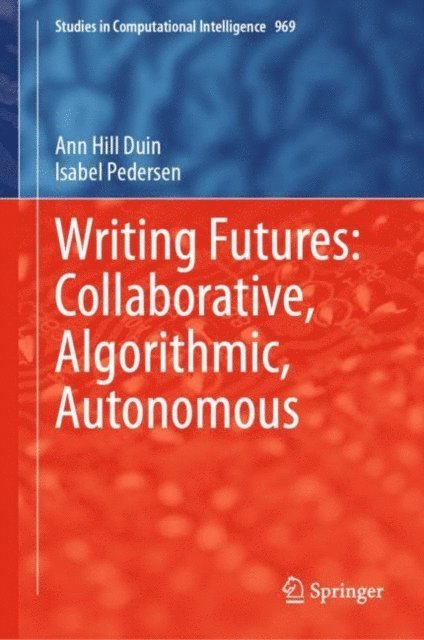
This book is useful to understand and write alongside non-human agents, examine the impact of algorithms and AI on writing, and accommodate relationships with autonomous agents. This ground-breaking future-driven framework prepares scholars and practitioners to investigate and plan for the social, digital literacy, and civic implications arising from emerging technologies. This book prepares researchers, students, practitioners, and citizens to work with AI writers, virtual humans, and social robots. This book explores prompts to envision how fields and professions will change. The book’s unique integration with Fabric of Digital Life, a database and structured content repository for conducting social and cultural analysis of emerging technologies, provides concrete examples throughout. Readers gain imperative direction for collaborative, algorithmic, and autonomous writing futures.
1 083 kr
Skickas inom 10-15 vardagar