
Arbind Sinha – författare
Visar alla böcker från författaren Arbind Sinha. Handla med fri frakt och snabb leverans.
2 produkter
2 produkter
534 kr
Läs direkt efter köp
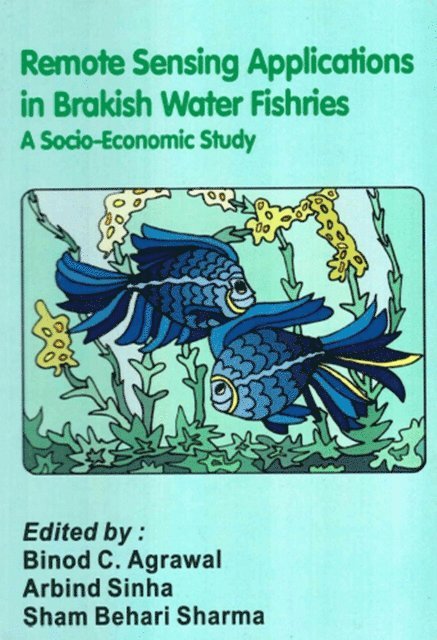
The book Remote Sensing Applications in Brackish Water Fisheries: A Socio-Economie Study, accounts for an unique case where socio-economic inputs, integrated with remote sensing data, were attempted for development for the marginalised groups in country side.The book also presents the team spirit among the remote sensing scientists and social scientists working together for the same mission, first ever attempt in India. It has presented a new dimension of social research methodology, and QUERI method as a new approach to understand the target group for development planning. The book will be helpful to those planning for remote sensing applications for micro planning, particularly the rural and other remote area development programmes. The book will be also be helpful in understanding people''s perception about co-operative efforts at the grass roots level. It will serve as a good reference materials for the students as well as the practitioners of co-operative management. It will provide a new tool to the social research studies.
1 335 kr
Läs direkt efter köp
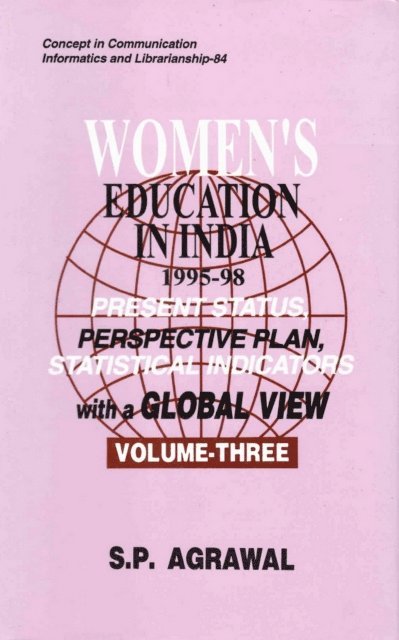
This is the third survey of Development of Women''s Education in India spanning the period from 1995 to 1997. Earlier the first and the second survey covered the period up to 1994. Being significant works on the subject the preceding volumes received rare reviews and proved very much helpful in understanding the problems of the women''s education. The second survey has provided an overview of the state of women''s education in India from 1988 to 1994 in all its spheres in the light of the National Policy on Education (NPE), 1986 and its Programme of Action (POA), detailed information about the recommendations of the Ramamurti Committee (1990) pertaining to women''s education and comments of the Janardhan Committee on the recommendations of the modified NPE and POA for the guidance of the Central Government. The present volume comprising three parts is a step forward in the direction of women''s education. Part One is devoted to recent developments in women''s education in all its aspects, particularly empowering women through Mahila Samakhya Programme. It also includes the Report of the National Commission for Women on the development of female education among tribal communities. While Part Two provides women''s educational indicators, Part Three includes the global view of the women''s education highlighting the measures taken by the United Nations in reducing illiteracy and achieving full integration of women in society on equal terms with men. It also presents the ''Declaration'' and the Platform of Action'' as adopted in the Fourth UN World Conference on Women in 1995. Appendices include, among others, the Final Draft of the National Policy for the Empowerment of Women, Mass Media and Women, Third World Organisation for Women in Science and Fact file 1952-1997 relating to women in politics in India. It is hoped that all these volumes will be of great interest and value to all those who are interested in the development of girls'' and women''s education at various levels.