Arthur I. Miller – författare
Visar alla böcker från författaren Arthur I. Miller. Handla med fri frakt och snabb leverans.
13 produkter
137
Jung, Pauli, and the Pursuit of a Scientific Obsession
Häftad, 2010
299 kr
Lägg i varukorg
Is there a number at the root of the universe? A primal number that everything in the world hinges on? This question exercised many great minds of the twentieth century, among them the groundbreaking physicist Wolfgang Pauli and the famous psychoanalyst Carl Jung. Their obsession with the power of …
Artist in the Machine
E-bok, 2019
342 kr
Lägg i varukorg
An authority on creativity introduces us to AI-powered computers that are creating art, literature, and music that may well surpass the creations of humans. Today''s computers are composing music that sounds “more Bach than Bach,” turning photographs into paintings in the style of Van Gogh''s …
Artist in the Machine
Häftad, 2020
288 kr
Lägg i varukorg
An authority on creativity introduces us to AI-powered computers that are creating art, literature, and music that may well surpass the creations of humans.Today's computers are composing music that sounds “more Bach than Bach,” turning photographs into paintings in the style of Van Gogh's Starry …
Albert Einstein’s Special Theory of Relativity
Emergence (1905) and Early Interpretation (1905–1911)
Häftad, 1997
1095 kr
Lägg i varukorg
This book analyzes one of the three great papers Einstein published in 1905, each of which would alter forever the field it dealt with. The second of these papers, "On the Electrodynamics of Moving Bodies," had an impact in a much broader field than electrodynamics: it established what Einstein …
Colliding Worlds
How Cutting-Edge Science Is Redefining Contemporary Art
Inbunden, 2014
348 kr
Lägg i varukorg
In recent decades, an exciting new art movement has emerged in which artists utilize and illuminate the latest advances in science. Some of their provocative creations—a live rabbit implanted with the fluorescent gene of a jellyfish, a gigantic glass-and-chrome sculpture of the Big Bang (pictured …
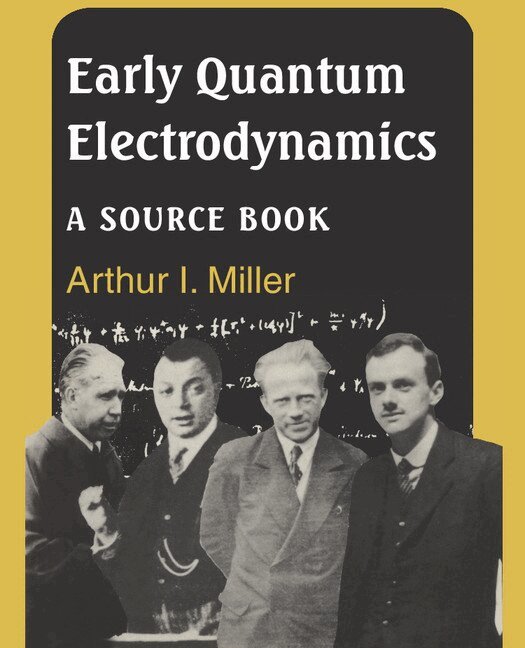
Early Quantum Electrodynamics
A Sourcebook
Av Arthur I. Miller, Arthur I. Miller
Häftad, 1995
1074 kr
Lägg i varukorg
This book provides a panoramic view from 1927-1938 of the development of a physical theory that has been on the cutting-edge of theoretical physics ever since P. A. M. Dirac's quantization of the electromagnetic field in 1927: quantum electrodynamics. Like the classic papers chosen for this volume, …
Empire Of The Stars
Friendship, Obsession and Betrayal in the Quest for Black Holes
E-bok, 2011
45 kr
Lägg i varukorg
In August 1930, on a boat trip from Bombay to England, the young Indian scientist Subrahmanyan Chandrasekhar calculated that certain stars could end their lives by collapsing indefinitely to a point - to nowhere. This idea brought Chandra into conflict with Sir Arthur Eddington, the grand old man …
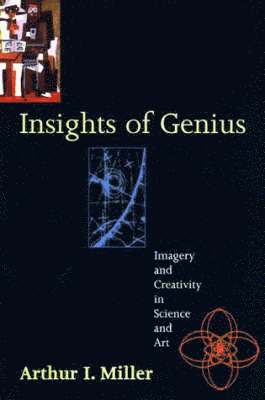
Insights of Genius
Imagery and Creativity in Science and Art
E-bok, 2012
734 kr
Lägg i varukorg
Since the Enlightenment, science has been seen as an objective, true method of explanation about the physical and mathematical laws that explain and govern the universe. The 20th Century has shown that science is also a human enterprise, informed by idealogy and other assumptions. In this book, …
Insights of Genius
Imagery and Creativity in Science and Art
Häftad, 2013
507 kr
Lägg i varukorg
Since the Enlightenment, science has been seen as an objective, true method of explanation about the physical and mathematical laws that explain and govern the universe. The 20th Century has shown that science is also a human enterprise, informed by idealogy and other assumptions. In this book, …
Sixty-Two Years of Uncertainty
Historical, Philosophical, and Physical Inquiries into the Foundations of Quantum Mechanics
E-bok, 2012
1570 kr
Lägg i varukorg
This volume contains proceedings from the International School of History of Science, Sixty-Two Years of Uncertainty: Historical Philosophical and Physical Inquiries into the Foundations of Quantum Mechanics, convened at the Ettore Maj orana Centre for Scientific Culture, Erice, Sicily, 5-15 August …
Sixty-Two Years of Uncertainty
Historical, Philosophical, and Physical Inquiries into the Foundations of Quantum Mechanics
Häftad, 2012
1207 kr
Lägg i varukorg
This volume contains proceedings from the International School of History of Science, Sixty-Two Years of Uncertainty: Historical Philosophical and Physical Inquiries into the Foundations of Quantum Mechanics, convened at the Ettore Maj orana Centre for Scientific Culture, Erice, Sicily, 5-15 August …